

TL;DR:
- Improving SEO for small businesses requires focusing on search intent, technical foundations, and content refreshes.
- Utilizing tools like Google Search Console and AI enhances efficiency but demands human oversight for optimal results.
If you’re running a small or medium-sized business and wondering how to improve SEO without a dedicated tech team, you’re not alone. Search engine optimization shifts constantly, and what worked two years ago may be actively hurting you today. This guide breaks down the exact steps you need to take right now, from laying technical groundwork to optimizing content for Google’s AI-driven search features. Every recommendation here is practical, specific, and built for business owners who need real results without the agency-speak.
Table of Contents
- Key takeaways
- How to improve SEO: building your foundation
- On-page SEO optimizations that actually move the needle
- Leveraging tools and AI for smarter SEO
- Common SEO mistakes that kill your rankings
- Measuring SEO success and knowing what to adjust
- My honest take on what actually drives SEO growth
- Ready to stop guessing and start ranking?
- FAQ
Key takeaways
| Point | Details |
|---|---|
| Start with search intent | Aligning content to what users actually want matters more than keyword density for ranking. |
| Fix technical SEO first | Crawlability, mobile-friendliness, and Core Web Vitals are non-negotiable ranking foundations. |
| Use long-tail keywords | Phrases of three or more words make up the majority of search queries and convert better. |
| Refresh before you create | Updating existing content often outperforms publishing new pages for faster ranking improvements. |
| Track the right metrics | Monitor impressions, click-through rate, and conversions, not just rankings, to measure real progress. |
How to improve SEO: Building your foundation
Before you touch a single title tag or write a word of content, your website needs to be technically ready for search engines to read and index it. Think of this as clearing the road before you start driving.
SEO breaks into three interconnected areas. On-page SEO covers what’s on your actual pages: content, headings, metadata, and keyword use. Off-page SEO includes links pointing to your site from elsewhere. Technical SEO is everything under the hood: site speed, crawlability, mobile performance, and structured data. Neglecting any one of these limits how far the others can take you. Effective on-page SEO blends content quality, HTML and metadata integrity, and sound site architecture.
Two tools you should set up immediately are Google Search Console and Google Analytics. Search Console shows you which queries bring people to your site, how your pages rank, and whether Google can actually crawl your content. Analytics tells you what visitors do once they arrive. Together, they give you the data needed to make smart decisions rather than guesses.
When it comes to keywords, go specific. Long-tail keywords of three to five words make up 70% of all search queries and carry higher conversion rates with far less competition. “Digital marketing agency” is brutal to rank for. “Digital marketing agency for restaurants in Dallas” is a real opportunity.
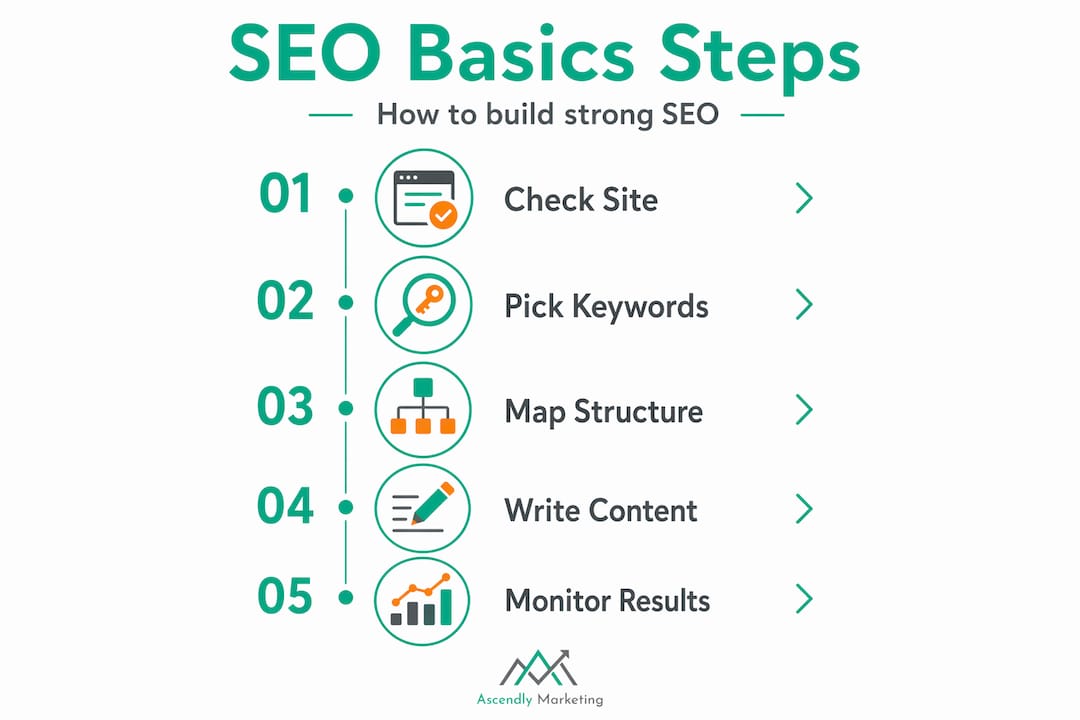
Site structure matters more than most SMB owners realize. Instead of publishing dozens of thin, disconnected pages, build one comprehensive pillar page that links to five to eight focused cluster articles. This architecture helps Google understand your topical authority and makes your site easier to crawl.

Pro Tip: Before running any keyword research, open Google Search Console and check the “Queries” report. You may already rank on page two for several terms. Those are your fastest wins.
On-page SEO optimizations that actually move the needle
Once your foundation is solid, on-page optimization is where you spend most of your time. Here’s a step-by-step process that reflects how search actually works in 2026.
-
Front-load your content with value. The first 100 words of any page should directly answer the searcher’s core question. Structuring answers clearly and front-loading value is now the most important shift in how Google’s AI Overviews select content. Don’t save your best insight for paragraph five.
-
Build a clean heading hierarchy. Use one H1 per page that matches the primary search intent. H2s should organize major topics. H3s break those topics into specifics. Clear H2 and H3 headers with short factual sentences help Google’s systems parse your content and show it in AI-generated answers.
-
Incorporate keywords naturally throughout. Work your primary keyword and related phrases into your H1, first paragraph, at least one H2, and the conclusion. Never repeat a keyword so often it reads awkwardly. Search intent alignment is prioritized over keyword density, and misaligned content causes poor rankings even when technical SEO is perfectly executed.
-
Optimize images before you upload them. Rename image files with descriptive, keyword-relevant names before uploading. Write alt text that describes the image clearly and naturally. Compress images to keep file sizes small, because large images hurt your Core Web Vitals scores. Google targets LCP under 2.5 seconds as a threshold for a good page experience.
-
Write title tags and meta descriptions last. Once your content is finalized, write the title tag to match what the page actually delivers. Title tags have the highest impact on click-through rate. Meta descriptions don’t directly affect rankings, but a compelling one pulls more clicks from the same position.
-
Place internal links early. Link to your pillar pages or key service pages within the first three to four sections of any article. This passes authority where it matters and helps visitors find more of your content. For a deeper look at on-page best practices for small businesses, the Ascendly Marketing on-page SEO guide breaks this down with practical examples.
Pro Tip: Write your meta description as if it’s an ad. Ask yourself: if this were a Google search result, would I click it? If the answer is no, rewrite it.
Leveraging tools and AI for smarter SEO
Technology has made keyword research, content planning, and technical auditing significantly faster. The key is knowing what to delegate to tools and what to keep under human control.
Google Search Console’s most underused feature is its ability to surface “low-hanging fruit.” Queries ranking on page two are the ones where you already have some authority. A targeted content update and a few additional internal links can push those pages into the top ten without building anything from scratch.
AI tools accelerate the early stages of content planning. They can generate keyword clusters, suggest related questions your audience asks, and draft initial meta descriptions at scale. AI tools work best as productivity multipliers for keyword brainstorming and metadata generation, but they must never replace human verification. An AI-generated meta description might be technically correct but completely wrong for your brand voice. Always review what the tool produces. For a broader look at how this works in practice, read about AI transforming SEO strategies for businesses like yours.
Here’s a quick reference for which tools support which SEO tasks:
| SEO Task | Recommended Tool | What to Watch For |
|---|---|---|
| Crawl error detection | Google Search Console | Index coverage report, 404s |
| Core Web Vitals monitoring | PageSpeed Insights | LCP, INP, CLS scores |
| Keyword research and gaps | Search Console + AI assist | Intent match, not just volume |
| Meta description generation | AI tools with human review | Brand voice and accuracy |
| Competitor content analysis | Manual + analytics comparison | Topic gaps you can fill |
A sustainable SEO workflow means checking these tools monthly, not just when something breaks. Set a recurring calendar reminder to review your Search Console performance report, check for crawl errors, and identify any pages that have dropped in impressions. Consistent maintenance beats sporadic optimization every time.
Common SEO mistakes that kill your rankings
Knowing what not to do is just as valuable as knowing what to do. These are the mistakes that show up most often, even among businesses that think they have SEO handled.
- Misreading search intent. If someone searches “how to fix a slow website,” they want a tutorial, not a sales page for your development services. Sending the wrong type of content to a query tanks your rankings regardless of how well-optimized that page is.
- Ignoring crawl errors. A page Google can’t crawl is a page that can’t rank. Check your Search Console index coverage report regularly and fix 404 errors and redirect loops promptly.
- Keyword stuffing. Repeating your target keyword ten times in 500 words doesn’t help. It reads poorly and signals manipulation to Google’s spam systems.
- Neglecting mobile performance. Google indexes the mobile version of your site first. If your mobile experience is slow or broken, your entire site suffers.
- Never refresh old content. Regularly updating and refreshing content often delivers faster SEO improvements than publishing new pages. Update statistics, rewrite weak sections, and add new internal links to pages that already have some authority.
- Overloading pages with internal links. Linking to every page on your site from every other page dilutes the value of each link. Be selective. Link to the pages that most directly support the topic at hand.
“The biggest SEO mistake isn’t a technical error. It’s treating your website like a billboard instead of a resource. Pages that genuinely help people rank. Pages that talk at people do not.”
Measuring SEO success and knowing what to adjust
Tracking the right numbers is what separates businesses that grow through SEO from those that spin their wheels. Here’s the sequence that gives you the clearest picture.
-
Start with impressions and click-through rate. In Google Search Console’s Performance report, impressions tell you how often your pages appear in search results. CTR tells you how often people click. A high impression count with a low CTR signals that your title tags and meta descriptions need work.
-
Track organic traffic by page. In Google Analytics, filter by organic channel and look at traffic by individual page. This tells you which content is actually driving visitors, not just which pages look good in rankings.
-
Monitor Core Web Vitals monthly. These scores are ranking signals. PageSpeed Insights gives you LCP, INP, and CLS readings for any URL. Fixing a score that falls below Google’s thresholds can produce noticeable ranking improvements within weeks.
-
Measure conversions from organic traffic. Traffic that doesn’t convert is just noise. Set up goal tracking in Google Analytics so you can see which organic pages lead to contact form submissions, purchases, or calls.
-
Set realistic timelines. New content typically takes three to six months to reach its ranking potential. Refreshed content on established pages can show movement in four to eight weeks. Proven SEO strategies for SMBs work, but they require patience and consistency.
| Metric | What it tells you | Where to find it |
|---|---|---|
| Impressions | How visible your pages are in search | Google Search Console |
| CTR | Whether your listings attract clicks | Google Search Console |
| Organic sessions | How much traffic SEO is generating | Google Analytics |
| Core Web Vitals | Page experience quality | PageSpeed Insights |
| Conversions from organic | Whether SEO traffic produces business outcomes | Google Analytics |
My honest take on what actually drives SEO growth
I’ve worked with enough SMBs to say this clearly: the businesses that win at SEO are not the ones obsessing over rankings. They’re the ones obsessing over their customers’ questions.
Every SMB owner I’ve talked to wants to rank number one. Very few ask, “What does the person searching that term actually need?” That gap is where most SEO efforts fall apart. You can have perfect metadata and a fast site, but if your content doesn’t answer the real question behind a search query, you won’t hold a top position for long. Modern SEO has shifted focus from rankings alone to prioritizing user experience and genuine helpfulness.
AI tools are genuinely useful, and I encourage you to use them. But I’ve seen business owners hand their entire content strategy to an AI and wonder why their traffic plateaued. AI acts as a productivity multiplier, not a replacement for the human judgment that makes content trustworthy and worth reading.
The most overlooked SEO opportunity for most SMBs is their existing content. You probably have pages sitting on page two of Google right now. Updating those pages with better answers, stronger internal links, and fresher data will outperform publishing five new articles in most cases. Start there.
Treat SEO as a monthly practice, not a one-time project. Review your data. Update what’s underperforming. Build on what’s working. That rhythm compounds faster than any shortcut.
— Ascendly Marketing
Ready to stop guessing and start ranking?
Understanding how to improve your website’s SEO is one thing. Executing it consistently across a growing business is another challenge entirely.

At Ascendly Marketing, we’ve helped small and medium-sized businesses build search visibility that converts since 2013. From technical SEO audits to content strategy and ongoing optimization, our team handles the work so you can focus on running your business. If you’re ready to see what a targeted SEO strategy looks like for your specific situation, explore our digital marketing services or visit Ascendly Marketing to book a consultation. We also offer integrated solutions across PPC, social media, and content marketing for businesses ready to grow on multiple fronts.
FAQ
What is the fastest way to improve search engine ranking?
Refreshing existing pages that already rank on page two is typically the fastest path to better rankings. Add updated information, improve internal links, and rewrite weak sections to give Google a reason to push that page higher.
How long does it take to see SEO results?
New pages generally take three to six months to reach their full ranking potential. Updated content on established pages can show noticeable improvement in four to eight weeks, depending on your site’s authority.
What are the best SEO strategies for beginners?
Start with keyword research focused on long-tail phrases, fix any technical crawl errors in Google Search Console, and make sure every page clearly answers the search intent behind its target query. These three steps outperform most advanced tactics if executed well.
How do I improve website visibility without paid ads?
Focus on on-page SEO techniques including strong title tags, clear heading structure, and content that directly answers searcher questions. Build internal links between related pages and consistently update content to stay relevant in organic search results.
Should I use AI tools to help with SEO?
Yes, but with oversight. AI tools are effective for keyword brainstorming and generating metadata at scale, but every output needs human review for accuracy, brand voice, and search intent alignment. Use them to work faster, not to replace editorial judgment.