

Most advice on content marketing for professional services gets the order wrong. Firms are told to push email, chase SEO, and publish generic posts, then they wonder why the pipeline stays flat. The stronger play is to build content that helps buyers understand the category, compare options, and trust a firm’s point of view before sales ever gets involved.
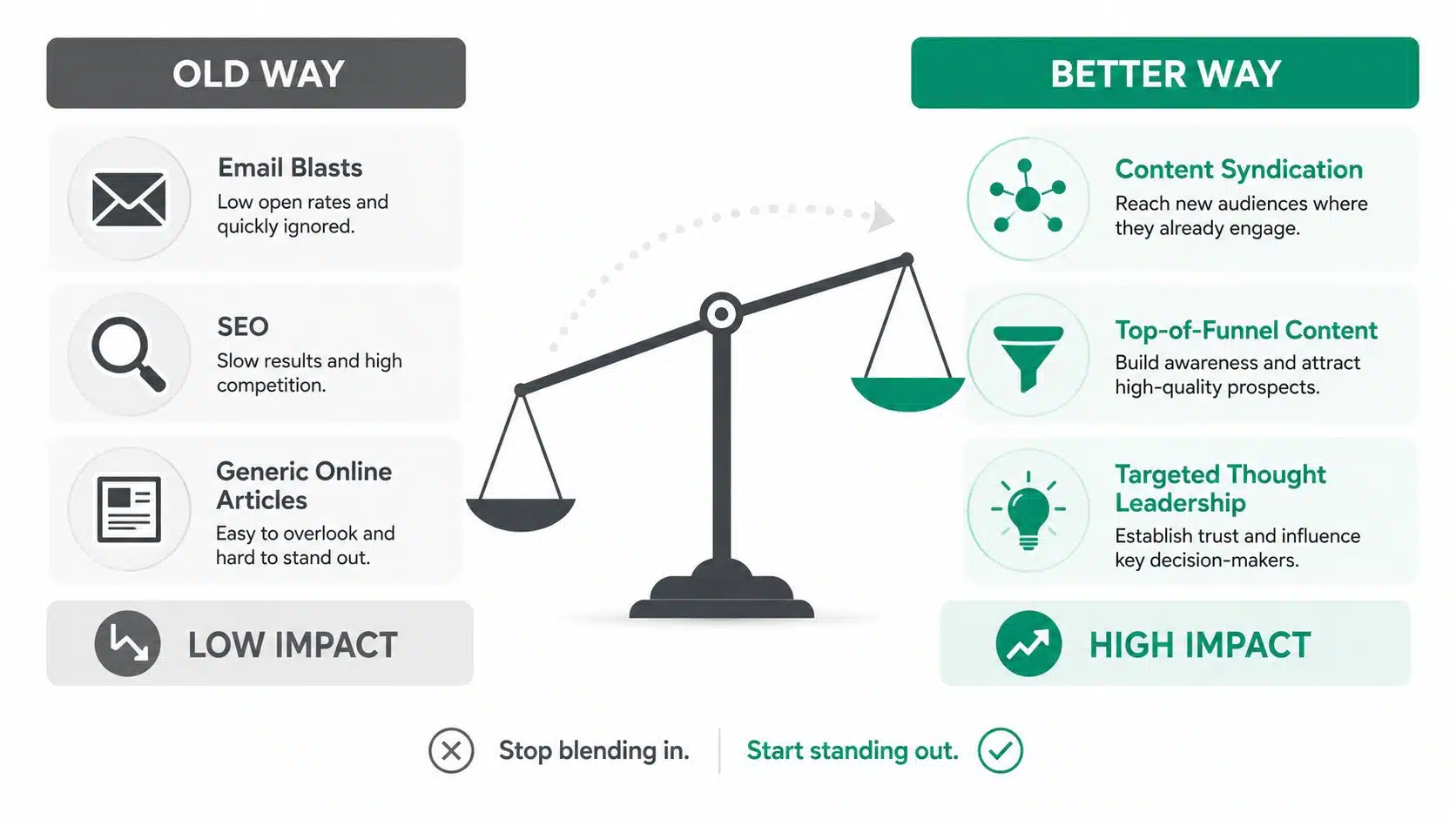
The data backs that up. In a large effectiveness study cited by Considered Content, content syndication ranked 3rd most effective, top-of-funnel content ranked 4th, and online articles and blogs ranked 5th among lead-generation tactics, while email marketing ranked 24th and SEO ranked 25th on effectiveness even though they were far more popular as tactics, according to Considered Content. For firms that sell expertise, that gap matters because prospects usually need proof, education, and a clear category fit before they contact anyone.
Why Most Professional Services Firms Get Demand Generation Wrong
The usual mistake is treating content like decoration. A firm publishes a few posts, sends a newsletter, and calls that demand generation, then assumes the problem is volume. The core problem is that the content never does the work of helping a buyer move from uncertainty to action.
Professional services buyers rarely buy on first contact. They compare expertise, look for signs of judgment, and search for evidence that the firm understands their specific situation. That is why substantive content works better than promotional outreach alone, and why content syndication, top-of-funnel pieces, and online articles perform better in actual lead generation than the channels firms often overuse – Considered Content.
Popular does not mean effective
The mismatch is the part many managing partners miss. The same effectiveness study found email marketing was the 1st most popular demand-generation tactic but only 24th most effective, and SEO was the 2nd most popular lead-generation tactic but only 25th most effective – Considered Content. Popularity can keep teams busy. It does not automatically produce qualified conversations.
Practical rule: If a tactic gets attention but not meetings, treat it as a support channel, not a primary demand engine.
That does not mean SEO or email are useless. It means they work better when they distribute strong content instead of trying to substitute for it. The same is true for firm websites that publish service pages with no real point of view. Buyers can tell the difference quickly.
For a broader view of how content supports trust and discovery, this internal overview on the benefits of content marketing is a useful companion. The main takeaway here is simple. For professional services, content is not a branding side project; it is the durable lever that supports demand generation over time.
Defining Your Ideal Client and Mapping the Buyer Journey
Before a firm writes a single article, it needs to decide who is worth attracting and why they would buy. That means getting specific about the industries served, the company types that fit, and the problems those clients are trying to solve. Broad audience definitions lead to broad content, and broad content rarely moves a buyer toward a conversation.
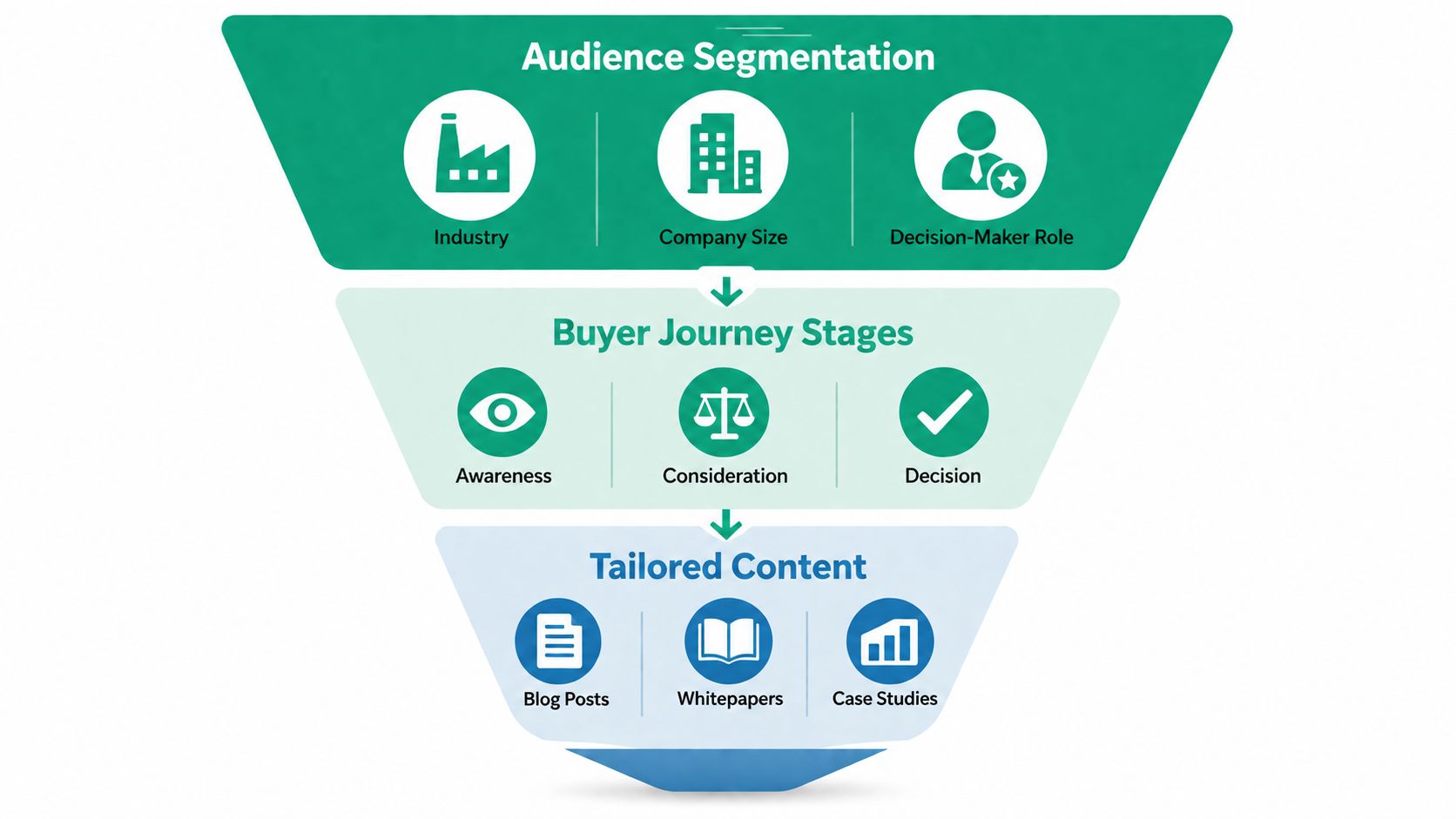
Start with the ideal customer profile. From there, segment by industry, company size, and decision-maker role, then add the psychographic details that affect response: urgency, risk tolerance, and the kind of proof each audience trusts.
Match questions to stage, not just topic
A law firm targeting mid-market M&A clients does not need the same content as an accounting firm serving SaaS startups. The law firm’s awareness-stage material might answer broad questions about transaction readiness. The accounting firm’s decision-stage material might focus on how a SaaS finance team handles recurring revenue reporting or investor reporting concerns. The question changes with the buyer’s stage, so the content should change too.
The buyer journey gives that work structure. Awareness content should answer the problem in plain language. Consideration content should compare approaches and explain trade-offs. Decision content should provide proof, process, and specific evidence that reduces perceived risk.
- Awareness: Write to the problem the buyer can already name.
- Consideration: Address evaluation criteria, internal objections, and comparison points.
- Decision: Use case studies, qualifications, and implementation detail.
The trade-off is focus. A narrower audience usually means fewer total readers, but it also gives the sales team sharper material and reduces the odds that the firm publishes content meant for everyone and persuasive to no one. A short video can help here, especially for internal teams that need to see how segmentation flows into content planning.
The payoff comes from discipline. Narrow the audience enough to be useful, and the content plan gets clearer, the sales team gets better material, and the firm can measure whether those assets are creating qualified discussions over a long sales cycle. Go too broad, and pipeline attribution gets muddy fast.
Building Authority Content That Generates Pipeline
Professional services firms need two content types, and they do different jobs. Flow content is the short, frequent material that keeps a firm visible and searchable. Premium content is the deeper asset used to generate leads and move buyers farther into the process – Hinge Marketing. Confusing those two categories is one of the fastest ways to waste time.
Build one topic system, not a pile of posts
A pillar-and-cluster structure solves that problem. Choose one practice-area topic, then map the questions buyers ask from top to bottom of the funnel. Publish a broad pillar page, then add long-tail cluster assets for each intent. That turns scattered articles into a searchable topic system instead of a random archive.
A consulting firm might build a pillar around a core advisory offer, then support it with cluster posts on pricing models, implementation risks, and procurement questions. A law firm can do the same around a narrow transaction or compliance topic. An accounting firm can structure content around a single software ecosystem, audit need, or funding stage. The point is not volume. The point is topical coherence.
Concrete standard: If a piece of content cannot be tied to a buyer question, a practice area, and a next-step action, it probably belongs in an idea list, not on the site.
Use proof formats where trust matters
HubSpot describes case studies as providing “concrete evidence” that a firm’s services have helped others, and that is the right standard for professional services content – HubSpot. Case studies are not fluff; they are proof. They show how a problem was handled, what the firm did, and what changed in a way buyers can evaluate.
Thought leadership articles, whitepapers, webinars, and client testimonials all fit into the same authority stack. But they should be used with intent. Thought leadership shows perspective. Whitepapers explain a point of view in depth. Webinars create a direct channel for questions. Case studies close the loop by showing that the work has been done before.
A practical way to think about it is this. Flow content earns attention. Premium content earns contact details. Case studies help both, because they support business development conversations long after publication. A firm with a searchable topic system and a few strong proof assets can speak more clearly than a firm with fifty loose posts and no structure.
Editorial Calendars and Production Workflows for Expert-Driven Content
The people who know the most are usually the busiest. That is why content production in professional services breaks down when marketing teams build calendars as if subject matter experts have unlimited time. The fix is a workflow that respects availability, reduces review friction, and keeps the pipeline of ideas moving.
A workable calendar starts with knowledge capture. Interview practitioners before drafting, rather than asking them to rewrite finished copy. That keeps the draft moving and lowers the number of times a partner has to re-engage with the same piece. The calendar itself should separate evergreen themes from timely commentary so the team can protect long-form assets while still reacting to market shifts.
Make the workflow easier than saying no
Templates matter because they reduce hesitation. A repeatable structure for interviews, outlines, and review notes gives lawyers, consultants, accountants, and advisors a clear path to approving content without turning every article into a custom project. The same logic applies to repurposing. One strong interview can become a blog post, a short newsletter note, a quote-led social post, and a draft outline for a webinar.
The principle is straightforward. If one expert conversation can support multiple assets, use that conversation once and repurpose it carefully. Do not make the expert explain the same point four times.
For firms that want a working framework, this content marketing plan template is a practical starting point. It fits the kind of production process that expert-led firms need.
Separate publishing cadence from hero content
Not every asset needs the same level of effort. A monthly pillar article may deserve deep review, while a short commentary post can move faster. That split protects the firm from the common mistake of over-editing low-value pieces and under-investing in the assets that support search, sales, and positioning.
Roles need to be clear. Marketers should own topic framing, draft structure, and production flow. Practitioners should validate the substance. Senior leadership should only review what affects positioning, claims, or risk. When every person touches every draft, the calendar slows down, and the content gets blander.
The best calendars do not chase perfect timing. They create a rhythm the firm can sustain.
Distribution and Amplification Across Channels
Good content still needs distribution. If a buyer never sees the piece, the quality of the writing does not matter much. Professional services firms usually get better results when they match channels to the stage of the buyer journey instead of pushing the same asset everywhere in the same format.
SEO still plays a role, but not as a standalone answer. It works best as part of a system that includes LinkedIn, email nurturing, and PR. Organic search helps capture intent. LinkedIn helps surface points of view to known audiences. Email nurtures people who already showed some interest. PR can extend a strong idea into a broader credibility signal.
SalesGenie reports that 83% of marketers say content marketing is the most effective method for demand generation, ahead of organic SEO at 67%, paid advertising at 53%, and paid search at 45% – SalesGenie. That ranking makes sense in professional services because the channel mix works better when content leads, and distribution supports it.
Use each channel for the job it does best
An article that answers a high-intent question belongs on the website and in search. A point-of-view post belongs on LinkedIn where partners can share it with their networks. A deeper asset belongs in an email sequence where a prospect can consume it over time. A strong announcement or research angle can be pitched to media or industry publications when the topic is relevant beyond the firm.
That same asset can be repackaged differently. A summary works for an email. A key argument works for a social post. A fuller version works as a landing page or downloadable resource. The firm does not need more content for the sake of it. It needs better distribution of the content it already has.
For firms that want to connect these channels to reporting, the measurement approach discussed in enterprise SEO analytics gives a useful framing for what happens after publication. The core point is that distribution should not be random. It should mirror how buyers move from awareness to consideration to decision.
Measuring What Matters Beyond Vanity Metrics
Pageviews make dashboards look busy. They do not answer the question a managing partner cares about. Did this content create qualified interest, support a deal, or move revenue forward? The measurement model has to answer that question, or the content budget will stay under pressure.
The strongest reporting stack connects content to pipeline instead of stopping at visibility. That means tracking organic entrances, engaged sessions, scroll depth, assisted conversions, conversion rate, and CRM-connected sourced or influenced revenue. It also means using GA4 with CRM data or enforcing UTM governance so content can be tied to specific topics and asset types rather than just pageviews. For email follow-up and nurture sequences, a resource such as essential email campaign KPIs can help teams think more clearly about engagement tracking without drifting into vanity metrics.
Use a pipeline-linked dashboard, not a traffic report
A useful dashboard shows which topics attract the right audience, which assets keep people engaged, and which pieces support meetings or opportunities. If one whitepaper drives conversations but a blog post only gets visits, those two assets should not be judged the same way. Content should be measured by its role in the funnel, not by a single number.
The reporting setup discussed in enterprise SEO analytics gives a useful frame for tying content to outcomes after publication. Use it to connect topic performance, landing-page behavior, and CRM activity, then decide where the content is helping pipeline and where it is just collecting visits. The same logic applies across channels. Measure the action that matters at the stage the asset is meant to influence.
Practical rule: If you cannot connect an asset to a lead, a meeting, or an opportunity, you do not yet have a useful content report.
Use time as part of the model
Content also has a maturation curve. For organic search, meaningful keyword-rank movement typically appears in 3 to 6 months on an established domain, inbound inquiries often take 6 to 12 months, and thought-leadership recognition can take 12 to 24 months of consistent publishing OmniSEO Agency. That timeline is why short-term traffic spikes are a weak way to judge the channel.
| Outcome | Typical Timeline | Key Indicators |
|---|---|---|
| Keyword-rank movement | 3 to 6 months | Search visibility, ranking improvement |
| Inbound inquiries | 6 to 12 months | Form fills, calls, meeting requests |
| Thought-leadership recognition | 12 to 24 months | Repeated engagement, referrals, direct mentions |
Firms waste money when they measure before they have a model. They also waste money when they keep every article forever. Pruning weak content and committing more resources to topics that support pipeline gives the program room to mature without bloating the site.
Finding the Specialization Sweet Spot and Scaling Production
Specialization drives relevance, but too much of it can shrink the market faster than the pipeline can refill. That is the trade-off firms avoid discussing. Narrow positioning helps buyers understand what the firm does, yet over-narrow content can cut lead volume when the audience gets too small.
Pick a focus that buyers can recognize
The best guidance points toward smaller demographic and psychographic segments, one practice area, and one audience at a time, Rattleback. That still leaves a real judgment call. How narrow is narrow enough? The answer comes from performance data, not from ideology. If the content draws the right people but not enough of them, the firm may need an adjacent audience or a second problem set. If the content brings volume but weak fit, the niche is too broad.
That trade-off shows up in the questions prospects ask. If every piece sounds like it could belong to any advisory firm, the positioning is too general. If only one tiny subgroup understands the content, the funnel may be too small. The sweet spot sits where the firm can name a clear audience and still generate repeatable demand.
Scale in the right order
Internal teams should own topic strategy, voice, and review standards. Outsourcing makes more sense when the firm needs faster throughput, specialized drafting, or subject-matter coverage that in-house marketers cannot realistically produce. Specialized writers help most when they understand the profession well enough to avoid generic phrasing and unnecessary back-and-forth.
Ascendly Marketing can support that kind of work through marketing consulting, website design, SEO, content marketing, public relations, and email marketing, which gives a firm a way to connect strategy, publishing, and distribution in one workflow. The right vendor, though, is the one that matches the firm’s actual bottleneck.
- If relevance is weak: Tighten the niche and rewrite the topic map.
- If volume is weak: Expand into an adjacent audience or offer.
- If production is weak: Add outside writing support.
- If measurement is weak: Fix attribution before scaling more content.
The cleanest programs do not chase breadth for its own sake. They keep the message sharp, watch the data, and widen only when the market says the current focus has hit its limit.
If you want a content program built for long sales cycles, clear positioning, and measurable pipeline influence, talk with Ascendly Marketing. The team can help you shape the topic strategy, build the publishing workflow, and connect content to reporting that leadership will use.