

The U.S. home services market sits at $842 billion in 2026 and is projected to reach $989 billion by 2031 at a 3.27% CAGR. That does not mean your contractor marketing agency should chase more clicks. It means your agency should find the leak between lead intake and booked jobs, because that’s where the money is getting lost.
Most contractors hire the wrong partner because they ask the wrong question. They ask, “Can you get me more leads?” when the better question is, “Can you tell me why the leads I already get aren’t turning into work?” A good contractor marketing agency doesn’t just push traffic. It diagnoses lead quality, follow-up, and service-area fit, then fixes the bottleneck that is costing you jobs.
Why Lead Volume is Not Your Real Problem
A bigger lead count looks good in a report, and that’s exactly why so many contractors get fooled by it. More inquiries mean nothing if the people calling aren’t a fit, your office misses the first response window, or your service area is too broad for the jobs you want. The bottleneck is often not traffic. It’s conversion leakage.
Stop blaming the top of the funnel
When lead volume is high but close rates are weak, the problem usually sits in one of three places. The lead was never qualified. The salesperson waited too long. Or the job didn’t fit the company’s pricing or territory. That’s the operational question a real contractor marketing agency should ask first, because adding more spend before you answer it just scales the waste.
Practical rule: If your estimates aren’t turning into signed jobs, don’t buy more traffic until someone explains where the drop-off happens.
A lot of agencies hide behind activity. They’ll talk about impressions, clicks, and form fills while ignoring whether the office answered fast enough or whether the inquiry was even in the right service category. That’s sloppy work. If your sales process is weak, more leads only gives you more chances to lose them.
What to ask before you spend another dollar
You want a partner that can separate lead quality from sales execution. Ask them how they would tell the difference between bad targeting, weak follow-up, and a mismatch between your offer and your market. If they can’t answer that cleanly, they’re selling volume, not booked work.
The right mindset is simple. Don’t buy more leads to cover up a broken process. Fix the process, then scale the channel mix that produces qualified appointments.
Understanding the Contractor Market You Operate In
The contractor market is crowded, fragmented, and full of small businesses that cannot afford sloppy marketing. Analyst benchmarks on contractor marketing statistics for 2026 show the U.S. home services market at $842 billion, with a projection to $989 billion by 2031 at a 3.27% CAGR. That growth matters, but market structure matters more. A large market still punishes agencies that do not understand how trade businesses run.
Small teams need measurable systems
The same benchmark says 78% of HVAC contractors employ fewer than 10 people. That explains why in-house marketing is rare and why outsourced systems dominate the category. Small crews do not have time for vague strategy decks. They need a contractor marketing agency that can track calls, forms, booked appointments, and revenue impact without piling more work onto the office.
A generic digital agency often misses that reality. They treat a contractor like any other local business, then recommend broad campaigns that look neat on paper and fail in practice. Contractors do not need branding theater. They need booked jobs that fit the crew, the schedule, and the margin structure.
Why agency selection matters more here
In a fragmented market, the agency that improves booked-job efficiency has real value. If the marketing partner understands how seasonality, trade type, and crew capacity affect demand, the work gets sharper fast. If they do not, you will spend months paying for leads that create operational stress instead of profit.
A contractor business is not a subscription brand. The marketing has to match dispatch, estimating, and install capacity or the whole thing falls apart.
If you want a trade-specific starting point, a focused HVAC SEO approach shows how service pages, local intent, and map visibility should be handled for a narrow category, which is why this HVAC SEO guide belongs in your research stack.
The takeaway is blunt. A contractor marketing agency should understand that small teams need accountable systems, not marketing entertainment.
Mapping Your Services to the Right Marketing Channels
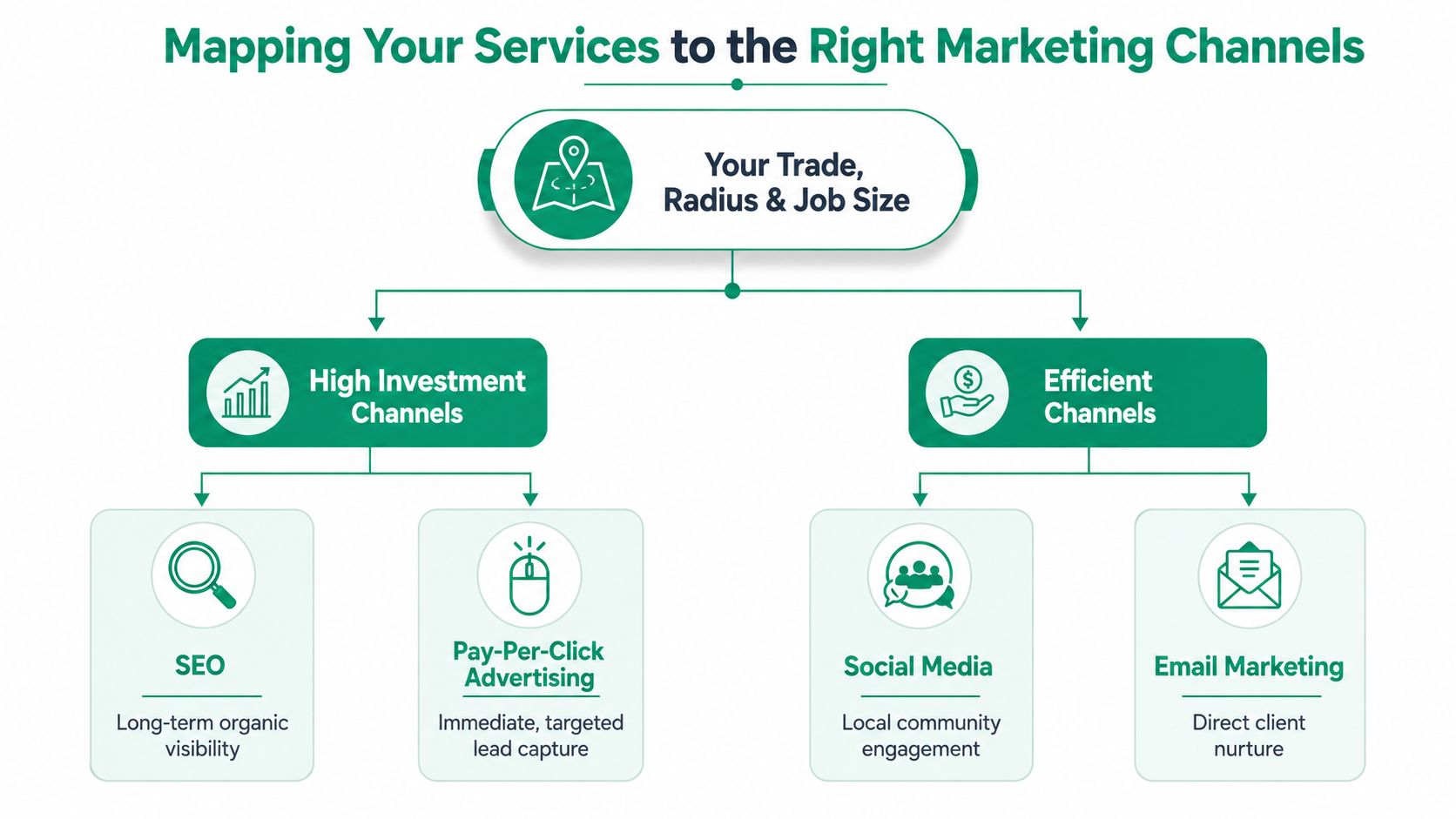
Start with your trade, your radius, and your average job size. Those three variables decide whether you should lean on local search, paid search, social, email, or reputation work. A contractor marketing agency that pushes every channel equally is not strategizing. It’s selling packages.
Match the channel to the buying behavior
Some services are search-driven. Others are visual. Others rely on follow-up. SEO makes sense when buyers look for a service and a location together. Pay-per-click works when you want immediate lead capture and can tolerate paying for speed. Social media is better for neighborhood familiarity and project proof. Email works when you’re nurturing past clients and referral sources.
Google’s Local Pack captures 44% of all local search clicks (journela.com). That’s not a branding detail. It’s a map visibility problem. If your agency ignores local pack rankings, it’s ignoring a major share of buyer attention before people even reach organic results.
Use your business model to narrow the mix
A high-ticket remodeler with a long sales cycle needs a different channel mix than a small repair-focused outfit. If the average job value is high and the service area is tight, local SEO and map visibility deserve more attention. If demand is urgent, paid search and Local Services Ads matter more. If homeowners need time to warm up, email and reputation management carry more weight.
The useful question is not, “Which channel is best?” The useful question is, “Which channel produces booked work for this service in this market?” A contractor marketing agency should help you answer that before it sells you a bundle.
For a broader view of channel selection, this guide to local business marketing channels is worth a look because it frames channel choice around fit, not hype.
You want a partner that can map services to channel roles. If they try to sell everything at once, they’re not reading your business. They’re reading a price sheet.
Vetting a Contractor Marketing Agency
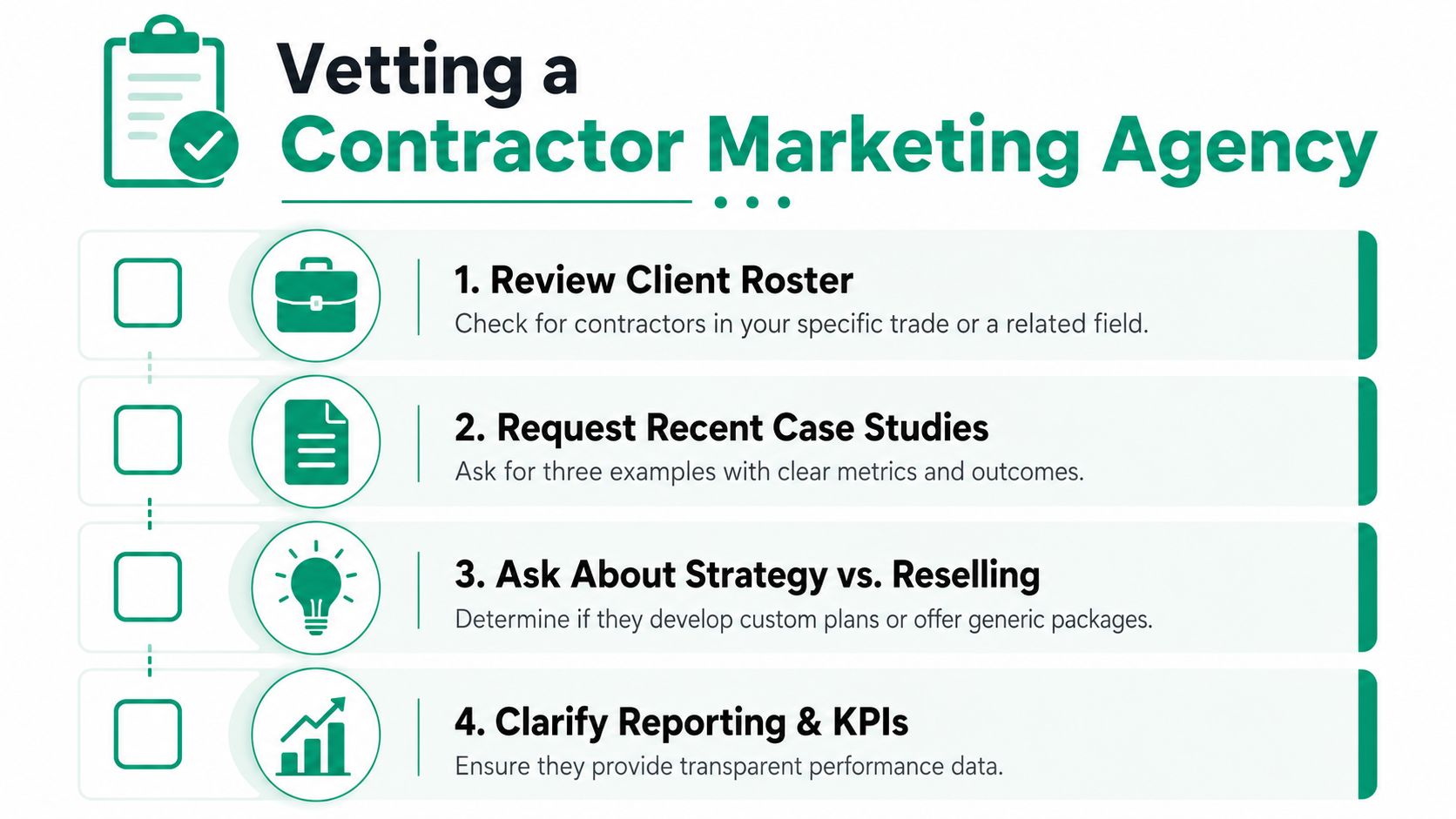
Start by checking whether the agency has worked with contractors in your trade or a close one. A roofer, HVAC company, and remodeling firm don’t need identical campaigns, but they do share enough operational reality that the agency should recognize the difference. If their client list is all over the place and none of it looks trade-specific, be careful.
Ask for proof, not polish
Request three recent case studies that show measurable work, not just nice design. Ask what the campaign changed, what they tracked, and where the results came from. Vanity metrics don’t help you. If they show you only traffic graphs, they’re probably hiding the part that matters.
A sample plan is even better. Ask how they would approach your market, your service area, and your most profitable service lines. A competent contractor marketing agency should be able to explain how it would handle lead capture, routing, and follow-up based on your specific setup.
Separate strategy from reselling
Here’s the line I draw. Strategists explain tradeoffs, ask about capacity, and adjust the plan when the market changes. Resellers push the same bundle on everybody. One is thinking about booked jobs. The other is thinking about fulfillment margin.
If you want a resource that helps you think through the tooling side of local search and evaluation, the AI tools for local SEO piece is a useful reference point because it reflects how modern agencies are using automation to support local visibility and lead handling.
Use these interview questions
- What did you change for the last contractor client you worked with? You want a real decision, not a generic answer.
- How do you tell whether lead quality or sales follow-up is the problem? If they can’t diagnose that, they’re guessing.
- What do you show in reporting every month? Ask for the exact fields.
- How do you handle automated lead capture and follow-up? Missed follow-up is where a lot of jobs die.
- What does a campaign plan look like for my service area? If they dodge this, they’re not custom enough.
A good agency will answer directly and show you the logic. A weak one will talk around the question. Don’t hire the one that sounds smoothest. Hire the one that can explain the work.
Pricing Models and Cost Per Lead Benchmarks
Pricing only matters when it ties back to booked work. A contractor can pay less for a lead and still lose money if the lead never turns into an estimate or a signed job. The average contractor cost per lead sits around $35 for SEO, $45 for Local Services Ads, $90 for Google Ads, and $28 for Meta Ads (bluegridmedia.com). Those are channel benchmarks, not promises, but they show why a low media bill can still become a bad deal.
Compare the common pricing structures
Monthly retainers are the model you see most often. You pay for ongoing management, reporting, and execution. That works when the agency is doing the work, not just sending you ad spend invoices with a few screenshots attached. Performance-based fees sound cleaner, but they get messy fast if the agency gets paid for leads that never close. Hybrid models split the difference, usually with a base retainer plus compensation tied to agreed milestones.
Choose the structure that matches your level of control. If you need strategy, content, ad management, and reporting, a retainer is usually the cleanest fit. If your team already handles operations well and you only need one piece of the funnel managed, a narrower structure can work. Avoid vague bundled pricing with no clear deliverables. That kind of proposal hides the cost until the bill is already in your inbox.
Read the channel math before you sign
General contractor Google Ads data across Q1 2023 through Q4 2024 showed a 4.24% CTR, $5.84 CPC, 4.8% conversion rate, and $124 CPA (bluegridmedia.com). Meta Ads showed a 1.04% CTR and 2.4x ROAS in the same benchmark (bluegridmedia.com). That is the kind of comparison that should shape your proposal review, because a small shift in channel economics can change whether the campaign works at all. If you want to understand the math behind that number, review how to lower CPL before you sign anything.
If you want a clearer breakdown of what agencies charge and what is usually included, the marketing agency cost guide is a useful companion because it helps you separate service fees from media spend.
Bottom line: Judge the proposal by booked-job efficiency, not by how low the monthly fee looks.
A cheap agency that cannot generate qualified appointments is expensive. A higher-fee partner that tracks the right numbers can be the better deal.
Onboarding and Tracking the Right KPIs
Good onboarding starts with the sales pipeline, not the ad account. Your contractor marketing agency should map how leads enter, who answers them, how estimates get sent, and where deals get lost. If they skip that, they’re not setting up measurement. They’re hoping.
Define qualified before campaigns launch
Your contract should spell out what counts as a qualified lead, how often reporting arrives, and what happens when performance slips. That definition matters because a form fill from outside your service area is not the same as a booked estimate. Neither is a price shopper who has no budget alignment.
Track booked jobs, cost per booked job, lead response time, and conversion rate by channel. Those numbers tell you whether marketing is making the phone ring with the right people and whether your team is closing them. Impressions and clicks can stay in the background unless you need them for diagnosis.
Build the reporting rhythm into the relationship
Ask for a discovery phase that reviews your current presence, your call handling, and your digital assets before anything launches. Then ask how often you’ll get updates and what data you’ll see. A transparent contractor marketing agency will show you the path from source to sale, not just the platform summary.
For a practical example of how form-layer optimization affects lead quality, this roofing lead cost guide from Growform is useful because it focuses on the part of the funnel most agencies ignore, the form itself.
Use the numbers that touch revenue
The best reporting stack is simple:
- Lead source by channel, so you know where the inquiry came from.
- Booked jobs by source, so you know what closed.
- Cost per booked job, so you stop overpaying for weak channels.
- Response time, so slow follow-up stops hiding in the dark.
- Conversion by channel, so you can shift budget with confidence.
That’s the standard. If your agency can’t report at that level, they’re not managing growth. They’re managing dashboards.
Ascendly Marketing builds contractor-focused SEO, PPC, content, and conversion systems that track leads beyond the click and connect marketing work to booked jobs. If you want a partner that treats reporting, follow-up, and channel fit as part of the same system, visit Ascendly Marketing and compare your current setup against a more accountable approach.