

A franchisor sees one location ranking well in Google Maps, another buried, and a third showing the wrong hours. Franchisees start sending screenshots. Corporate wants tighter control. Local owners want the freedom to fix what’s hurting leads in their market. Meanwhile, the website has dozens or hundreds of location pages that look nearly identical.
That’s the point where standard local SEO breaks down.
SEO services for franchises aren’t just a larger version of small business SEO. They deal with a structural problem. A franchise has one brand, many operators, overlapping service areas, shared assets, uneven execution, and constant tension between consistency and local relevance. If that tension isn’t managed well, rankings fragment, content gets duplicated, and franchisees lose trust in the marketing program.
The Franchise Dilemma of Scaling Online
A common pattern shows up in franchise systems. Corporate builds a polished national site. Franchisees create their own workarounds because they need local visibility now. One owner updates a Google Business Profile. Another buys directory listings. A third writes thin location copy stuffed with city names. The result isn’t growth. It’s inconsistency.
Customers feel that inconsistency fast. They search for a nearby location and find outdated listings, weak location pages, or no strong local result at all. The brand looks larger than its local search presence can support.
One brand, many local markets
A franchise network has to do two jobs at once. It must protect brand standards centrally, and it must let each location compete in its own local search results. Those goals can clash when the site architecture, content system, and approval process were designed for control rather than visibility.
Generic agencies usually miss that. According to franchise SEO industry data, only 18% of digital marketing agencies offer franchise SEO services. That gap matters because franchise SEO needs multi-location processes, not a single-location playbook copied across every page.
Practical rule: If an agency talks about franchise SEO the same way it talks about local SEO for one office, it probably doesn’t have the operating model to support a network.
Where fractured execution shows up
The failure points are usually predictable:
- Location pages look interchangeable and give search engines no clear reason to rank one page for one market.
- Google Business Profiles drift because no one owns updates, categories, service data, and review workflows at scale.
- Franchisees create side channels such as microsites or duplicate pages when they don’t trust the corporate system to drive local demand.
This is why specialized SEO services for franchises exist. They provide the governance, tooling, and local execution model that a franchise needs.
Why Franchise SEO Requires a Specialized Approach
A standard SEO campaign assumes one site, one market focus, and one decision-maker. A franchise has none of those. It has overlapping territories, central approvals, local operators, and content demands that can’t be solved with a template alone.
The first problem is internal competition. If multiple locations target the same service terms without a clear geographic structure, they start competing with each other. Rankings blur. Google has trouble deciding which page belongs to which query. Franchisees then blame the channel, when the issue lies with architecture and governance.
Brand control can block local relevance
Corporate teams often prefer uniform pages because they’re easier to manage. Uniformity creates a search problem. Local search rewards signals tied to a specific place, specific staff, specific reviews, and specific customer proof. A page that reads like a reusable brochure won’t carry enough local relevance.
That problem is now wider than classic search. Uberall’s analysis of collaborative franchise SEO notes that most franchise SEO strategies fail to balance brand control with hyper-localized content needed for GEO readiness. It also identifies conversational content as a competitive advantage because AI systems prioritize that format, while few providers have a workable framework for doing this across many locations.
GEO readiness changes the content standard
GEO, or Generative Engine Optimization, raises the bar for franchise content. Static location pages don’t answer the kinds of questions people ask in AI-driven search experiences. A useful local page does.
That means each location page needs room for answers such as:
- Service context tied to the area the franchise serves
- Local proof from customers in that market
- Operational details that help a customer decide where to call or visit
- Conversational phrasing that matches how real people search and ask follow-up questions
A franchise page has to do more than exist. It has to prove that this location is a distinct, useful result for a local customer.
Why one-size-fits-all campaigns fail
A generic campaign usually pushes the same title tags, same copy blocks, same internal links, and same reporting framework across every location. That produces neat dashboards and weak outcomes.
Franchise SEO needs a different logic:
- Separate markets cleanly so locations don’t cannibalize each other.
- Give each page enough local substance to rank on its own.
- Keep corporate in control of brand standards while allowing local detail to enter the page.
- Build content that works for both traditional search and AI-driven discovery.
Without that balance, centralization protects the brand but blocks local growth. Total decentralization gives local owners freedom but creates chaos. The right approach sits in the middle.
Core Components of a Franchise SEO Program
A franchise SEO program needs six working parts. Miss one, and the whole system gets weaker. Strong rankings won’t hold if the profiles are unmanaged. Good content won’t help much if the technical structure is broken. This is an operating model, not a checklist.
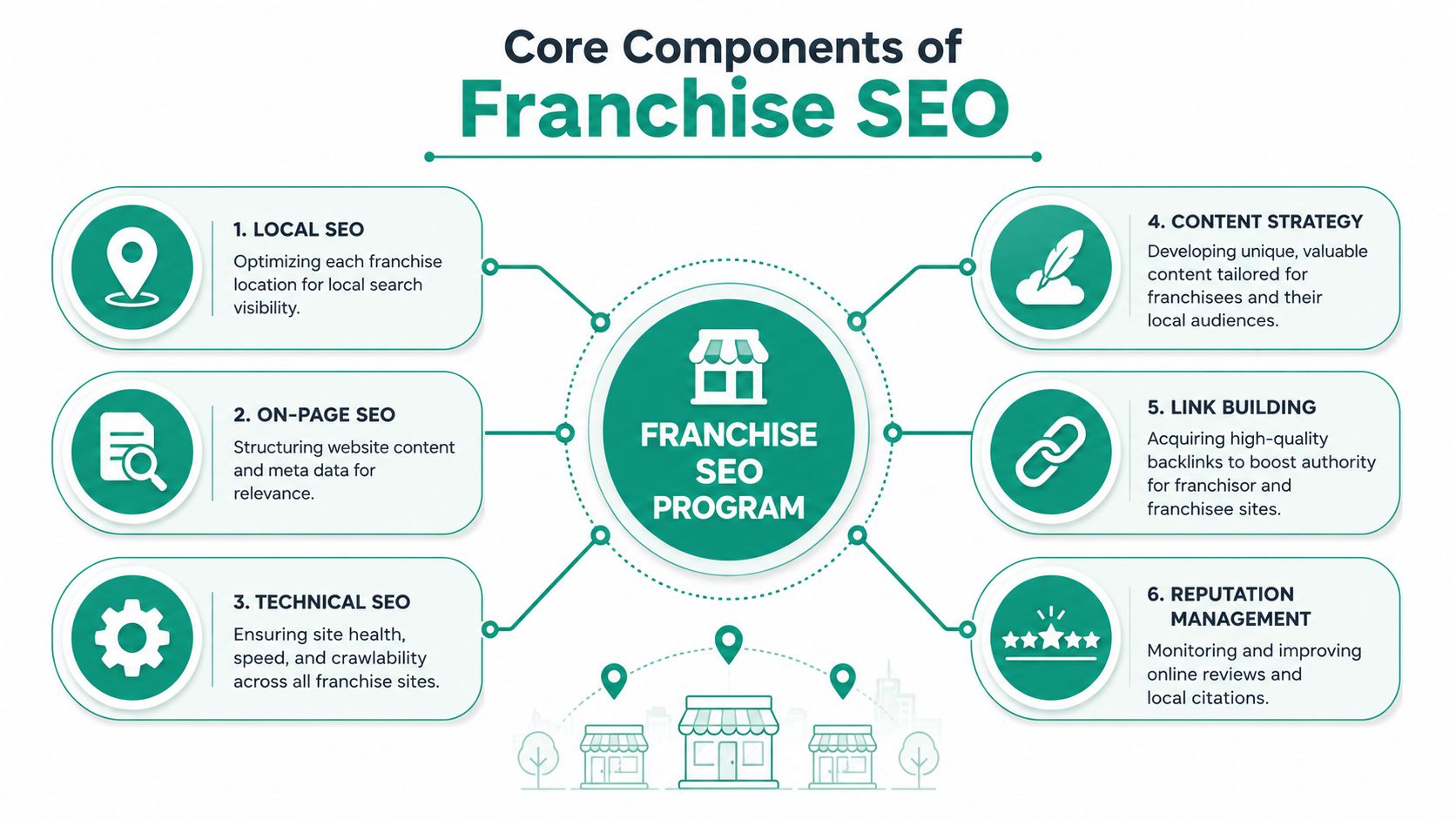
The six pillars that actually matter
-
Local SEO
Each franchise location needs its own local search footprint. That includes geographic targeting, location relevance, map visibility, and local landing pages that match search intent. -
On-page SEO
Titles, headings, internal links, schema, and page structure must reflect both the brand and the local market. Many franchise sites often get too generic in this regard. -
Technical SEO
Large location networks create crawl, indexing, duplication, and template issues fast. Technical SEO keeps the platform stable as the location count grows. -
Content strategy
Franchise content has to scale without becoming copy-paste filler. The system needs editorial rules, approved modules, local contribution workflows, and clear publishing standards. -
Link building
Authority has to support both the main domain and local relevance. That often means a mix of network-wide authority signals and location-specific citations or backlinks. -
Reputation management
Reviews, response workflows, citation accuracy, and profile completeness shape local trust and local pack visibility.
Google Business Profile management is not optional
For many franchise systems, Google Business Profile management is the most impactful local task because it sits so close to the conversion point. According to Outpace SEO’s franchise SEO analysis, optimized Google Business Profiles generate 520% more calls than unmanaged or minimal listings. That’s why profile completion, category control, service lists, photos, hours, and review response workflows need central standards with local accountability.
A serious program treats GBP management as a system:
- Governance for naming, categories, service descriptions, and hours
- Access control so listings don’t get abandoned when staff changes
- Review handling with clear rules on who responds and how quickly
- Update workflows for openings, moves, holiday hours, and temporary changes
Content depth and local differentiation
Thin location pages don’t carry their weight. A franchise page needs enough substance to show local relevance and enough structure to support scalable production. That requires editorial planning, not just a CMS template.
Field note: The franchise brands that perform best usually stop thinking in terms of “location page production” and start thinking in terms of “local market publishing.”
What qualified agencies should actually deliver
When evaluating SEO services for franchises, expect deliverables tied to execution, not vague strategy language:
- Keyword architecture mapped by location and service line
- Template and schema standards that reduce duplication risk
- GBP operating procedures for every listing in the network
- Content workflows that let local proof enter the site without breaking brand rules
- Reporting by location so each franchisee can see what their market is doing
If one of those parts is missing, the campaign usually turns into central reporting with local frustration.
Structuring Your Digital Presence for Success
A franchise can lose search visibility before content or links are even discussed. The site structure itself can create the problem. The wrong model makes governance harder, splits authority, and confuses which page should rank for which market.
The first decision is where location pages live. The second is who controls them.
Subdirectories versus subdomains
Subdirectories usually keep authority consolidated on the main domain. Subdomains can give operational separation, but they often make SEO management harder because each section behaves more like its own property. Franchises that want strong central governance and cleaner authority flow often prefer a single domain with organized location paths.
Canonicalization matters here too. If locations share near-identical service pages, duplicate or competing versions need to be handled deliberately. Otherwise, the brand creates its own ranking conflict.
Franchise website structure models compared
| Model | Brand Control | Local Agility | SEO Complexity |
|---|---|---|---|
| Centralized | High | Low | Moderate |
| Decentralized | Low | High | High |
| Hybrid | Medium to high | Medium to high | Moderate to high |
A centralized model keeps control with corporate. That usually means consistent branding, fewer rogue pages, and easier governance. The trade-off is slow local responsiveness. Franchisees wait on approvals, and local differentiation tends to get squeezed out.
A decentralized model gives local owners broad autonomy. That can enable faster local action, but it often creates duplicate content, uneven quality, and inconsistent technical execution across the network.
A hybrid model is usually the most workable. Corporate controls the platform, templates, technical SEO, and brand standards. Franchisees contribute approved local inputs such as staff bios, service-area notes, photos, offers, FAQs, and testimonials. For a deeper look at location-focused implementation, this guide on local SEO for franchises is a useful companion.
How to choose the right model
The right structure depends on your operating reality, not preference alone.
- Choose centralized if franchisees aren’t equipped to manage content quality and platform changes.
- Choose decentralized only if the brand has strong local operators and a way to audit quality continuously.
- Choose hybrid when the network needs shared control with local relevance built into the workflow.
The best-performing setup usually isn’t the one with the most freedom. It’s the one with the clearest rules for where local differentiation belongs.
What a workable hybrid setup includes
A hybrid model works when the boundaries are explicit:
- Corporate owns domain structure, templates, schema rules, technical fixes, and editorial standards.
- Franchisees supply market-specific proof and operational details.
- Approvers review local changes against brand and SEO criteria before publishing.
That structure prevents chaos without forcing every location into the same bland page.
Developing a Scalable Franchise Content Strategy
Most franchise content programs fail for one simple reason. They confuse scale with repetition. A network can publish hundreds of location pages and still end up with pages that feel empty, interchangeable, and hard to rank.
A scalable content system needs controlled variation. The brand message stays consistent, but the proof must change by location.

Build templates that leave room for local proof
A practical way to do this is an 80/20 model. Most of the page stays brand-approved. The remaining portion is reserved for location-specific content that gives the page a reason to exist.
That local portion can include:
- Team details such as manager notes, bios, or staffing context
- Service-area language tied to real neighborhoods, landmarks, or customer needs
- Photos and examples from the location’s work, events, or storefront
- FAQs based on questions that location receives
Another rule matters just as much as the template. Location pages need enough copy depth to avoid looking like listings with a paragraph attached. This franchise SEO checklist states that franchise SEO requires 600 to 1,200 words of unique, location-specific copy per page to avoid thin “business card” content and satisfy local relevance needs.
Local testimonials change conversion behavior
Trust rises when proof is local. Generic praise about the brand doesn’t do the same job as a testimonial tied to the customer’s own area. According to franchise marketing statistics from Unbounce cited here, franchise landing pages with localized testimonials convert 42% better than pages with generic or non-localized content.
That changes how content should be gathered. Don’t just ask franchisees for a review feed. Ask for testimonials that identify the location context clearly enough to support both trust and conversion.
A location page should answer a customer’s quiet question: “Has this specific team helped people like me, near me?”
A content workflow that doesn’t collapse
The workable version looks like this:
- Corporate creates the master page framework with approved sections, style rules, and prohibited edits.
- Franchisees submit local content inputs through a form or content portal.
- Editors shape those inputs into readable, compliant page copy.
- SEO reviewers check uniqueness, internal linking, metadata, and local intent alignment.
- Corporate approves publication within a defined turnaround window.
That process is slower than handing everything to the field. It performs better because it creates pages worth ranking and worth converting on.
How to Evaluate and Choose a Franchise SEO Agency
Most agencies can talk about SEO. Fewer can operate inside a franchise system without creating friction between corporate and franchisees. That difference shows up in the questions they can answer, the reports they show, and the rollout model they recommend.
The first screening filter is specialization. A franchise SEO partner should talk comfortably about governance, approval workflows, location page systems, local reporting, Google Business Profile access, and rollout sequencing. If the conversation stays generic, the fit is weak.
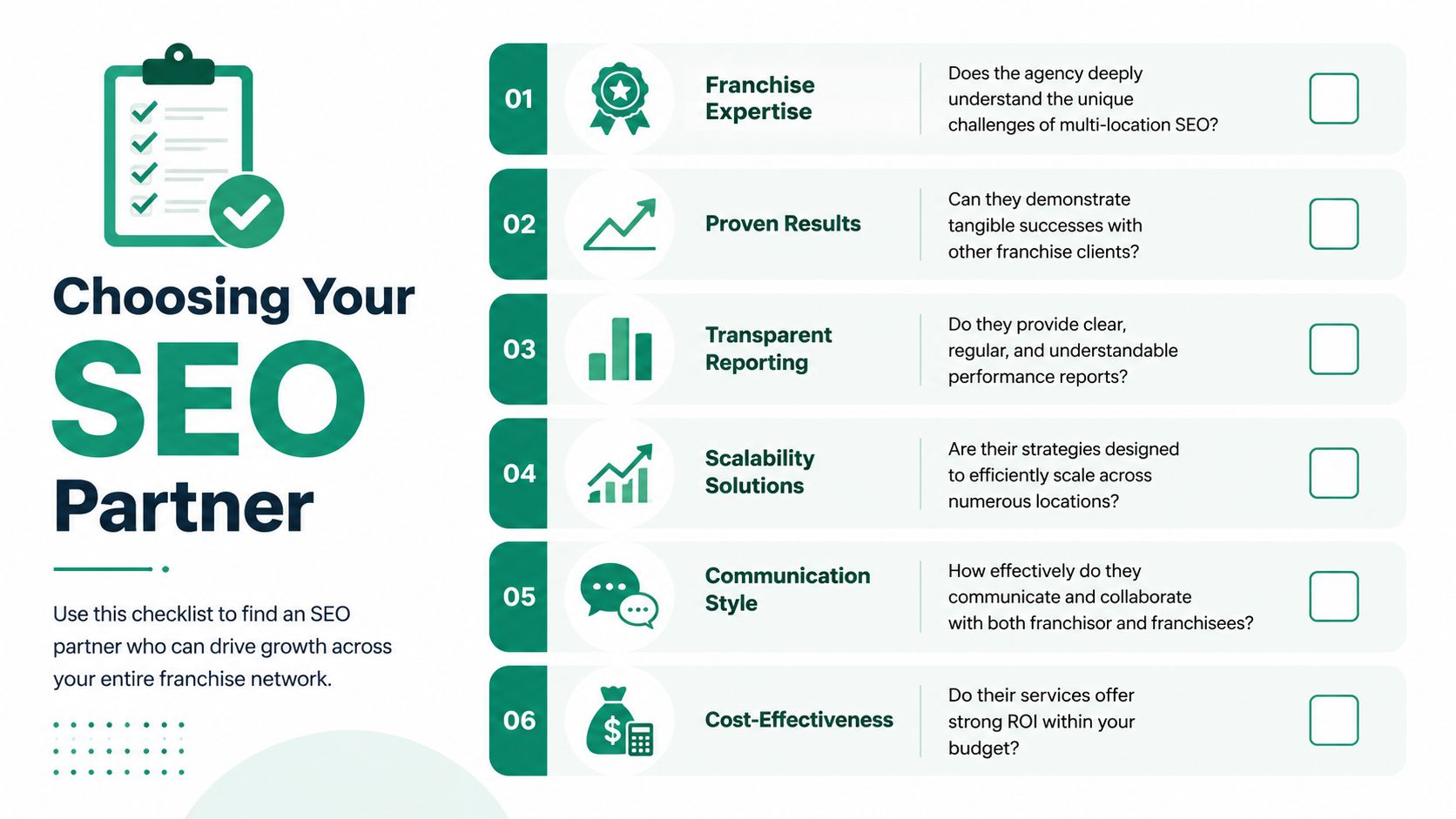
Questions that expose real capability
Ask direct questions and ask for artifacts, not promises.
- Show me a franchisee-facing report so I can see how one location’s performance is communicated.
- Walk me through your content approval workflow between corporate and local owners.
- Explain how you prevent nearby locations from competing for the same queries.
- Tell me who manages Google Business Profile changes when hours, categories, or services need updates.
- Describe how you pilot a program before scaling it network-wide.
A solid agency won’t answer in slogans. It will describe process, ownership, and constraints clearly. If you need a broader framework for vendor selection, this guide on how to choose a digital marketing agency gives a useful checklist.
Pricing should match scope and rollout
Price alone won’t tell you whether a partner is right, but unrealistic pricing usually signals unrealistic delivery. According to Onely’s overview of franchise SEO agencies, mid-market franchise SEO retainers typically range from $2,500 to $7,500 per month, while enterprise technical and AI-search engagements can reach $5,000 to $10,000+ per month. The same source notes that many successful programs pilot 5 to 20 locations before a full rollout.
That pilot model makes sense. It lets the brand test workflows, page formats, reporting, and franchisee adoption before applying the system across the network.
Red flags worth treating seriously
Watch for these patterns:
- Aggregate-only reporting that hides what is or isn’t happening at the location level
- No clear local content workflow beyond “we’ll template it”
- No GBP process for ownership, optimization, and updates
- No rollout logic beyond trying to launch every location at once
- No explanation of AI search or GEO readiness despite selling future-focused SEO
The wrong agency often sounds smooth in a pitch meeting because franchise complexity doesn’t show up until execution starts.
The agency you want is the one that can handle that complexity before it becomes your problem.
Measuring Success and Proving ROI to Franchisees
Franchise SEO falls apart when reporting stays at the corporate level. A franchisor may see overall traffic growth and broader visibility. A franchisee wants to know whether their location got more calls, more leads, and better visibility in their own market. Both views are valid. Neither replaces the other.
That means reporting needs two layers. One for network leadership. One for individual operators.
What corporate should see
Corporate reporting should focus on system-wide performance and consistency:
- Location coverage across the network
- Visibility trends for priority markets and service lines
- Profile health across Google Business Profiles
- Lead flow patterns by market cluster
- Content deployment status by location or region
That helps the brand spot structural issues. It also gives leadership a way to compare execution quality across the network.
A stronger reporting mindset connects visibility to business outcomes. This resource, The AI CMO’s ROI measurement playbook, is useful because it pushes measurement beyond top-line traffic and into operational accountability.
What franchisees should see
Each franchisee needs a simpler dashboard. It should answer practical questions quickly. Did rankings improve in the territory? Did calls and form submissions rise? Which pages or profiles are pulling their weight?

A good local dashboard usually includes:
- Segmented rankings for the location’s priority terms
- Google Business Profile actions such as calls or direction requests
- Lead source visibility separated from paid channels where possible
- Landing page performance for that location’s key pages
For a practical view of how reporting should be structured, this overview of SEO reporting is worth reviewing.
Here’s a useful reference point on why aggregate reporting alone often causes friction. Searchbloom’s discussion of franchise SEO agency reporting gaps highlights that many agencies still fail to show how local SEO performance ties to revenue at the individual franchise level.
Use reporting to maintain buy-in
Franchisees stay engaged when they can see local progress in plain terms. Corporate stays aligned when local data rolls up into a network view without hiding underperformance.
A short video can help teams align on how SEO and ROI reporting connect in practice:
The operational goal is simple. Give leadership enough data to govern the system, and give franchisees enough clarity to trust the investment.
If your franchise needs a partner that can align brand control, local visibility, and measurable reporting, Ascendly Marketing is worth a closer look. They work with growth-focused brands that need structured digital marketing execution, clear communication, and reporting that connects strategy to business outcomes.