

Your pipeline looks busy on the surface. Search Console shows movement, a few pages rank, and content keeps getting published. Then sales looks at the inbound and says the same thing every month: most of this isn’t usable.
That gap is exactly where a B2B SEO consultant earns a seat at the table. In B2B, organic search is not just a traffic channel; it’s a revenue channel, and the benchmark data explains why. Industry summaries cite 748% to 825% average ROI over about 3 years, with SEO generating 76% of all trackable B2B website traffic and 44.6% of total B2B revenue in cited benchmarks, which is why the job is usually about pipeline impact, not vanity rankings alone. B2B SEO benchmark data
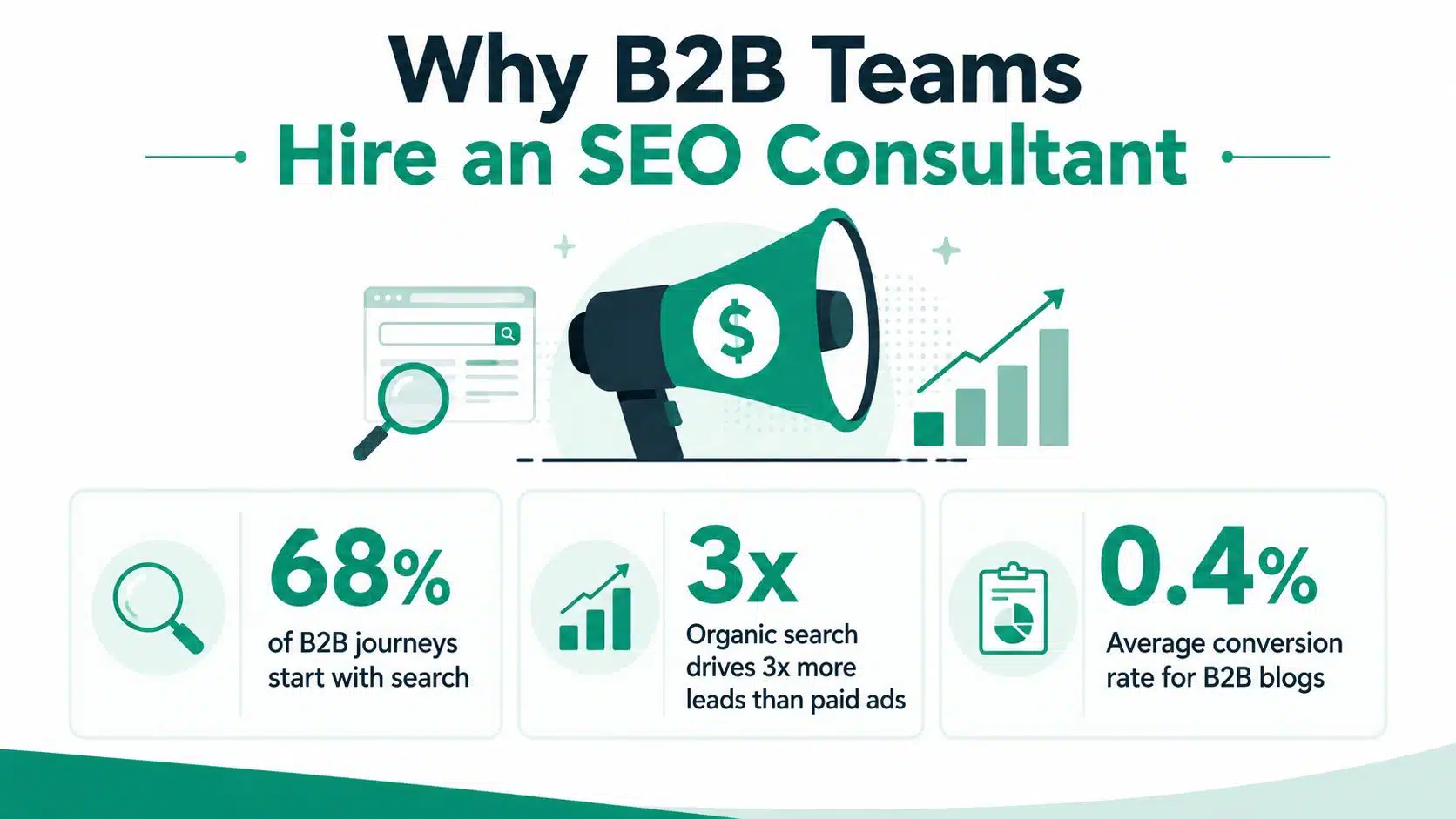
If that sounds familiar, you’re probably dealing with one of two problems. Either your team has enough SEO activity but not enough SQL impact, or you don’t have the internal bandwidth to fix technical issues, content targeting, and reporting at the same time. A consultant exists to close that gap without turning your marketing team into a full-time search operations shop.
For a practical overview of the broader agency field, the roundup of leading B2B SaaS SEO agencies is a useful comparison point when you’re deciding whether to hire a specialist, a freelancer, or a larger partner.
Why B2B Teams Hire an SEO Consultant
The pattern is painfully common. A mid-market company ships a steady stream of blog posts, ranks for a few obvious terms, and keeps hearing that organic search is “working.” Then the sales team opens the CRM and sees that most inbound leads still need heavy qualification, while competitors own the searches that happen earlier in the buying process.
That’s the primary reason teams hire a B2B SEO consultant. The consultant is there to connect search demand to the buyer journey, then turn that demand into a pipeline your sales team can use. In B2B, the work has to account for long research cycles and multiple stakeholders, because a prospect often starts with a generic problem search long before they know which vendor they want. The data backs that up: 71% of B2B researchers start with a generic search rather than a branded query. B2B search behavior and revenue benchmarks
Where generic SEO advice breaks down
Most in-house teams don’t fail because they lack effort. They fail because they use a consumer-style SEO playbook in a B2B buying environment. Broad keywords, thin content clusters, and ranking reports don’t tell you whether you’re attracting the right account types or moving buyers toward a sales conversation.
A consultant steps in where that mismatch starts to hurt. They shape content around problem language, decision-stage questions, and the kind of proof buyers ask for before they book a demo. If your current setup produces attention but not qualified conversations, that’s the signal to stop treating SEO as a content calendar and start treating it as a pipeline system.
Practical rule: If your organic traffic goes up but sales can’t trace more qualified opportunities back to search, the strategy is aimed at the wrong intent.
The hiring decision usually becomes obvious when the team needs outside judgment, not more internal debate. You need someone who can diagnose why the site attracts the wrong visitors, clean up the technical blockers, and force the program to answer one question: which pages produce sales-ready demand?
What a B2B SEO Consultant Actually Does
A competent consultant doesn’t arrive with buzzwords and a slide deck full of screenshots. They work across a few narrow areas that all have to line up, or the program stalls. For B2B companies, those areas usually break down into technical SEO, content strategy, link acquisition, analytics, and conversion work.
Technical work that clears the path
Technical SEO is the unglamorous part that still decides whether the rest of the plan can work. A consultant audits crawl issues, indexation, internal linking, duplicate content, page templates, and structured data. If the site’s architecture confuses search engines, content quality won’t save it.
Content strategy tied to buyer language
Good consultants don’t just “do keywords.” They map topics to business problems, then shape content around how buyers speak in sales calls, support tickets, and demo requests. That’s where topical authority starts. A consultant who understands B2B content will build pages that answer a narrow question well enough to support a sales conversation later.
Link acquisition without junk tactics
Link work in B2B should be selective. That means digital PR, partner content, resource placements, and industry-relevant citations, not noisy directories and spammy placements. The goal is authority that fits the category your buyers already trust.
Analytics that connect search to pipeline
Traffic means very little unless you can tie it to the right landing pages, lead forms, and sales stages. A solid consultant sets up reporting that separates informational traffic from high-intent traffic and shows where organic sessions become opportunities. If the consultant can’t talk about attribution cleanly, keep looking.
CRO that makes the traffic useful
Organic traffic usually needs page-level changes before it turns into leads. Strong consultants look at calls to action, form friction, page layout, trust signals, and message clarity. A better page won’t fix weak targeting, but it will make solid targeting pay off faster.
If you want a structured starting point for the technical side, an SEO audit service is usually the first piece worth discussing before any larger engagement.
The best consultants don’t try to own everything. They identify the few leverage points that make the rest of the SEO work matter.
Building a Keyword Strategy Around the B2B Buyer Journey
Most B2B keyword plans fail for the same reason: they chase search volume instead of pipeline value. That approach produces traffic, but not the kind your sales team wants to hear about. The better model starts with the buyer journey, then works backward from the questions prospects ask at each stage.
Map keywords to how buyers actually decide
At the awareness stage, buyers are trying to understand a problem. At the consideration stage, they’re comparing approaches and vendors. At the decision stage, they’re looking for proof, fit, and next steps.
A B2B SEO consultant should map every meaningful keyword to one of those stages. If a term can’t reasonably support an eventual SQL, it doesn’t deserve priority just because the volume looks nice in a tool.
Mine real language instead of guessing
Sales calls and support tickets are where the best keyword ideas usually hide. They show you the exact phrases buyers use when they describe the problem, ask for a workaround, or question a feature. That language is often more useful than the polished wording inside your own product pages.
A consultant should also judge difficulty with B2B competition in mind. One B2B guide notes that top 10 B2B keywords average DR 78 versus DR 62 for B2C, which means the bar is higher and the field is more crowded. B2B keyword strategy and difficulty benchmark
| Criterion | B2B Approach | B2C Approach |
|---|---|---|
| Primary goal | SQL likelihood and pipeline value | Traffic and conversion volume |
| Keyword source | Sales calls, support tickets, product questions | Popular demand and broad intent |
| Stage targeting | Awareness, consideration, decision | Mostly immediate purchase intent |
| Competitive posture | Selective, authority-led targeting | Broader volume capture |
| Content shape | Problem pages, comparisons, proof-driven assets | Reviews, product pages, transactional pages |
Useful filter: If the keyword doesn't map to a real buying question, it's probably a content vanity play.
For a deeper framework on selection criteria, the guide on how to choose keywords for search engine optimization is worth using alongside your internal discovery notes.
Engagement Models and When Each One Fits
The right engagement model depends on how much direction you need, how much execution you already have, and how fast you need clarity. Don't overbuy. A lot of B2B teams hire too much help too early, then spend half their budget on meetings and status updates instead of search work.
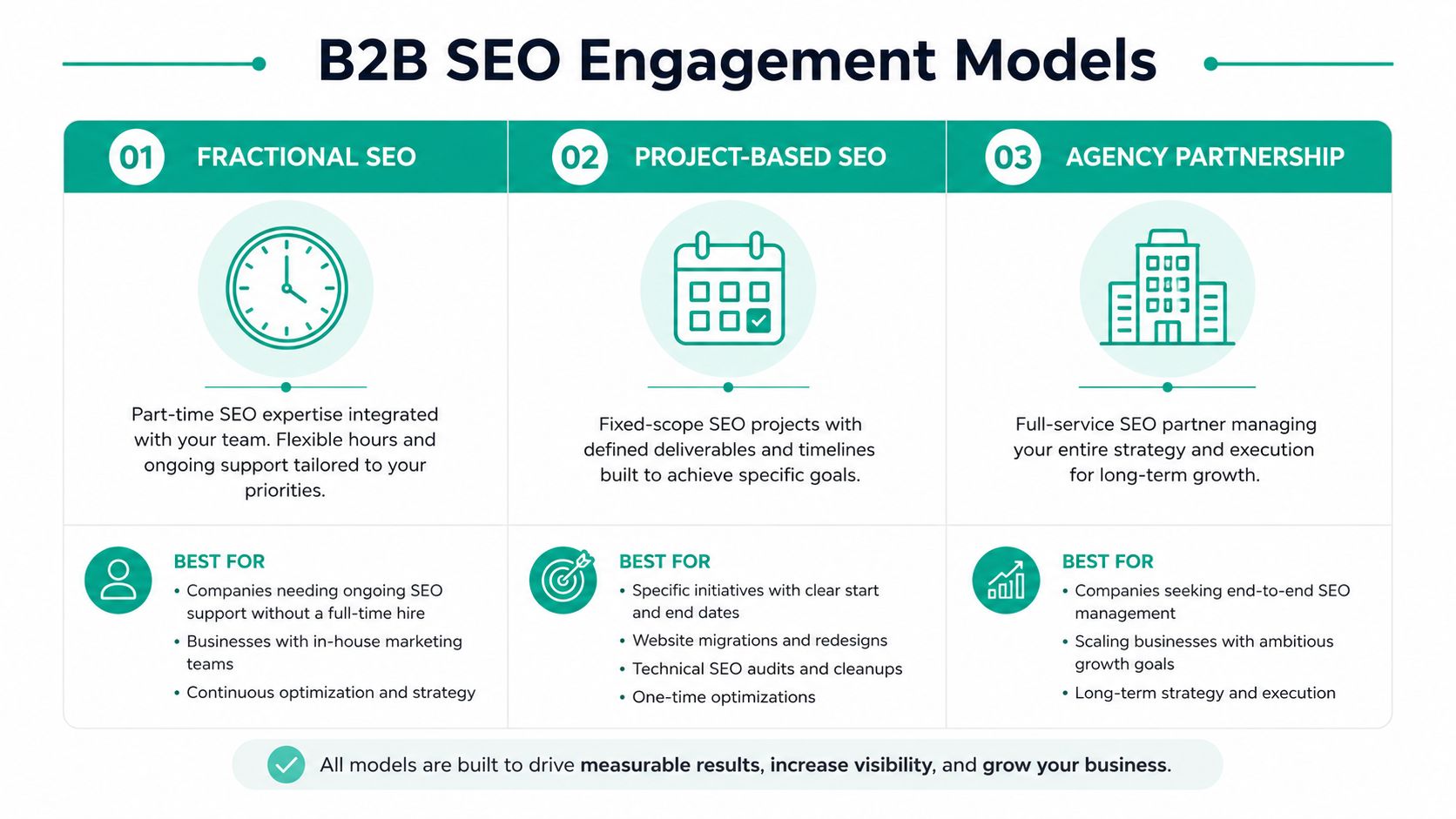
Fractional consultant
A fractional consultant fits companies that need senior judgment but don't need a large execution team. This model works well when the company already has content, development, or marketing support and just needs someone to make decisions and keep the program honest.
Project-based engagement
A project-based setup fits a defined problem, such as an audit, migration support, or keyword architecture work. If the issue is specific and the scope can be boxed in, this model gives you focus without a long retainer commitment.
Agency partnership
An agency partnership makes sense when strategy, content, outreach, and reporting all need to move together. That's usually a better fit for a company that wants one team to own more of the workflow, especially when internal bandwidth is thin.
| Model | Best Fit | Main Trade-off |
|---|---|---|
| Fractional consultant | Teams with internal execution and a need for senior strategy | Less hands-on execution |
| Project-based | A specific SEO problem with a clear finish line | Limited continuity after delivery |
| Agency partnership | Companies that want strategy plus execution under one roof | More coordination and higher overhead |
A startup pre-product-market fit usually needs a narrow, project-based engagement or light fractional guidance. A scaling SaaS company usually needs a fractional consultant who can steer prioritization while the team executes. An established brand with an in-house marketer often does best with a consultant or agency that can challenge assumptions and clean up the search program without creating another layer of chaos.
Evaluation Checklist and Interview Questions
Treat the hiring process like a scorecard, not a vibe check. The wrong consultant can talk confidently about SEO and still leave you with the same pipeline problem you started with. The right one can explain trade-offs, show how they think, and tie search work to revenue without hiding behind jargon.
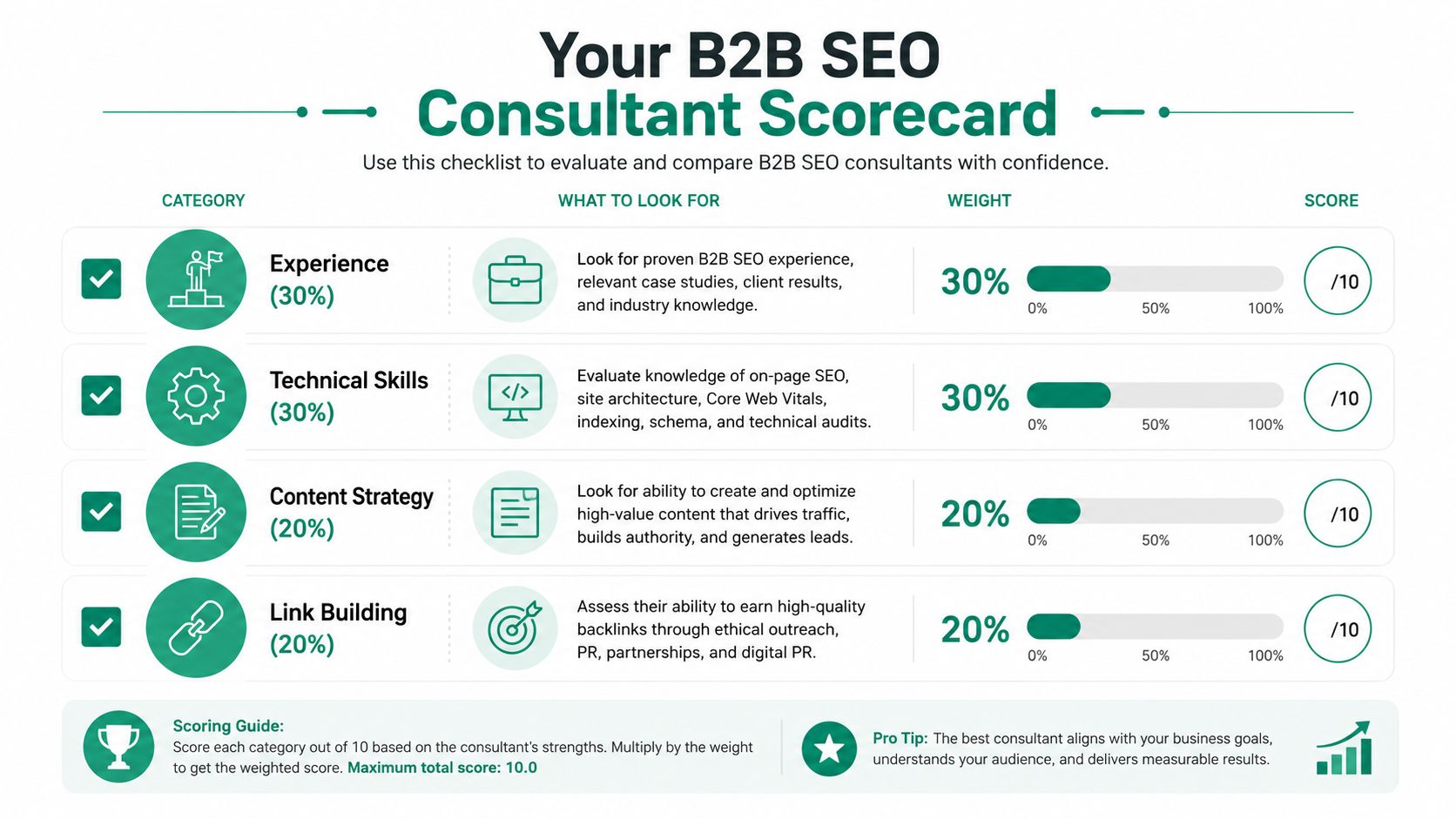
A simple weighted scorecard
| Criterion | Weight | Strong signal | Weak signal |
|---|---|---|---|
| Experience | 30% | Has worked on complex B2B sites with real sales cycles | Talks mostly in generic SEO terms |
| Technical Skills | 30% | Can explain crawl, indexation, templates, and site architecture clearly | Defers everything to developers |
| Content Strategy | 20% | Builds topics from buyer language and sales input | Chases keyword lists with no funnel logic |
| Link Building | 20% | Uses relevant authority-building tactics | Talks about quantity instead of relevance |
If you want a formal document to structure that review, a marketing RFP is worth preparing before the sales calls start. A marketing request for proposal works well as the briefing layer when you want vendors to answer the same questions in the same format.
Six interview questions that separate senior consultants
- How do you decide which keywords deserve priority? A strong consultant talks about pipeline value, search intent, and feasibility. A weak one falls back to volume.
- What does your technical audit cover? Good answers mention crawlability, indexation, internal linking, duplicate content, and template issues.
- How do you turn sales call notes into content ideas? Senior people use those notes as a source of topic mapping, not just a brainstorm aid.
- How do you approach link acquisition for a B2B brand? Listen for relevance, authority, and editorial judgment. Ignore anyone who sells shortcuts.
- How do you report on organic performance when PPC is running too? The best answer explains attribution boundaries instead of pretending channels work in isolation.
- What would you fix first on a site that gets traffic but no qualified leads? Senior consultants start with intent mismatch, page quality, and conversion friction.
For industrial teams that need a sharper lens on category complexity, the Machine Marketing industrial strategy guide gives a useful benchmark for how specialized B2B positioning should look in a tougher niche.
If the candidate can’t explain how they’d evaluate a site in the first 30 minutes, they’re not ready to own your SEO decision-making.
Pricing, Timelines, and What Results to Expect
Pricing depends on scope, but the core issue is what you’re paying for. A consultant who only sends recommendations is cheaper than a partner who diagnoses the site, reshapes the keyword plan, and helps the team execute. The right comparison is not hourly rate versus retainer; it’s cost versus decision quality.
What changes the price
Site size, category competition, content volume, and link acquisition needs all move the number. A broad SaaS market with multiple product lines needs more planning than a narrow industrial niche. A migration, audit, or rescue engagement also costs differently from an ongoing advisory relationship because the work is concentrated.
What the timeline usually looks like
The first 90 days should produce clarity. You should see a technical diagnosis, a ranked keyword plan, and a content or page priority list tied to business goals.
By 180 days, the site should be showing movement in priority pages, reporting should be cleaner, and the consultant should be able to point to which changes are creating qualified activity.
At 12 months, you want a stable operating system, not just a set of one-off wins. That means better topic coverage, stronger pages, cleaner attribution, and a search program the internal team can maintain without guesswork.
Read the engagement against milestones
A weak consultant spends the first quarter talking about what they plan to do. A strong one uses that time to remove uncertainty and set a clear execution path. If you’re not getting specific next steps, the engagement is drifting.
Practical rule: Early SEO work should reduce confusion first. Lead growth comes after the site stops leaking intent.
KPIs, Reporting, and How to Measure Success
Rankings are useful, but they’re not the score. A B2B SEO program lives or dies by whether organic search creates qualified demand that sales can work with. If the monthly report doesn’t answer that question, the report is decoration.
The KPI categories that belong in the report
- Organic traffic quality from landing pages with clear intent.
- Lead generation from form fills, demo requests, and other tracked actions.
- Keyword portfolio coverage across priority topics, not just a single headline term.
- Technical performance across crawlability, speed, and indexation health.
A solid monthly report starts with a short executive summary, then shows the numbers that matter most to the business. It should separate brand demand from non-brand demand, show which pages drove conversions, and flag which experiments are next. If the report can’t explain what changed and what happens next, the consultant is hiding behind metrics.
Here’s the kind of block you should expect:
| Area | What good reporting shows |
|---|---|
| Organic traffic quality | Which pages attracted the right visitors |
| Lead generation | Which pages produced form fills or demo requests |
| Keyword portfolio | Which priority topics moved or held steady |
| Technical performance | What blocked crawling, indexing, or speed |
Good reporting also links SEO to the rest of the funnel. That includes where organic search enters, where it assists, and where it converts. On the agency side, that’s where integrated teams like Ascendly Marketing usually fit, because SEO, content, outreach, and CRO can be reviewed together instead of in separate silos.
The headline lesson is simple. Measure whether organic search is bringing in the kind of demand your sales team wants, then use the report to decide what to fix next.
If your current SEO setup is producing traffic but not enough sales-ready conversations, talk to Ascendly Marketing and ask for a B2B SEO review that focuses on keyword priorities, technical blockers, and reporting tied to pipeline.