
You can spot the problem fast. Corporate posts are polished, local pages are inconsistent, franchisees are reposting whatever they can find, and paid ads are running in different directions across locations. The brand looks busy, but the system isn’t producing steady local demand, and nobody trusts the numbers.
Franchise social media marketing works when the franchisor and each location operate from one shared playbook. That means the brand keeps control over voice, visuals, approvals, and reporting, while local teams stay free to post about the neighborhood, the staff, and the offers that matter in each market.
Introduction to Franchise Social Media Marketing
A franchise can’t treat social media like a side task anymore. In 2025, 83% of marketers said social media had become their primary customer acquisition channel, and brands putting more than 20% of their marketing budget into social reported 33% higher ROI than those investing less, according to Sprinklr’s social media marketing statistics. For a franchise system, that shift changes the job. Social now has to support both the national brand and the local unit at the same time.
That’s where the friction usually shows up. Corporate teams want consistency, franchisees want flexibility, and both sides end up compromising in the wrong places. The result is usually uneven content, slow approvals, weak local relevance, and wasted spend on campaigns that never connect to a specific store visit, booking, or call.
A workable system connects strategy, governance, content production, paid social, training, compliance, and KPIs in one structure. It gives headquarters a way to protect brand standards, and it gives franchisees a way to publish useful local content without guessing. If you’ve ever had one location posting polished brand assets while another uses off-brand graphics and a third boosts random posts with no tracking, this is the fix.
The sections below focus on a practical operating model. You’ll see how to align national and local goals, how to set rules without choking local voice, how to build templates and training workflows, how to split paid spend, and how to measure real business outcomes instead of noise.
Align Corporate and Local Social Media Strategy
A franchise social plan works best when headquarters and local operators are solving the same problem from different angles. Corporate needs brand consistency and campaign reach. Franchisees need posts that turn nearby attention into calls, bookings, walk-ins, and other local actions. If those priorities sit in separate plans, the network ends up with content that looks coordinated on paper but does not perform in market.
Start with one planning session, not two separate agendas
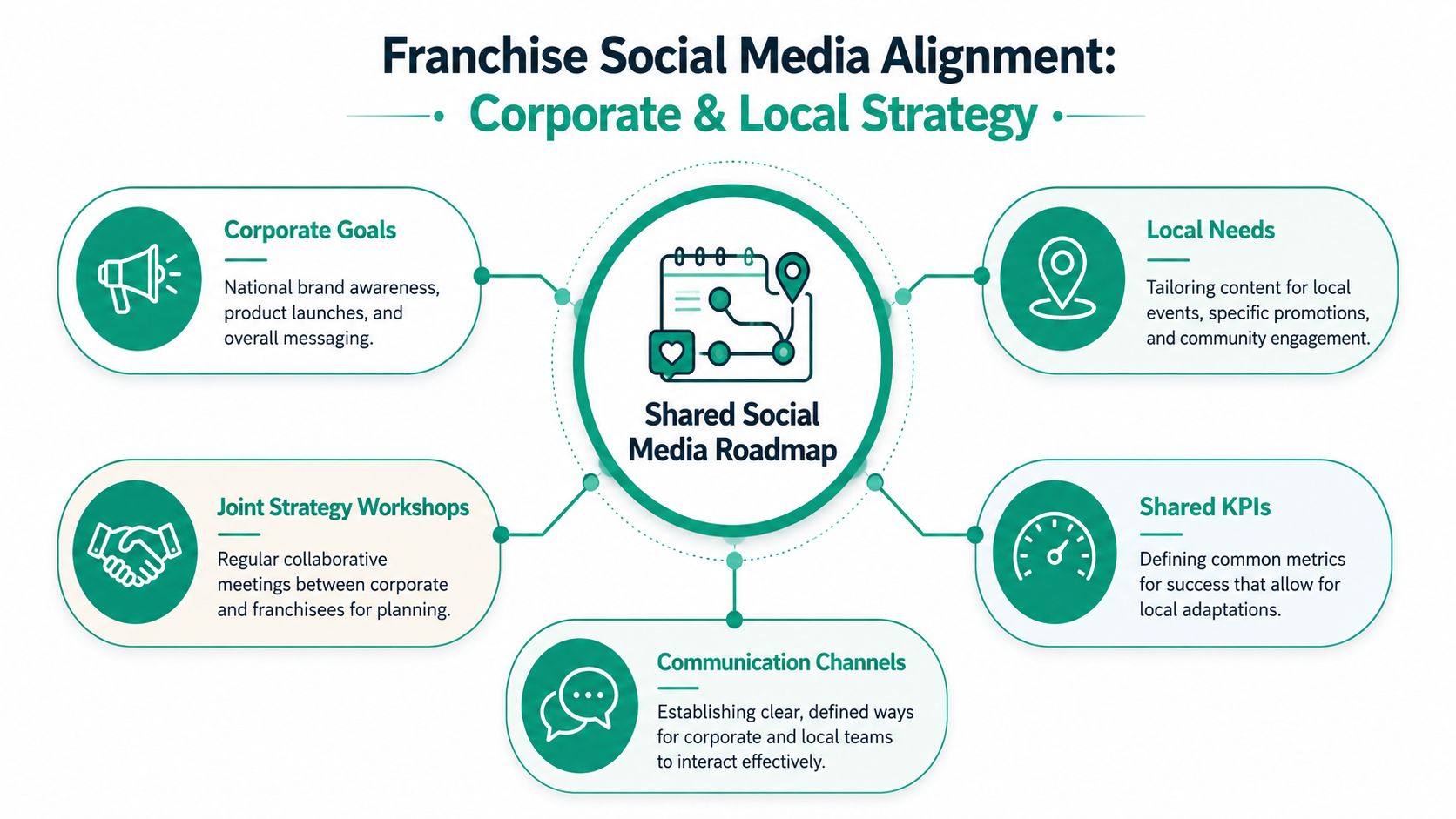
Joint strategy workshops solve more than communication problems. They force corporate teams and franchisees to decide what the brand is trying to accomplish, what each location is trying to sell, and which posts can serve both. That matters because franchise discovery is concentrated on major social platforms, and AMRA and Elma franchise marketing statistics show that Facebook and Instagram account for a large share of initial franchise awareness.
The workshop should end with three written decisions. First, the brand themes for the quarter. Second, the local goals each market owns. Third, the content types that can be adapted by location without losing approval. If those three pieces are not written down, local pages drift, and corporate campaigns get copied badly.
Practical rule: If a post cannot be tied to a brand objective or a local action, do not publish it.
A shared calendar works better than a shared folder alone. The calendar should mark national launches, seasonal promotions, recruitment pushes, local events, and community dates. Franchisees can then see where they have room to customize, rather than guessing whether corporate will approve a post after the fact.
Use separate KPIs without creating separate silos
The strongest planning model defines KPI sets at both levels. Corporate should watch reach, network consistency, and campaign delivery. Local teams should watch the actions that show demand in a market, like calls, bookings, and map requests. That split keeps the franchise from chasing the same number for every location, which usually hides what each market needs.
A simple template helps.
| Level | What to track | Why it matters |
|---|---|---|
| Corporate | Brand-wide campaign consistency, post cadence, approval compliance | Shows whether the system is executing the plan |
| Location | Calls, bookings, map requests, local post engagement | Shows whether the page is creating demand in that market |
This also connects to local SEO for franchises. Social and local search pull in the same direction when a location page, map profile, and local posts all point to the same store action.
Build a meeting rhythm that does not drag
Monthly check-ins keep strategy from going stale. Quarterly reviews keep the network honest about what proved effective. Between those meetings, a short communication channel for approvals and asset requests prevents small issues from turning into a long backlog.
The tools matter less than the discipline. Some teams use shared calendars and project boards, others run everything through a campaign tracker, and some keep it simple with a central spreadsheet plus approval notes. What matters is that local requests do not disappear into email threads. Franchisees need a clear path for asking for assets, and corporate needs a clear way to say yes, no, or revise.
Establish Brand Governance and Compliance Policies
Social media breaks down quickly when every location improvises. One franchisee posts a promotion in a tone that doesn’t match the brand, another uses outdated graphics, and a third answers customer comments in a way that creates a compliance problem. That isn’t a style issue; it’s a governance issue.
Give franchisees freedom inside firm guardrails
A useful governance framework separates corporate control from local adaptation. Some things should never change. Brand voice, logos, visual standards, and response rules need to stay consistent across the network. Other things should flex by market, including local events, neighborhood language, and community partnerships. Marvia’s franchise social media strategy guidance captures this split clearly, with brand-wide themes, approved assets, and shared content libraries on one side, and local customization on the other.
That structure prevents two common failures. The first is brand drift, where every page starts sounding different. The second is overcontrol, where franchisees stop posting because the approval process takes too long. A policy should block both.
A policy manual should include five sections:
- Voice guidelines: Define tone, vocabulary, and response style so replies sound like the same brand across every market.
- Visual standards: Set rules for logos, colors, image styles, and layout use.
- Posting rules: State how often locations should publish and what content types are expected.
- Approval workflow: Explain which posts need review and who signs off.
- Escalation path: Show what happens when a post involves a complaint, legal concern, or sensitive topic.
Make compliance usable, not buried
Policies fail when they’re written like legal memos that nobody opens after onboarding. A better approach is a short manual, a stored approval log, and a review board that handles exceptions quickly. New franchisees should know what can be customized on day one, and experienced operators should know which content types move faster because the risk is lower.
A clean review system also protects local autonomy. If a location posts community photos, event notices, or staff spotlights, those should not wait in the same queue as paid ads or customer complaint responses. Separate paths reduce friction and keep the system moving.
Compliance works when the rules are visible before the post is created, not after someone has already designed it.
This is also where clear examples help more than broad principles. Show approved captions, approved hashtags, and approved image types in the policy package. Franchisees copy what they see, so the guidance should remove guesswork instead of adding more.
Build Content Systems Templates and Training Workflows
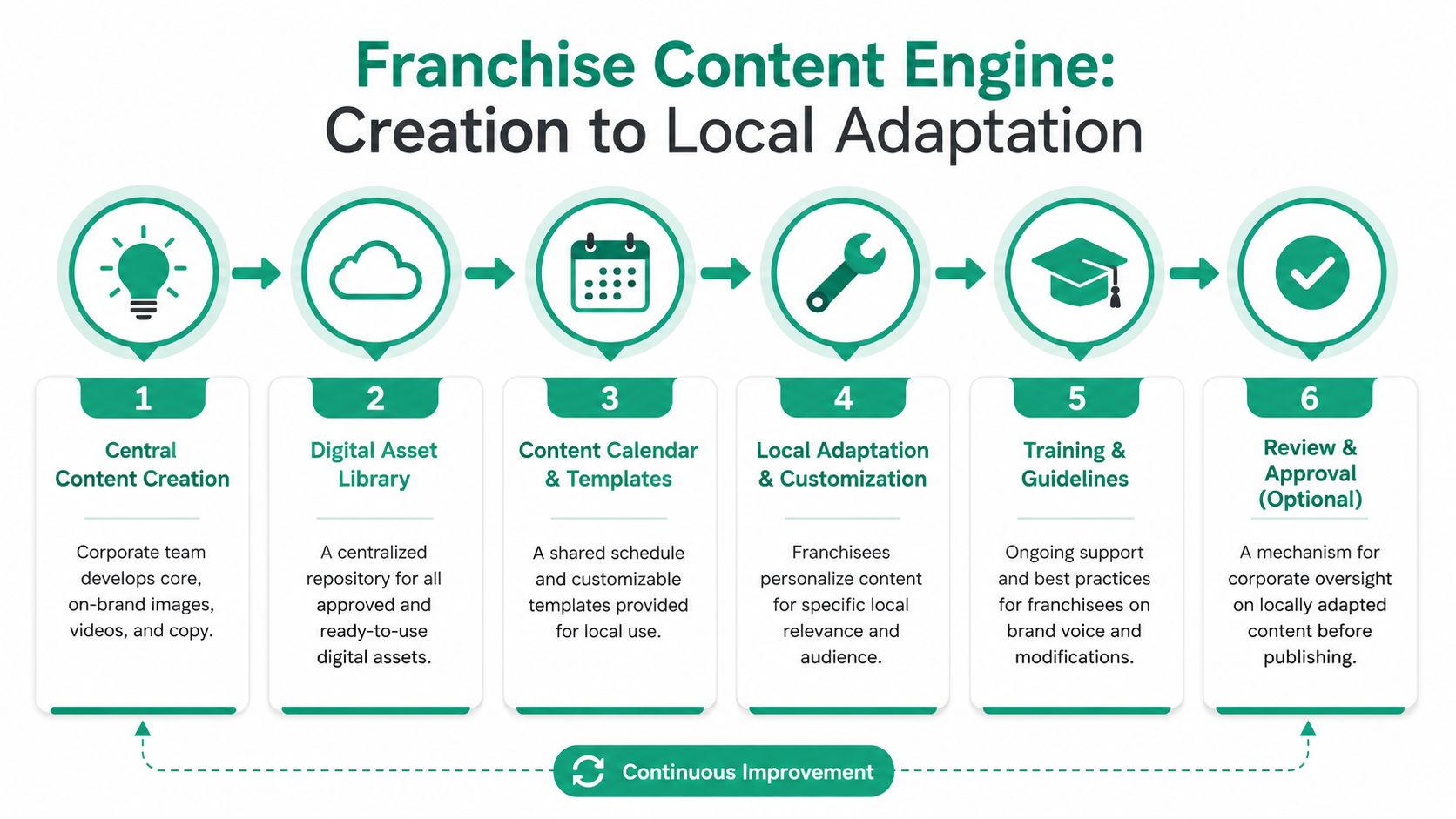
A franchise social program becomes easier to run when the content engine is centralized. The corporate team creates the core assets, and local teams adapt them with market-specific details. That cuts down on production time, but it prevents each location from reinventing the same basic post every week.
Build the content engine first
The core workflow should start with a shared calendar, a digital asset library, caption templates, and response scripts. Corporate teams can prepare the branded materials once, then franchisees can customize the local layer without changing the structure. A practical list includes:
- Shared calendar. Store weekly and monthly post themes in one place so each location knows what’s coming.
- Asset library. Keep approved photos, short-form video, graphics, and logo files in one folder with version control.
- Caption templates. Provide fill-in-the-blank lines for promos, event posts, service reminders, and community posts.
- Hashtag sets. Include brand tags and location-specific tags in a ready-to-use format.
- Response scripts. Prepare replies for common comment types, especially questions, praise, and complaints.
- Approval notes. Mark which content types need a review before publishing and which can go live after local customization.
If the team needs help producing or adapting assets, AI solutions for social media content can support concepting and versioning, as long as the brand still reviews the final output before it goes live.
Train people on the workflow, not just the brand book
A training program should teach franchisees how to use the system, not just what the brand looks like. That means onboarding modules on content selection, approval timing, response expectations, and local adaptation rules. A live workshop helps owners see how a post moves from draft to publication, and an assessment makes sure they can repeat the process on their own.
A sample module sequence looks like this:
- Module 1, Brand basics: What can’t change across locations.
- Module 2, Content assembly: How to pull assets, edit captions, and add local details.
- Module 3, Publishing workflow: How approvals work and where delays happen.
- Module 4, Community response: How to handle questions and comments quickly.
- Module 5, Review and correction: How to fix mistakes before they spread.
The best training materials are short and concrete. A one-page guide to local promotion posts will get used more than a fifty-page policy deck. That’s where a structured library such as types of content for social media becomes useful, because it gives operators examples they can plug into the workflow.
A high-performing franchise social media program should use a centralized playbook plus local execution, with brand voice, visual standards, posting frequency, response protocols, and a shared content calendar, then location-specific posts and approvals by content type. Iconosquare guide to franchise social media marketing. That model reduces confusion without forcing every location into the same post.
Configure Paid Social and Budget Allocation
A franchise paid social plan works best when corporate and local teams are buying media for different jobs. Corporate can keep the brand visible across the network, while franchisees can put money behind offers, openings, events, or booking windows tied to one market. If both sides run ads without coordination, the same audience can see overlapping messages and spend gets wasted.
Compare the platforms by the job they do
Facebook and Instagram are the main consumer-facing channels for many franchise systems because they handle awareness and local promotion well. AMRA and Elma franchise marketing statistics reported that 61% of initial franchise awareness comes from Facebook and Instagram. LinkedIn serves a different purpose, especially for B2B partnerships, site selection, and recruitment, which fits the broader shift in how social channels get used.
The platform choice should follow the goal.
- Facebook: Useful for local visibility, event promotion, and community response.
- Instagram: Useful for visual storytelling and local brand presence.
- LinkedIn: Useful for franchisor recruitment and B2B outreach.
- TikTok: Useful when the brand wants short-form attention and has content that works in a looser format.
Budget allocation should follow that same split. Corporate funds should cover national launches and brand campaigns. Local owners should fund market-specific boosts, local offers, and event ads. A fixed percentage rarely fits every location, because market size and seasonality change the economics from one unit to the next.
Use a budget sheet that separates spend by purpose
A practical sheet needs three lines for every location. One line should cover brand-funded media, one should cover local spend, and one should cover test budget. The test line should stay small and should be used for creative or audience changes, not for random experimentation.
| Budget line | Owner | Purpose |
|---|---|---|
| Brand campaign | Corporate | National visibility and network-wide launches |
| Local promotion | Franchisee | Store-level offers, bookings, and events |
| Test spend | Shared | Creative and audience testing by market |
That structure prevents a common mistake: treating every boosted post as a strategy. Boosting can help, but only when the content drives a local action, and the location has a clear reason to capture it. Otherwise, the spend creates more impressions without much business value.
Ownership for budget changes should be set before launch. If a market underperforms, the local owner should know whether the fix is creative, audience selection, timing, or budget reallocation. If no one owns that decision, monthly spend drifts and no one can explain why.
Keep the local calendar tied to the campaign calendar
Seasonality matters more in a franchise than in a single store because one market can be in a peak window while another is flat. Corporate should publish the main campaign calendar early, and local teams should layer market events on top of it. That keeps each unit relevant without running ads that fight the network-wide message.
The strongest setup uses one planning calendar, one approval path, and clear local budget guardrails. Corporate gets consistency and cleaner spend control. Franchisees get room to respond to local demand without waiting for a full network refresh.
Define Reporting KPIs and Optimize Performance
The wrong report can make a weak campaign look healthy. A page with lots of impressions and likes may still create no calls, no bookings, and no store visits. For franchises, that means the report has to answer a simple question. Did the post help the local business?
Track brand metrics and branch metrics separately
The strongest methodology defines separate KPIs for the brand and for each branch, then reviews them regularly and optimizes by market. That guidance lines up with Sprout Social’s franchise marketing guide, which also recommends daily monitoring of comments, messages, and reviews to keep response times tight. A franchise manager who waits until the end of the month to read comments is already behind.
Corporate dashboards should show whether the network is executing the plan. Local dashboards should show whether the content is driving real customer action. That means calls, bookings, form submissions, and map requests should sit above vanity metrics when the goal is demand generation. A location page can be active and still fail if none of those actions move.
If the report doesn’t show a local action, the report isn’t finished.
A clean review format helps teams move from data to action. The meeting can follow four questions: which posts drove action, which locations outperformed, which themes underperformed, and what gets copied next month. That keeps the team from drowning in charts that don’t lead anywhere.
Use location tags and market notes
Location tagging matters because it lets the brand compare one unit against another without mixing results. Neighborhood-specific hashtags help the same way, especially when a market has events or community behavior that changes the way people discover the page. The point isn’t to collect hashtags for their own sake. The point is to make the data readable by market.
A simple review template works like this:
| Review item | Question |
|---|---|
| Top posts | Which post led to a local action? |
| Weak posts | Which post drew attention but no response? |
| Market comparison | Which location handled the same campaign better? |
| Next action | What gets repeated, revised, or stopped? |
Quarterly review meetings should focus on replication. The best-performing locations already show the team what the network should do more often. That may be a faster response style, a clearer offer, or a local content format that feels natural in that market.
Implementation Checklists and Case Study Examples
A rollout works better when every team knows what done looks like. The checklist should be short enough to use and detailed enough to catch the common failures. That means one version for corporate and one version for each local outlet.
Master checklist for corporate teams
- Define the playbook: Lock the brand voice, visual standards, approval steps, and escalation rules.
- Build the asset system: Create the shared calendar, caption templates, graphic library, and response scripts.
- Set KPI ownership: Assign corporate metrics to the brand team and location metrics to the local team.
- Train franchisees: Run onboarding sessions and collect proof that each owner can use the workflow.
- Review by market: Compare locations, identify the strongest content patterns, and update the playbook quarterly.
Local outlet checklist
- Use approved assets: Publish only from the shared library or approved local photos.
- Add local relevance: Tie each post to a nearby event, customer need, or community moment.
- Check response timing: Reply to comments and messages daily.
- Track actions: Note calls, bookings, map requests, and message volume.
- Escalate when needed: Send sensitive comments or claims through the approval path.
A regional service franchise used a tighter governance policy to clean up inconsistent posting across multiple markets. After the team standardized voice, visuals, and approval steps, local pages became easier to manage and engagement improved, which matched the broader logic of separating corporate control from local adaptation. For a related view of structured rollout work, the digital marketing agency case studies page shows how execution frameworks get applied in practice.
Another location used a more disciplined paid social budget model, with local spend tied to a single offer and a clearer approval path. The team stopped boosting generic posts and put money behind a campaign built for local action. The result was a much cleaner lead flow than the owner had been getting from scattered promotion.
The pattern is consistent. Franchises improve when the system is simple, the rules are visible, and the local team has enough freedom to make the content feel real. Start with the playbook, train the users, and measure the actions that prove the page is doing work.
A CTA for Ascendly Marketing.