

Public relations is the strategic communication process that builds mutually beneficial relationships between an organization and its publics. The accepted PRSA definition puts it plainly: PR is about shaping how an organization is perceived, earning trust, and maintaining credibility with the groups that matter most to its survival and growth. It is not advertising. It is not spin. At its core, PR is about honest, deliberate communication that serves both the organization and the people it affects.
The field covers a wide range of functions, each aimed at managing reputation and building relationships:
- Media relations: Pitching stories, responding to press inquiries, and securing earned coverage
- Crisis communication: Protecting an organization’s reputation when things go wrong
- Issues management: Identifying and responding to emerging public concerns before they escalate
- Internal communications: Keeping employees informed, aligned, and engaged
- Community relations: Building goodwill with local populations and civic groups
- Government affairs: Engaging with policymakers and regulatory bodies
- Social media engagement: Managing public conversations across digital platforms
What ties all of these together is the focus on earned credibility rather than purchased attention.
Table of Contents
- How public relations developed from press agentry to strategic discipline
- What do PR professionals actually do every day?
- Why “publics” is the right word, and what it actually means
- How public relations differs from marketing
- Ethical considerations in public relations
- Key Takeaways
- Ready to put PR to work for your business?
How public relations developed from press agentry to strategic discipline
PR did not arrive fully formed. It grew out of a messy, often manipulative tradition of press agentry in the late 19th century, when publicists like P.T. Barnum treated the press as a tool for spectacle rather than truth. The shift toward something more principled came in the early 20th century, largely through the work of Ivy Lee and Edward Bernays. Lee introduced the idea that organizations owed the public honest information. Bernays, drawing on psychology, argued that PR was a legitimate profession with ethical obligations.

The mid-20th century brought formal academic programs and professional associations. The Public Relations Society of America (PRSA) was founded in 1947, giving the field its first major professional home in the United States. Over the following decades, PR moved from a largely reactive, press-focused function into a proactive management discipline.
| Era | Key Development |
|---|---|
| late 19th century | Press agentry and publicity stunts dominate |
| early 20th century | Ivy Lee and Edward Bernays establish ethical and strategic foundations |
| 1947 | PRSA founded; professional standards begin to take shape |
| 1950s–1970s | Academic PR programs grow; two-way communication models emerge |
| 1980s–1990s | Corporate PR expands; crisis communication becomes a specialty |
| — | Digital media reshapes PR; online newsrooms and blogs enter the mix |
| 2010s–present | Social media, real-time monitoring, and influencer relations redefine the field |
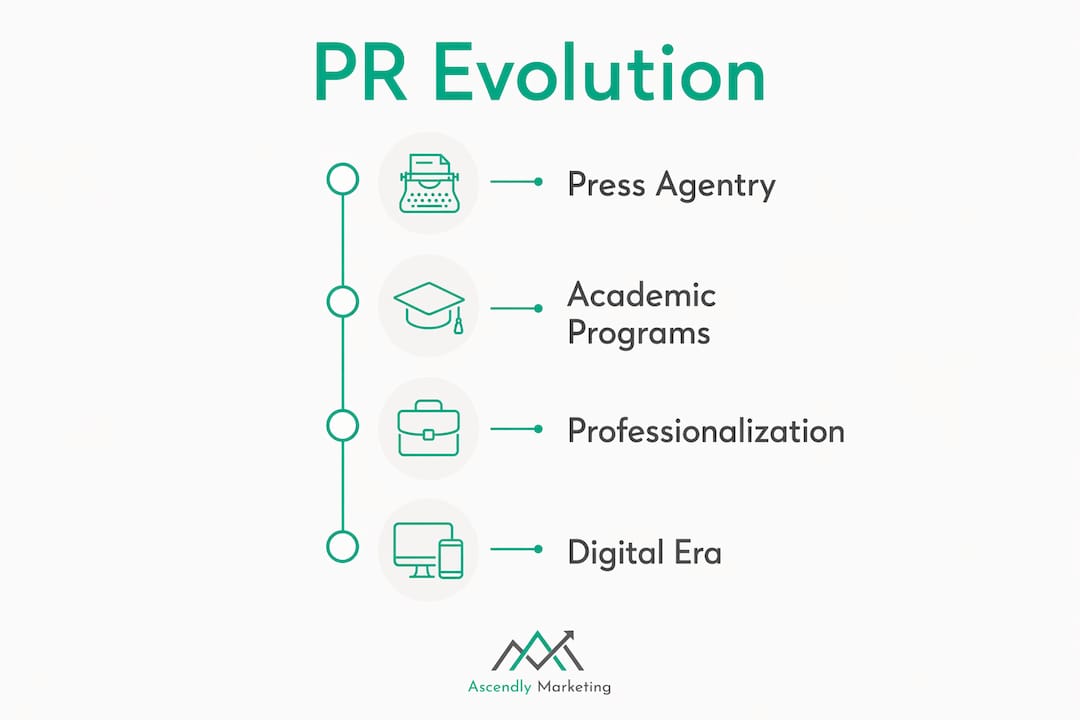
The digital era changed everything about pace and reach. A story that once took days to spread through newspapers now travels in minutes. PR professionals today work in a 24-hour news cycle, managing reputations across platforms that did not exist a generation ago. The core mission, building trust through honest communication, has not changed. The tools and speed have.
What do PR professionals actually do every day?
The PRSA outlines 12 key competencies for PR professionals, ranging from acting as trusted counsel to senior leadership, to executing publicity programs and managing community relationships. In practice, the job looks different depending on the organization, but certain responsibilities show up consistently across the field.

PR professionals serve as strategic advisors to management, helping executives understand how decisions will land with the public before those decisions are announced. That advisory role is one of the most underappreciated parts of the job. A PR professional who only writes press releases is doing a fraction of the work.
The day-to-day functions typically include:
- Media relations: Building relationships with journalists, pitching stories, and responding to press inquiries
- Content creation: Writing press releases, bylined articles, speeches, and talking points
- Crisis communication: Developing response plans and managing messaging during emergencies
- Issues management: Monitoring public sentiment and flagging emerging concerns
- Community engagement: Representing the organization at events and building local goodwill
- Internal communications: Drafting employee newsletters, managing intranet content, and supporting leadership communications
- Research and measurement: Using the RPIE process (Research, Plan, Implement, Evaluate) to set goals and document impact
- Social media management: Monitoring brand mentions, engaging audiences, and managing reputation online
The RPIE framework is worth pausing on. It treats PR as a cyclical, measurable process rather than a series of one-off tactics. Research informs the plan; the plan guides implementation; evaluation feeds back into the next research phase. Organizations that skip the research and evaluation steps tend to run PR campaigns that feel disconnected from actual audience needs.
Pro Tip: If you want to demonstrate PR’s value to leadership, document your baseline reputation metrics before any campaign launches. Without a before-and-after comparison, proving impact is nearly impossible.
Why “publics” is the right word, and what it actually means
The term “publics” trips up a lot of people who are new to the field. It sounds like a grammatical error, but it is deliberate. PRSA clarifies that “publics” is preferred over “stakeholders” because it captures the broad, public-facing nature of PR work rather than the narrower financial connotation that “stakeholders” carries.
A stakeholder, in the traditional business sense, is someone with a financial or legal interest in an organization. Publics are far wider. They include anyone whose relationship with the organization matters, whether or not money is involved.
“Public relations is a strategic communication process that builds mutually beneficial relationships between organizations and their publics.” This definition, adopted by PRSA, deliberately uses “publics” to reflect the full range of groups an organization must engage, from customers and employees to regulators, journalists, and community members.
Publics shift depending on the issue. A pharmaceutical company’s publics during a drug recall include patients, physicians, regulators, journalists, and investors. During a community sponsorship announcement, the relevant publics might be residents, nonprofit partners, and city officials. The same organization, different situations, entirely different audiences.
Understanding your publics shapes every PR decision:
- Geographic publics: Local communities, regional stakeholders, national audiences
- Functional publics: Employees, suppliers, distributors, and business partners
- Normative publics: Trade associations, professional groups, and regulatory bodies
- Diffuse publics: Media, activist groups, and the general public
Mapping your publics before launching any communication effort is not optional. It determines the message, the channel, and the tone.
How public relations differs from marketing
The simplest way to draw the line: marketing drives sales, PR builds trust. Both matter, but they operate on different timelines and through different mechanisms. Marketing focuses on revenue through paid and owned channels. PR earns credibility through unpaid, third-party endorsements, the kind that money cannot directly buy.
A full-page ad tells people your product is great. A glowing review in a respected publication tells them someone independent thinks so. The second carries more weight, and it is harder to get. Earned media coverage is recognized as one of the most valuable assets in business communication precisely because it relies on independent validation rather than controlled messaging.
Here is how the two disciplines compare across key dimensions:
- Primary objective: PR builds reputation and trust over time. Marketing generates leads and conversions.
- Channel type: PR works through earned media, third-party coverage, and organic relationship-building. Marketing uses paid ads, email campaigns, and owned content.
- Timeline: PR is a long-term investment. Marketing can produce measurable results in days or weeks.
- Measurement: PR tracks reputation metrics, media sentiment, and share of voice. Marketing tracks clicks, conversions, and return on ad spend.
- Control: Marketers control the message completely. PR professionals pitch and advocate, but editors and journalists decide what runs.
PR is a critical management function, not a tactical add-on to a sales campaign. Agency leaders consistently make this point: organizations that treat PR as a quick-fix for slow sales misunderstand what it does. PR builds the credibility assets that protect a brand during a crisis and open doors during a market entry. That kind of equity takes years to build and can disappear in a news cycle if it is not maintained.
The smartest approach is integration. Earned media from PR amplifies marketing campaigns by lending credibility that paid channels cannot manufacture. A brand that has both a strong PR foundation and a well-funded marketing operation moves faster and recovers from setbacks more cleanly than one that relies on either alone. Explore how PR and digital marketing strategies work together to build that kind of compounded visibility.
Pro Tip: When pitching PR to a skeptical executive, frame it around risk, not just opportunity. Ask: “If a crisis hit tomorrow, what credibility assets do we have with journalists and the public?” That question usually lands.
Ethical considerations in public relations
Ethics sit at the center of PR practice, not at the edges. The entire premise of public relations, that an organization can earn trust through honest communication, collapses the moment that communication becomes deceptive. PRSA maintains a formal Code of Ethics built around six core values: advocacy, honesty, expertise, independence, loyalty, and fairness. These are not aspirational slogans. They define what separates a PR professional from a propagandist.
Several ethical tensions come up repeatedly in the field. Transparency is the most common pressure point. Organizations often want to control information, delay disclosure, or frame bad news in ways that minimize damage. PR professionals are frequently the people in the room arguing for disclosure, because they understand that a cover-up discovered later does far more damage than the original problem. The Tylenol crisis of 1982 remains the textbook example: Johnson & Johnson’s decision to communicate openly and act decisively protected the brand in ways that stonewalling never could have.
Conflicts of interest are another live issue, particularly for PR agencies that represent multiple clients in the same industry. A PR firm advising a pharmaceutical company and a patient advocacy group simultaneously faces a structural conflict that no amount of good intentions resolves cleanly. Most professional codes require disclosure and, in many cases, recusal.
The rise of social media has added new ethical terrain. Astroturfing, creating fake grassroots movements to simulate public support, is widely condemned but still practiced. Undisclosed paid partnerships between brands and influencers violate Federal Trade Commission guidelines and erode the very credibility PR is supposed to build. Managing social media reputation ethically means being transparent about who is speaking and why, even when that transparency is inconvenient.
Ultimately, ethical PR is not just the right thing to do. It is the only version of PR that works over time. Organizations that cut ethical corners tend to find that the short-term gains are not worth the long-term exposure.
Key Takeaways
Public relations is a strategic communication discipline focused on building earned trust between organizations and their publics, and it is distinct from marketing in both method and purpose.
| Point | Details |
|---|---|
| Core definition | PR builds mutually beneficial relationships between organizations and their publics through strategic communication. |
| PR vs. marketing | Marketing drives sales through paid channels; PR earns credibility through third-party endorsements and reputation management. |
| Professional scope | PR professionals follow the RPIE process (Research, Plan, Implement, Evaluate) to set goals and measure impact. |
| The “publics” concept | “Publics” is preferred over “stakeholders” because it reflects the broad, public-facing groups organizations must engage. |
| Ethics are foundational | Honest, transparent communication is not optional in PR; deception undermines the trust the entire discipline depends on. |
Ready to put PR to work for your business?

Understanding what public relations is only gets you so far. Putting it into practice, consistently, across media relations, crisis preparedness, and community engagement, requires both expertise and time. Ascendly Marketing has been helping small and medium-sized businesses build the kind of credibility that paid advertising alone cannot create since 2013. From digital PR services to full-service digital marketing, the team brings the strategic depth your brand needs to grow and stay protected. Visit Ascendly Marketing to start a conversation about what PR can do for your organization.