

What is competitor analysis and why does it matter?
Competitor analysis is the systematic process of identifying your business rivals and evaluating their strengths, weaknesses, pricing, products, and marketing tactics to inform your own strategic decisions. The U.S. Small Business Administration describes it as a core tool for finding a competitive edge that creates sustainable revenue. Done well, it tells you not just what competitors are doing today, but what their moves mean for your business tomorrow.
A common misconception is that competitor analysis and competitor monitoring are the same thing. Monitoring tracks what rivals are doing right now. Analysis goes further: it translates data into strategy, identifying market gaps and messaging opportunities you can act on. One is a news feed; the other is a decision-making tool.
The core elements you assess in a thorough competitor analysis include:
- Strengths and weaknesses of each rival (product quality, customer service, brand reputation)
- Pricing structure and any discounting or bundling tactics they use
- Product or service features compared to your own offerings
- Marketing channels they rely on, from paid search to social media to email
- Customer sentiment, gathered from reviews, forums, and social comments
- Market share and positioning, including how they describe themselves versus how customers perceive them
You should account for three competitor types: direct competitors (same product, same audience), indirect competitors (different product, same need), and substitute competitors (entirely different category that still competes for your customer’s budget). Ignoring indirect and substitute rivals is one of the most common blind spots for small business owners.
Why competitor analysis gives SMBs a real edge
For a small or mid-sized business without a dedicated research team, competitor analysis can feel like a luxury. It isn’t. The U.S. Chamber of Commerce frames it as a foundational step in building any viable business strategy, and the benefits show up in concrete, practical ways.
- Spot market gaps before rivals do. When you map what competitors offer, you often find customer needs they’re ignoring. That gap is your opening.
- Sharpen your messaging. Knowing exactly how rivals position themselves lets you craft a pitch that highlights what makes you different, not just what you do.
- Price with confidence. Surface-level pricing comparisons miss the full picture, but a structured analysis of competitor pricing tiers, bundles, and hidden fees helps you set rates that are both competitive and profitable.
- Avoid being blindsided. A competitor launching a new feature or dropping prices can gut your sales if you didn’t see it coming. Regular analysis keeps you aware.
- Improve customer targeting. Studying who buys from competitors, and why, sharpens your own audience definition and ad spend.
- Make faster, better decisions. When you have current, organized data on rivals, you stop guessing and start choosing based on evidence.
The practical reality for SMBs is that complexity is the enemy here. A focused comparison of your top three to five competitors, updated regularly, delivers more value than an exhaustive annual report that nobody reads twice. Simplicity with focus beats thoroughness with paralysis.
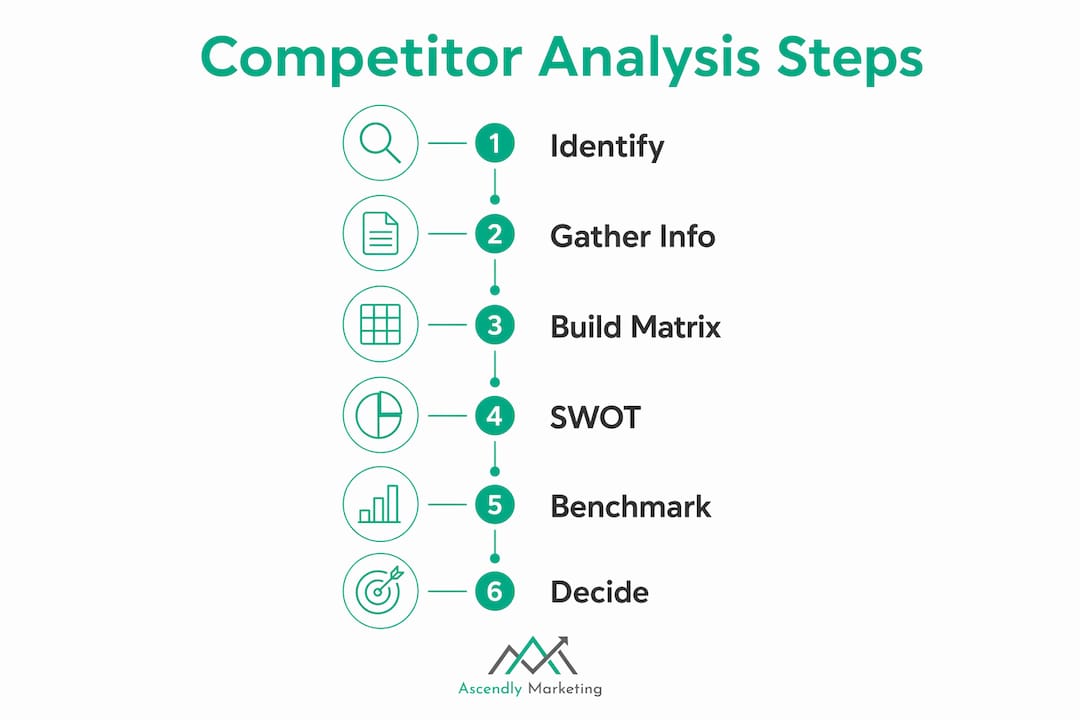
How to conduct competitor analysis in six steps
The six-step framework from the U.S. Chamber of Commerce gives SMBs a repeatable process that doesn’t require a research budget. Here’s how to run it.
Step 1: Identify your competitors
Start broader than you think you need to. List your direct competitors first, then add indirect ones (businesses solving the same customer problem a different way) and substitute competitors (alternatives your customers might choose instead of any business in your category). In niche markets where direct rivals are scarce, analyzing substitute competitors and analogous markets helps establish benchmarks and positioning.
Step 2: Gather competitive intelligence
For each competitor on your list, collect data across these areas:
- Digital presence: Website quality, SEO visibility, social media activity, ad spend signals
- Product or service details: Features, quality, guarantees, and any unique capabilities
- Pricing: Published rates, trial offers, and bundling
- Marketing channels: Where they advertise, what content they publish, how often
- Customer feedback: Google reviews, Yelp, Reddit threads, and industry forums
Free tools like Google Search, Google Alerts, and your rivals’ own websites cover most of this. For deeper SEO and content insights, tools like Google Search Console (for your own data) and publicly available SEO platforms help you understand keyword gaps. A guide on SEO competitor analysis walks through how to benchmark digital presence and search visibility specifically.
Step 3: Build a competitor comparison matrix

Organize everything in a spreadsheet. A simple matrix with competitors as columns and key attributes as rows gives you a visual snapshot that’s easy to update. Here’s a starter format:
| Attribute | Your Business | Competitor A | Competitor B | Competitor C |
|---|---|---|---|---|
| Core product/service | ||||
| Price range | ||||
| Key features | ||||
| Primary marketing channel | ||||
| Customer rating (avg.) | ||||
| Unique selling point | ||||
| Obvious weakness |
Fill in every cell with facts, not opinions. If you don’t know something, mark it as unknown and find out.
Step 4: Run a mini SWOT for each key competitor
For your top three to five rivals, write a brief SWOT: what are their genuine strengths, where do they fall short, what market opportunities are they positioned to capture, and what threats could hurt them? Keep each one to a single page. The goal isn’t a comprehensive profile; it’s a clear picture of where they’re strong and where they’re exposed.

Step 5: Benchmark your offerings
Compare your pricing tiers, features, and sales process directly against each competitor. Be honest. If a rival’s onboarding is faster or their support hours are longer, note it. This step often surfaces the most uncomfortable truths and the most useful ones.
Step 6: Turn insights into decisions
This is where most SMBs drop the ball. They gather data, build the matrix, and then file it away. The point of the whole exercise is to make a specific move: adjust your pricing, rewrite your homepage headline, launch a feature a competitor is missing, or shift ad spend to a channel they’re ignoring. Every analysis session should end with at least one concrete next action.
Pro Tip: Set a recurring calendar reminder to update your competitor matrix every quarter. A 90-minute quarterly review beats a 40-hour annual overhaul every time, and it keeps your strategy current without burning you out.
How competitor analysis and SWOT analysis work together
Competitor analysis and SWOT analysis are related but distinct tools, and confusing them costs you the benefit of both. Competitor analysis focuses externally on market rivals, while SWOT blends internal factors (your own strengths and weaknesses) with external ones (opportunities and threats in the market). They’re complementary, not interchangeable.
Here’s how they connect in practice:
- Competitor analysis feeds SWOT directly. The threats and opportunities sections of your SWOT should draw heavily from what you learn about rivals. If a competitor is gaining ground in a segment you’ve ignored, that’s a threat. If they’re weak on customer support and your reviews are strong, that’s an opportunity.
- They run on different schedules. Your SWOT might get a full review once or twice a year, tied to annual planning. Your competitor matrix should update quarterly, or whenever a rival makes a significant move. Keeping them as separate documents with different update cycles gives you more agility than merging them into one unwieldy file.
- SWOT without competitor data is guesswork. Many small business owners fill in the “threats” box with vague fears rather than specific, evidence-based observations. Competitor analysis fixes that.
- Together, they produce a fuller strategic picture. Your SWOT tells you what you’re capable of and what the market looks like broadly. Your competitor analysis tells you exactly who you’re up against and where the openings are.
Think of competitor analysis as the research phase and SWOT as the synthesis phase. Run them in sequence, not in isolation.
Common mistakes that undermine competitor analysis
Most competitor analysis efforts fail not because the data is hard to find, but because of predictable process errors. Here’s what to watch for, and how to fix each one.
- Tracking too many competitors. A list of 20 rivals produces noise, not insight. Focus on five or fewer, and revisit the list quarterly.
- Ignoring indirect and substitute competitors. The business that steals your customer might not be in your category at all. A local gym loses clients to YouTube fitness channels. A tax preparer loses them to DIY software. Map the full competitive landscape.
- Surface-level pricing comparisons. Listing a competitor’s headline price without accounting for setup fees, contract length, or included features gives you a misleading picture. Compare total cost of ownership, not sticker price.
- Treating the analysis as a one-time project. Markets shift. Outdated assumptions are one of the most common reasons entrepreneurs get caught off guard by a competitor’s move. Build in regular updates from the start.
- Opinion-based SWOT entries. “Our competitor has bad customer service” is an opinion. “Our competitor has a 3.2-star average on Google with 47 reviews citing slow response times” is evidence. Base every SWOT entry on something you can point to.
- No actionable outcome. Analysis that doesn’t end in a decision is just expensive reading. Every session should produce at least one specific change to your product, pricing, messaging, or marketing.
- Competitor obsession. Watching rivals too closely can pull your attention away from your own customers. Use competitor data to inform your strategy, not to copy it. The goal is to understand market gaps and serve customers better, not to mirror what rivals do.
Pro Tip: After each quarterly update, write one sentence: “Based on this analysis, we will [specific action] by [specific date].” If you can’t write that sentence, the analysis isn’t done yet.
What types of competitor analysis should you run?
Not all competitor analysis serves the same purpose. Knowing which type to run, and when, saves time and produces sharper results.
Direct vs. indirect competitor analysis is the most common distinction. Direct analysis focuses on businesses offering the same product or service to the same audience. Indirect analysis examines businesses solving the same customer problem through a different approach. Both matter, but they answer different questions.
Strategic vs. tactical analysis operates on different time horizons. Strategic analysis looks at long-term positioning: where is a competitor headed, what markets are they entering, how are they building their brand? Tactical analysis zooms in on near-term moves: what keywords are they bidding on this month, what promotions are they running, what did they just launch? SMBs typically need both, but the tactical layer is where most day-to-day decisions get made.
Digital presence analysis has become its own discipline, covering SEO rankings, content strategy, social media engagement, and paid advertising. For businesses competing online, understanding how rivals rank for key search terms and what competitor content strategies look like is often the highest-leverage analysis you can do. Pairing this with data-driven marketing practices amplifies the impact.
Pricing and product analysis compares feature sets, pricing tiers, and value propositions head-to-head. This type is most useful when you’re preparing to launch a new offering or reposition an existing one.
Run the type that matches the decision you’re trying to make. Mixing all four into every session creates volume without clarity.
How to turn competitor data into actual strategy
Gathering data is the easy part. The harder skill is reading what it means and deciding what to do about it.
Start by looking for patterns across competitors, not individual data points. If three out of five rivals have poor mobile websites, that’s a market-wide gap you can exploit. If all of them are running Google Ads but none are active on LinkedIn, that might signal an untapped channel, or it might mean LinkedIn doesn’t convert in your category. Context matters.
Next, map findings to your own position. Where a competitor is strong, and you’re weak, you have a vulnerability to address. Where they’re weak, and you’re strong, you have a message to amplify. Where nobody in the market is strong, you have a potential differentiator to build. This mapping exercise is where competitor data connects directly to your marketing analytics and growth planning.
Prioritize by impact and effort. Not every gap is worth closing. A competitor’s weakness in a market segment you don’t serve isn’t an opportunity for you. Focus on the findings that connect to your actual customers and your actual revenue goals.
Finally, assign ownership and a deadline to every action item. “We should improve our onboarding” is not a strategic outcome. “We will add a 15-minute welcome call to our onboarding process by the end of next month” is.
Real-world examples of competitor analysis in action
Competitor analysis works across industries and business sizes. A few concrete examples show how the process plays out.
A regional accounting firm noticed through quarterly competitor reviews that two local rivals had stopped publishing educational content on their websites. The firm doubled its blog output, targeting the same search terms those rivals had abandoned. Within two quarters, organic traffic had grown enough to generate a measurable increase in consultation requests, without any increase in ad spend.
A small e-commerce retailer selling outdoor gear used a competitor pricing matrix to discover that rivals were charging a premium for expedited shipping while offering free standard shipping. The retailer restructured its shipping options to match the free standard tier and saw cart abandonment drop noticeably in the following month.
A solo marketing consultant used substitute competitor analysis to realize that her real competition wasn’t other consultants. It was DIY tools and template marketplaces that let clients build their own campaigns. She repositioned her services around strategy and oversight rather than execution, targeting clients who had already tried the DIY route and found it lacking. That pivot changed her client acquisition entirely.
These examples share a common thread: the analysis produced a specific insight, and that insight drove a specific decision. That’s the standard every competitor analysis effort should meet.
Key Takeaways
Competitor analysis is most valuable when it produces a specific decision, not just a document.
| Point | Details |
|---|---|
| Definition and scope | Competitor analysis systematically evaluates rivals’ strengths, weaknesses, pricing, and tactics to guide your strategy. |
| Three competitor types | Always assess direct, indirect, and substitute competitors to avoid blind spots in your market view. |
| Six-step process | Identify rivals, gather intelligence, build a matrix, run mini SWOTs, benchmark offerings, then act on findings. |
| SWOT integration | Competitor analysis feeds the Opportunities and Threats sections of SWOT; keep them as separate, complementary documents. |
| Quarterly updates | Break analysis into regular, focused reviews rather than one exhaustive annual report to stay current without burnout. |
Ready to put competitor insights to work?

Understanding your competitors is one thing. Turning that knowledge into a marketing strategy that actually grows your business is another. Ascendly Marketing has helped SMBs across the United States do exactly that since 2013, combining competitive research with SEO, paid advertising, content, and web design into plans that produce measurable results.
If you’re ready to stop guessing and start competing with real data behind you, explore Ascendly Marketing’s services or visit Ascendlymarketing.com to book a consultation.