

Most advice on keyword count gives you the same shrug: it depends. That answer isn’t useful when you’re planning pages, assigning topics, and trying to decide whether one URL should target five terms or fifty.
A better answer starts with page architecture. Modern SEO isn’t a guessing game about how many phrases you can squeeze into a page. It’s a structure problem. Each keyword type has a job, each page needs a clear purpose, and your site works better when those pieces don’t compete with each other.
The End of Vague SEO Advice
The old version of SEO trained people to think in totals. How many keywords should I use for SEO? How many times should I repeat them? How many variations can fit on one page?
That framing leads to messy pages.
A page doesn’t rank because it contains a pile of keywords. A page ranks when search engines can tell what that page is for. That’s why the most useful starting rule is simple: one page gets one main focus. Everything else supports that focus.
This change didn’t happen by accident. The standard approach shifted after Google’s major algorithm changes in 2011 and 2013, when search moved toward semantic understanding and content intent instead of crude exact-match counting, as outlined in this review of modern keyword strategy.
The question to ask instead
Don’t ask, “How many keywords can I use on this page?”
Ask these instead:
- What is this page mainly about
- What search intent should it satisfy
- Which related ideas help complete that answer
- Would another page on my site do this job better
That shift clears up most confusion. If a service page tries to rank for web design, SEO, PPC, branding, and email marketing all at once, the page sends mixed signals. If that same page focuses on one core term and supports it with closely related phrases, the topic stays clear.
Practical rule: A page needs a single main subject, not a shopping cart full of unrelated keyword targets.
If search intent still feels fuzzy, this guide to understanding search intent to win at SEO in 2026 gives the missing layer. Intent decides whether your page should teach, compare, sell, or answer.
Understanding Your Keyword Toolkit
Keyword strategy gets easier when you stop treating all keywords as the same thing. They’re not. Think of them like parts of a well-organized book. You have one title, several subheadings, specific phrases readers look for, and related terms that help explain the topic fully.
Understand the distinct roles of keywords to build an effective SEO strategy.

Primary keywords
Your primary keyword is the page’s central theme. It tells search engines and readers what the URL is mainly about.
If your article is about “email marketing software for nonprofits,” that phrase is the main target. It belongs in the title, the introduction, and the major framing of the page. It isn’t one topic among many. It is the topic.
According to Search Atlas on keyword architecture, expert consensus calls for one primary keyword per page plus 2 to 4 semantically related secondary keywords, and that structure can cover 90% of user intents for the topic.
Secondary keywords
Secondary keywords support the main term. They aren’t separate campaigns living on the same page. They’re subtopics and close variations.
For that same page, secondary terms might include related feature phrases, use-case modifiers, or closely connected questions. They deepen the page without changing its purpose.
A practical way to think about them:
- Primary keyword keeps the page on one lane
- Secondary keywords widen that lane slightly
- Unrelated keywords send the page into oncoming traffic
If you work in software or recurring-revenue markets, good SaaS keyword research strategies show this clearly. Strong SaaS content usually maps one buying-stage topic to one page, then builds support terms around product context, pain points, and use cases.
Long-tail and semantic keywords
Long-tail keywords are more specific searches. They often reveal sharper intent. Someone searching a longer phrase usually knows more about what they want.
Semantic keywords are related concepts, entities, and natural-language variations that help search engines understand the full context. They broaden relevance without forcing repetition.
A healthy page doesn’t read like a keyword list. It reads like a complete answer.
If you need a practical process for finding the right mix, this article on how to choose keywords for search engine optimization is useful because it helps sort broad terms from realistic page targets.
Applying The One Page One Focus Rule
The clearest answer to how many keywords should I use for SEO on one page is this: One primary keyword.
That’s the essential part.

When a page tries to rank for several primary topics, it usually ends up vague. A service page can’t be the definitive answer for local SEO, e-commerce SEO, technical SEO, and link building at the same time. Those are separate intents. Separate pages handle them better.
What support looks like in practice
The one-focus rule doesn’t mean one keyword appears alone. Support terms still matter. The question is how many.
A widely used framework described in this guide to keyword count by content length recommends:
| Content length | Keyword structure |
|---|---|
| 300–500 words | 1 primary plus 3–5 secondary keywords |
| 1,500–2,000 words | 1 primary plus 12–15 secondary keywords |
That same framework says to keep keyword density below 2%.
This makes sense when you look at page purpose. A short page has less room, so it needs tighter focus. A longer guide has space to answer related questions, define terms, compare options, and include supporting variations without drifting off topic.
A quick page-mapping example
Say you run a landscaping company. You might be tempted to build one page for:
- lawn care
- irrigation repair
- tree trimming
- drainage solutions
- outdoor space design
That creates one crowded page with mixed intent.
A cleaner setup looks like this:
- Page 1 targets lawn care services
- Page 2 targets irrigation repair
- Page 3 targets tree trimming
- Page 4 targets drainage solutions
- Page 5 targets outdoor design
Each page gets one clear primary keyword. Then each page adds secondary phrases that belong to that topic only.
For a visual explanation of page focus and placement, this video does a good job of showing how keyword targeting works in real content:
One URL should answer one main search need. That’s how you avoid intent confusion.
Calculating Keyword Density Without Stuffing
Keyword density sounds technical, but the math is simple. You take the number of times your primary keyword appears, divide it by the total word count, and convert that into a percentage.
If the phrase appears 10 times in a 1,000-word article, the density is 1%.
That old obsession with repeating the exact phrase over and over doesn’t hold up anymore. Modern guidance puts the useful range lower than many people expect.
The range that keeps content natural
According to HubSpot’s explanation of keyword density, keyword density should stay between 0.5% and 1.5%. For long-form content of 1,500 to 3,000+ words, that scales to 10 to 20 primary uses with 4 to 6 secondary keywords, and the main term appears roughly once or twice per 100 words.
That gives you a working rule without forcing robotic writing.
Here is the practical version:
- Shorter content needs restraint because repetition becomes obvious quickly
- Longer content gives you more room, so a higher raw count can still feel natural
- Readability decides whether your density is working
A simple check you can run
Use this quick process before publishing:
- Count the words on the page.
- Find the primary term and note how many times it appears.
- Calculate the percentage.
- Read the piece out loud. If repeated phrases sound awkward, revise them.
You can also scan headings, image alt text, and body copy to see whether the keyword distribution feels forced in one area and absent in another.
If a keyword appears often but adds no clarity, cut it.
For broader on-page placement guidance, this article on on-page SEO for small business success helps connect density with titles, headings, and content structure.
Mapping Keywords Across Your Entire Website
A website doesn’t need a random total number of keywords. It needs a map.
Think of your site like a library. Each page is a separate book with one clear subject. Those books still belong in larger sections, and the catalog should make those relationships obvious. SEO works the same way.
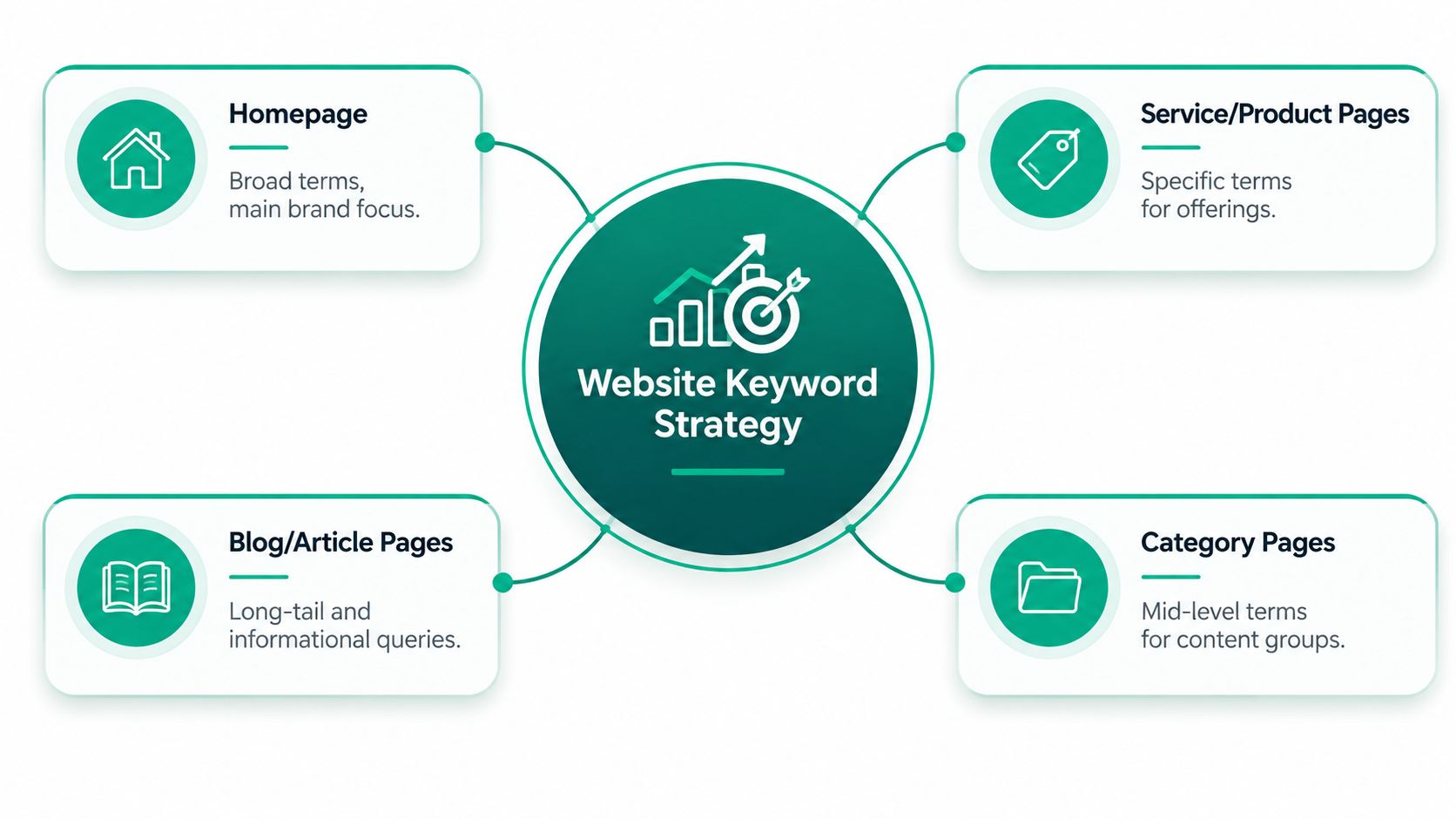
Page roles across the site
Different page types should target different levels of specificity.
| Page type | Best keyword role |
|---|---|
| Homepage | Broad brand and category terms |
| Service or product pages | Specific commercial terms |
| Blog articles | Informational and long-tail queries |
| Category pages | Mid-level topic terms |
This prevents a common problem: two or more pages on your own site chasing the same target. That’s how cannibalization starts. One page should own one main term. Another page should take the adjacent subtopic, not the same one with slightly different wording.
Topic clusters create order
A cluster model solves this neatly. You build one broader pillar page around a main theme, then support it with more specific pages that answer related questions or narrower intents.
The broad page covers the topic at a high level. The supporting pages go deeper on distinct subtopics and link back to the main resource.
According to this overview of page-level and cluster-level keyword planning, each page should target exactly one primary keyword, and an extensive topic page may use 5 to 15 well-defined keyword clusters to cover 90% of search intents rather than chase huge lists of raw terms.
A simple mapping method
Start with a spreadsheet or even a plain document. Give every important URL these fields:
- Primary keyword
- Search intent
- Secondary terms
- Closest related page
- Internal links in and out
Then check for overlap. If two pages have the same primary target and the same intent, merge them, split them more clearly, or redefine one page’s purpose.
A strong site map doesn’t give every page more keywords. It gives every page a cleaner job.
Optimizing for a Zero-Density Future
Keyword density still matters in classic search results, but a newer pattern is pushing writers toward a different habit. Repeating exact phrases isn’t the center of the game anymore.
AI-driven search is changing what relevance looks like.

What zero-density really means
A useful contrarian point appears in this analysis of keyword use in AI search results: in 2025–2026, Google’s SGE is described as requiring zero traditional keyword density for ranking, and a 2025 study found pages appearing in AI overviews used 0.3% average keyword density while staying relevant through contextual phrasing and entity coverage.
That doesn’t mean keywords vanish. It means exact-match repetition loses status. AI systems can often understand topic relationships through questions answered, concepts named, and entities connected on the page.
How to write for that environment
A page built for AI visibility tends to do a few things well:
- Answer direct questions with clear, plain wording
- Name related entities such as tools, categories, use cases, or processes
- Structure information cleanly with headings that reflect real user questions
- Use natural variation instead of repeating the same phrase in every paragraph
Consider two versions of the same article. One repeats a target phrase in every section. The other explains the topic clearly, names the important subtopics, defines terms, and answers likely follow-up questions. The second page is usually easier for both people and AI systems to interpret.
The shift in writing style
This changes how you edit. You stop asking, “Did I say the phrase enough?” and start asking, “Did I cover the topic well enough that a system could summarize it accurately?”
Write so a reader can understand the topic quickly, and an AI system can extract the relationships cleanly.
That approach holds up in both worlds. Traditional search still needs focus. AI-driven search rewards context.
If you want help turning this kind of keyword architecture into pages that rank and convert, Ascendly Marketing can help you map page targets, clean up cannibalization, and build a practical SEO structure for your website.