

What is measurable ROI, and why does it matter?
Measurable ROI, formally called Return on Marketing Investment (ROMI), is the financial return generated by a marketing activity relative to what it cost, expressed as a percentage or ratio. The standard formula: Marketing ROI (%) = ((Revenue Attributable to Marketing − Marketing Costs) ÷ Marketing Costs) × 100. Spend $10,000 on a campaign that drives $50,000 in attributed revenue, and your ROI is 400%, or a 5:1 ratio.
A few components shape every calculation:
- Net revenue attributable to marketing: The incremental sales that would not have occurred without the campaign
- Fully loaded marketing costs: Ad spend, agency fees, software, creative production, and staff time
- Attribution method: How credit is assigned across touchpoints
ROI differs from related metrics in ways that matter for budget decisions. ROAS (Return on Ad Spend) measures gross revenue per dollar of ad spend within a single platform. It is a tactical signal, not a business-level measure, and platform-reported ROAS inflates performance because platforms have a structural incentive to show their own channels working. Profit margin tells you what percentage of revenue you keep after costs, but it does not isolate marketing’s contribution. ROI does.
Why measurable ROI is the metric leadership actually trusts
ROI converts marketing activity into the language finance teams use: dollars in versus dollars out. Without it, budget conversations default to impressions, clicks, and engagement rates, none of which tell a CFO whether the spend was worth it.
A 5:1 marketing ROI ratio is widely considered strong. A 10:1 ratio is exceptional. A 2:1 ratio is often insufficient once overhead and cost of goods are factored in.
Why ROI measurement is a credibility issue, not just an analytics exercise: About 40% of marketers cite difficulty measuring ROI as a top barrier, and over 60% struggle with data integration for attribution. When you cannot show ROI clearly, budget defense becomes a gut-instinct argument.
The practical stakes are high. Teams that measure ROI consistently can point to which channels drive pipeline and which consume budget without contributing. Those that cannot measure it tend to defend spend based on activity metrics, which rarely survive a revenue miss.

How to calculate measurable ROI accurately
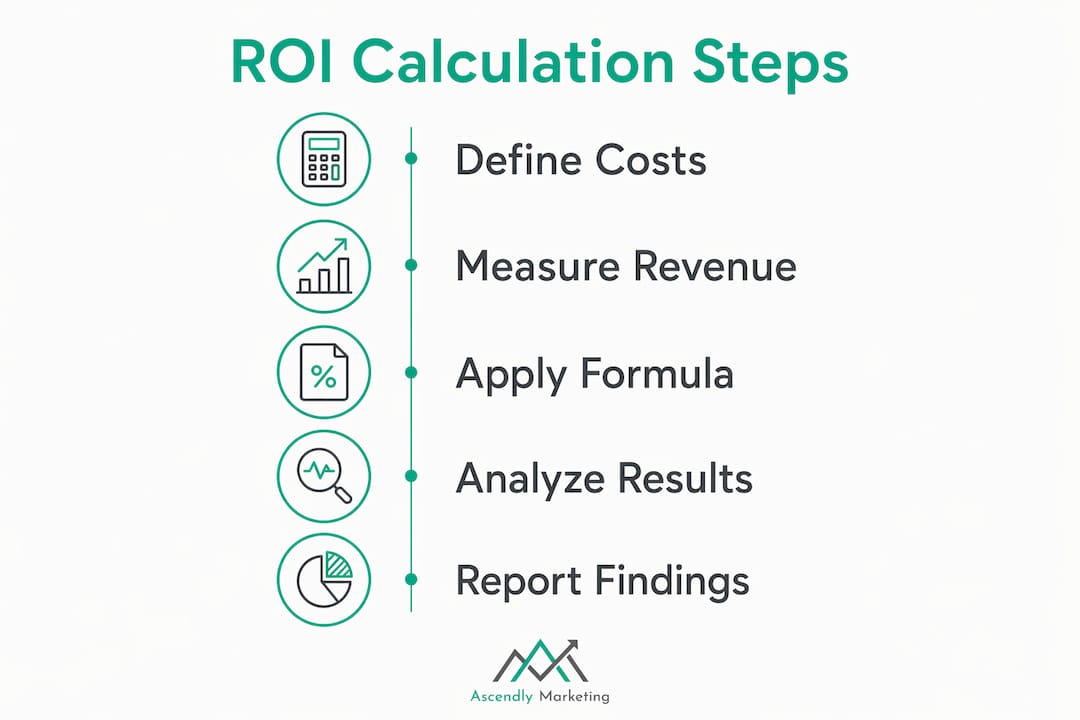
The core formula works across channels:
Marketing ROI (%) = ((Revenue Attributable to Marketing − Marketing Costs) ÷ Marketing Costs) × 100
For a more precise view, use the ROMI formula that accounts for margin:
ROMI = (Incremental Revenue × Contribution Margin % − Marketing Spend) ÷ Marketing Spend
This version strips out the cost of goods, so you are measuring profit contribution rather than gross revenue.
| Scenario | Revenue Attributed | Marketing Cost | ROI |
|---|---|---|---|
| Email campaign | — | — | 400% (5:1) |
| Paid search | — | — | 400% (5:1) |
| Brand content | — | $10,000 | 50% |
| Trade event | — | — | 400% (5:1) |
The brand content row illustrates a common trap. A 50% ROI looks weak in isolation, but brand campaigns generate returns that extend well beyond the measurement window. Cutting them based on short-term ROI alone often costs more than it saves.
Pro Tip: When presenting ROI to leadership, standardize on one expression, either percentage or ratio, across all reports. Mixing “400%” and “5:1” for the same result in the same deck creates confusion and erodes trust in the numbers.
For a step-by-step walkthrough, Ascendly Marketing’s guide on calculating marketing ROI covers formula variations and attribution approaches in detail.
What counts as a good ROI, and how do you read benchmarks?
ROI benchmarks vary by industry, channel, margin profile, and sales cycle. A SaaS company with 80% gross margins can sustain a lower revenue-based ROI than a retailer running at 30%. Context determines whether a number is good or bad.
General benchmarks to orient your targets:
- 10:1 ratio (900%): Exceptional; rarely sustained across full programs
- 5:1 ratio (400%): Strong; a realistic target for well-run campaigns
- 2:1 ratio (100%): Often insufficient once overhead is included
- Below 1:1: The campaign cost more than it returned
Any ROI above 1:1 means the investment returned more than it cost, but “profitable” and “worth doing” are not the same thing. A 1.2:1 ROI on a campaign that consumed your entire Q3 budget is technically positive and practically a problem.
Pro Tip: Never evaluate ROI without knowing the attribution window. A campaign showing a modest 2:1 ratio at 30 days may reach 5:1 at six months, particularly for brand or content investments. Build a second measurement pass at 90 and 180 days into your reporting calendar.
There is no universal benchmark that applies across industries. What matters more than hitting a specific number is whether the estimate reflects genuine incremental value, not just attributed correlation.
What actually distorts your ROI numbers
Most ROI measurement problems are structural, not analytical. The math is simple. Getting clean inputs is not.
More than half of commercial returns from marketing campaigns appear between five and twenty months after the campaign runs, well outside the typical attribution window. A clicks-and-conversions report captures only a fraction of that impact.
Key factors that skew ROI figures:
- Attribution model bias: First-touch and last-touch models dominate despite known limitations. They are easy to implement and explain, but they systematically over-credit the first or final touchpoint and ignore everything in between.
- Platform data conflicts: Disparate platform dashboards use different attribution logic and conversion windows. You cannot add Meta’s reported conversions to Google’s and call it total ROI.
- Data silos: CRM data, ad platform data, and website analytics rarely connect. Revenue events in the CRM never get tied back to the marketing touchpoints that drove them.
- Short attribution windows: Brand-building and upper-funnel content generate returns that attribution tools simply cannot see.
Stat: Data integration affects 61% of marketing teams, making fragmented data the most common structural barrier to accurate ROI measurement.
An over-reliance on easily trackable digital metrics also risks under-investing in brand-building and offline channels that generate long-term value. Channels that are easier to measure get the credit and the budget, even when less measurable work is driving results six months later.
How to improve your ROI measurement in practice
Fixing ROI measurement means fixing the infrastructure, not just the formula.
- Build a single source of truth. Connect your ad platforms, CRM, and analytics so every touchpoint maps to actual revenue. Unified data platforms end the argument about which platform’s numbers are right and make budget reallocation evidence-based rather than political.
- Implement server-side tracking. Server-side tracking sends conversion data directly from your server to ad platforms, bypassing browser blockers. More conversions get recorded, attribution data becomes more complete, and the enriched signals improve platform optimization.
- Compare attribution models side by side. Where last-click, linear, and time-decay models agree, you have high confidence. Where they diverge sharply, you have a signal that a channel is being under-credited or over-credited.
- Invest in both short-term and brand-building activity. Campaigns optimized purely for immediate ROI tend to cannibalize organic demand and starve the brand investments that compound over years.
Pro Tip: Use Marketing Mix Modeling (MMM) alongside your attribution data. MMM statistically isolates each channel’s incremental contribution while controlling for pricing, competition, and external factors, giving you a more reliable ROI estimate than platform dashboards alone.
Ascendly Marketing’s resource on marketing analytics for SMB growth covers how to connect analytics infrastructure to real revenue outcomes.
Expert perspective: What advanced ROI measurement actually looks like
The marketers who consistently defend their budgets are not the ones with the most sophisticated dashboards. They are the ones who treat measurement as a continuous discipline rather than a quarterly report.
“Perfect attribution is a myth. Smart marketers triangulate insights from multiple sources, then use story and signal to drive decisions.” — Katherine Lehman, Fractional CMO at ReturnBear, via CMO Alliance
The evidence-based approach combines two systems: deterministic experiments (A/B tests, holdout groups) for causal proof, and calibrated models like MMM and multitouch attribution for scale. Combining experiments with calibrated models creates a closed-loop measurement cycle: Test, Calibrate, Allocate, Verify, Retest. Each cycle strengthens confidence in the data.
Best practices from high-performing marketing teams:
- Run quarterly measurement cycles built around specific hypotheses, not just reporting periods
- Connect every test to a single business outcome metric, such as incremental revenue or margin
- Use first-party data and hashed identifiers to maintain measurement accuracy as third-party cookies continue to disappear
- Treat ROI as a directional tool for budget reallocation, not a precise figure to be optimized in isolation
Pro Tip: Transparency about measurement constraints builds more leadership trust than false precision. When you explain what the numbers can and cannot capture, and stay consistent quarter over quarter, stakeholders trust the framework even when individual figures shift.
How to report measurable ROI to stakeholders
ROI reporting fails most often not because the numbers are wrong, but because they are presented in the wrong frame. Finance teams think in ratios and incremental value. Marketing teams often report in volume metrics. The gap between those two languages is where budget credibility gets lost.
A few principles that close that gap:
Lead with the business outcome, not the channel metric. “Our Q2 paid search investment generated $240,000 in attributed pipeline at a 4:1 ROI” lands differently than “we drove 1,200 clicks at a $2.40 CPC.” Both are true. Only one answers the CFO’s question.
Show the measurement constraints alongside the number. If your attribution window is 30 days and your sales cycle is 90 days, say so. Acknowledging that the reported ROI likely understates full impact is more credible than presenting a clean number with no context.
Use consistent definitions every quarter. If your ROI calculation changes, explain why. Shifting definitions erode trust faster than a low number does. Consistency in methodology, even an imperfect one, lets leadership track trends rather than argue about inputs.
For longer-cycle campaigns, Ascendly Marketing’s guide on tracking long-term marketing returns covers how to structure reporting cadences that account for delayed commercial impact.
Key Takeaways
Measurable ROI is the most credible metric for connecting marketing spend to business outcomes, but accurate measurement requires unified data, the right attribution approach, and consistent reporting over time.
| Point | Details |
|---|---|
| Core formula | ROI (%) = ((Revenue Attributed − Marketing Costs) ÷ Marketing Costs) × 100 |
| Strong benchmark | A 5:1 ratio (400%) is widely considered strong; 10:1 is exceptional; 2:1 is often insufficient |
| Biggest measurement barrier | Over 60% of teams struggle with data integration, making fragmented data the primary obstacle |
| Attribution window risk | More than half of campaign ROI impact arrives 5–20 months post-campaign, outside most attribution windows |
| Reporting principle | Consistency in measurement methodology builds more leadership trust than precision in any single figure |
Ready to turn your marketing spend into measurable results?

Ascendly Marketing has helped businesses across the United States build measurement systems that connect real spend to real revenue since 2013. Whether you need to fix fragmented attribution, build a reporting framework that holds up in budget meetings, or identify which channels are actually driving growth, the team brings the experience to make it work.
Get measurable results with a team that has done it for over a decade.