

Long-term client relationships convert marketing spend from a recurring cost into a compounding revenue engine. Retain a client for a longer period instead of a shorter one, and you’re not just extending a contract — you’re lowering the effective cost of every dollar you ever spent acquiring them, raising gross margin, and generating referrals that replace paid acquisition. Customer lifetime value (CLV) and CAC payback are the two numbers that prove it. Ascendly Marketing has operated on this principle since 2013, and the math is consistent: retention-focused systems improve forecasting, stabilize cash flow, and produce higher-margin work than any acquisition sprint.
Table of Contents
- What are the real business benefits of long-term client relationships?
- Why does retention-led growth outperform acquisition-led growth?
- How do long-term relationships improve delivery operations?
- A step-by-step playbook to build lasting client relationships
- When do compounding results actually appear in a digital marketing retainer?
- Which KPIs actually prove the value of a long-term relationship?
- What breaks long-term relationships and how do you prevent it?
- How Ascendly Marketing builds long-term client relationships in practice
- Key Takeaways
- The case for relationship architecture over relationship management
- Ascendly Marketing’s retainer model puts this into practice
- Useful sources
What are the real business benefits of long-term client relationships?
The case for retention isn’t abstract. It shows up directly in margin, revenue predictability, and growth velocity.
- Higher CLV per acquisition dollar. A client retained for multiple years at a typical monthly retainer generates significantly more revenue from a single acquisition event. The same CAC that looked expensive early on looks much more justified over time.
- Lower effective CAC. Retaining an existing client costs substantially less than replacing them with a new one of equivalent value for service businesses in a similar revenue range.
- Predictable recurring revenue. Monthly retainers create forecastable cash flow that project billing never can. That stability funds better talent, better tools, and more strategic work.
- Expansion and upsell velocity. Retained clients already trust the process. The threshold for saying yes to an additional service is lower, and repeat clients tend to spend significantly more than first-time buyers.
- Referral generation. Retained clients generate referrals regularly, each entering the pipeline with near-zero acquisition cost.
A small improvement in retention can lift profitability substantially, depending on margin structure, with gains that dwarf typical earnings from new client acquisition efforts.
Why does retention-led growth outperform acquisition-led growth?

Acquisition adds one client at a time. Retention adds lifespan to every client you already have and every client you will ever acquire. That asymmetry is why the economics compound so differently.
Here’s a simplified model. Say your average monthly retainer, gross margin, and client retention combine to produce a certain CLV. Extending average retention through structured onboarding and QBRs can increase CLV significantly with no change in pricing or service scope. Meanwhile, your CAC payback period shortens because the same acquisition investment now funds a longer revenue runway.
- Calculate your current CLV and churn rate by client segment before making any acquisition investment.
- Identify your highest-churn window — for most agencies, it’s months 1–3 — and build a specific intervention for it.
- Model the retention improvement. Reducing annual churn substantially is achievable with structured onboarding and regular communication using tools like ClickCoach for coaching and client onboarding workflows.
- Scale acquisition only after your retention rate is below your industry average. For agencies, that benchmark is below 25% annual churn.
Pro Tip: Before your next new-logo push, run a simple CLV model on your current book. If your average client leaves before month 12, you’re paying full acquisition cost for clients who leave before you recover the investment.
How do long-term relationships improve delivery operations?
The operational gains from continuity are real and often underestimated. Long-term agency partnerships reduce friction — shorter review cycles, less time re-explaining brand voice, faster sprint velocity — because the agency functions as an extension of the client team rather than a vendor being re-evaluated each quarter.
- Shorter review cycles. A client who has worked with your team for 18 months approves creative in hours, not days.
- Richer testing history. You accumulate A/B test results, audience segment data, and channel performance benchmarks that a new agency would spend 6 months rebuilding.
- Consolidated reporting. One integrated dashboard across SEO, paid media, and social replaces the fragmented reporting that comes with multiple point vendors.
- Leadership change protection. CMO and marketing leadership tenure averages under three years, which means an agency can outlast multiple client marketing leaders. Documented strategy and test archives protect continuity when a new CMO arrives with different priorities.
Pro Tip: Maintain a living decision log and test-results archive for every client. When a new marketing director joins, hand them a 10-page current-state document instead of starting from scratch. That document is also your strongest argument against switching agencies.
A step-by-step playbook to build lasting client relationships
The goal is a repeatable system that converts projects into retainers and retainers into expansion. Here’s how to build it.
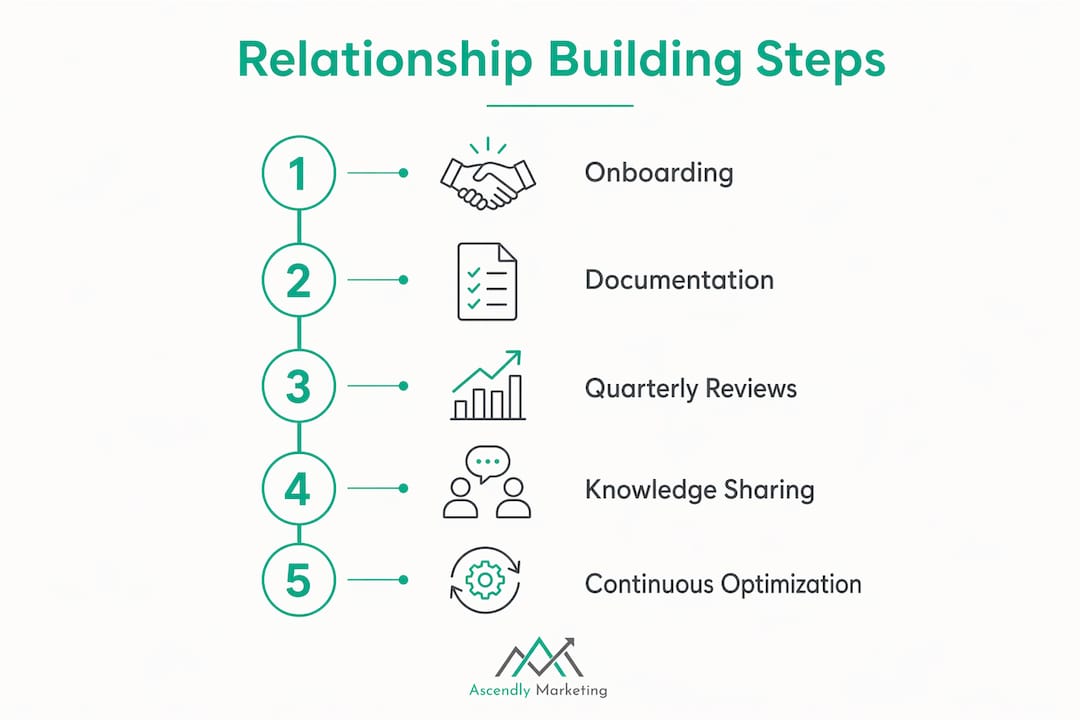
- Relationship-first onboarding. Deliver a current-state strategy document, a KPI alignment worksheet, and a stakeholder map within the first two weeks. Set 30-60-90-day milestones with specific, visible wins. Structured onboarding with early wins produces significantly better 90-day retention than ad hoc kickoffs.
- Weekly operational check-ins. Keep them to 30 minutes. Cover blockers, upcoming deliverables, and one data point that connects work to pipeline.
- Monthly performance summaries. Written, not just verbal. Include channel performance, pipeline contribution, and one strategic recommendation for the next 30 days.
- Quarterly Business Reviews (QBRs) with senior stakeholders. Agencies with structured QBRs tend to have higher gross retention rates than agencies without them. Invite the client’s CFO or CEO at least once per year.
- Productized expansion pathways. Define your next-step offers in advance. “After 6 months of SEO, here’s what a content + paid media layer looks like” reduces negotiation friction and sets clear scope expectations. The fully loaded cost of winning a new client can be 15–25% of the first-year contract value; expanding an existing client costs a fraction of that.
For documentation, maintain four artifacts per client: a decision log, a test-results archive, a pipeline contribution model, and an escalation path for scope changes.
When do compounding results actually appear in a digital marketing retainer?
Compounding effects typically emerge between months 6–18, though the timeline varies by service mix. Paid media can show meaningful results within 60–90 days. SEO and content compound more slowly but produce durable returns that outlast any single campaign.
- Months 0–1: Onboarding, baseline audits, KPI alignment, first quick wins.
- Months 1–3: Early performance data, channel calibration, first monthly summary.
- Months 3–9: Data accumulates, testing history builds, reporting tightens.
- Months 9–18: Compounding inflection — referral velocity increases, expansion conversations open naturally, CAC payback improves.
Retainer-based agencies generally experience lower early attrition compared to project-based models. That gap is largely explained by onboarding quality and communication in the first 90 days.
| Retainer phase | Timeline | Primary focus |
|---|---|---|
| Onboarding | Months 0–1 | Baseline docs, KPI alignment, stakeholder map |
| Early momentum | Months 1–3 | Quick wins, channel calibration, first summary |
| Stabilization | Months 3–9 | Testing history, data compounding, QBR #1 |
| Compounding inflection | Months 9–18 | Expansion, referrals, CAC payback improvement |
Which KPIs actually prove the value of a long-term relationship?
Track revenue-connected metrics, not platform activity. Impressions and click-through rates don’t survive a CFO review. These do.
| KPI | Definition | Formula | Reporting cadence |
|---|---|---|---|
| CLV | Total gross profit from one client | Avg. monthly retainer × margin × retention months | Quarterly |
| CAC payback | Months to recover acquisition cost | CAC ÷ (monthly retainer × margin) | Quarterly |
| Churn rate | % of clients lost in a period | Clients lost ÷ clients at start of period | Monthly |
| Expansion ARR | Revenue added from existing clients | New ARR from upsells and cross-sells | Monthly |
| Pipeline contribution | Revenue influenced by agency activity | Attributed pipeline ÷ total pipeline | Monthly |
In a QBR, lead with pipeline contribution and CAC payback. A new CMO or CFO needs to see business impact in the first 90 seconds, not channel metrics. Clients who can see value articulated regularly renew more reliably than clients left to assess value themselves. Pair each KPI with a trend line, not just a point-in-time number.
- Use marketing analytics to connect channel activity to pipeline, not just to traffic.
- Present churn risk signals proactively, before a client raises them.
- Include a written QBR output that populates a shared knowledge base.
What breaks long-term relationships and how do you prevent it?
Most relationships don’t end because the work was bad. Clients leave because they can’t connect agency output to business results — and because structural changes (budget cuts, leadership turnover, reorganizations) find no documented business case to push back against.
- Missing executive-level reporting. If only the marketing coordinator sees your results, you’re one leadership change away from losing the account.
- Single-stakeholder dependency. Build relationships with at least two client contacts. Executive relationship mapping creates multiple connections that must all break for retention to fail.
- Vague KPIs. “Increase brand awareness” is not a KPI. Pipeline contribution and CAC payback are.
- No test-history archive. When a new CMO arrives and asks “what have you tried?”, the answer needs to be a document, not a conversation.
Pro Tip: Include QBR cadence, documentation deliverables, and an escalation path for scope changes directly in the contract scope. These aren’t nice-to-haves — they’re the structural safeguards that keep a relationship alive through a budget cycle.
Practical contract language to add: a knowledge-base deliverable (strategy snapshot + test archive) due at months 6 and 12; a defined transition period if the engagement ends; and a written expansion clause that outlines next-step services and pricing.
How Ascendly Marketing builds long-term client relationships in practice
Ascendly Marketing has worked with clients across industries since 2013, and the pattern in successful multi-year engagements is consistent: the relationship-first onboarding, the documented test archive, and the QBR cadence are what separate accounts that compound from accounts that churn.
A representative engagement looks like this. A mid-sized B2B company came in with a project brief for a website redesign and paid search launch. Ascendly Marketing delivered a current-state strategy document and KPI alignment in week two, ran a 90-day paid media sprint that produced early pipeline wins, and proposed a retainer covering SEO, content, and ongoing paid media at month three. By month 12, the client’s CAC payback had shortened, and organic pipeline contribution had grown meaningfully. By month 18, the account had expanded to include social media management and marketing consulting.
The case demonstrates the broader principle: documented institutional knowledge protects revenue continuity, and a productized expansion pathway converts early wins into long-term growth. For more examples, see Ascendly Marketing’s digital marketing case studies.
Key Takeaways
Long-term client relationships are the highest-ROI investment in a digital marketing business because retention compounds CLV, lowers effective CAC, and generates referrals that replace paid acquisition.
| Point | Details |
|---|---|
| Retention compounds revenue | Extending client retention duration raises CLV significantly with no pricing change. |
| First 90 days are critical | Retainer-based agencies generally experience lower early attrition compared to project-based models; structured onboarding reduces early churn. |
| QBRs protect the relationship | Structured Quarterly Business Reviews (QBRs) typically lead to significantly higher gross retention rates compared to agencies that do not have them. |
| Track revenue KPIs, not activity | CLV, CAC payback, expansion ARR, and pipeline contribution survive a CFO review; impressions don’t. |
| Ascendly Marketing’s approach | Since 2013, Ascendly Marketing has used relationship-first onboarding, documented test archives, and QBRs to build multi-year retainers that compound client revenue. |
The case for relationship architecture over relationship management
Most agencies treat client relationships as something to manage. The better frame is architecture: design the system, document the knowledge, and build the review cadence before you need them. Reactive relationship management is what produces the 25% annual churn that plagues the industry average. Proactive architecture is what produces industry-leading retention rates among agencies with the highest growth and scale.
The agencies that grow without burning out their teams are the ones that stopped treating retention as a support function and started treating it as the primary growth engine. Every new client you acquire enters a system designed to keep them. Every retained client lowers the cost of the next acquisition. That’s the compounding model, and it’s available to any agency willing to build the architecture.
Ascendly Marketing’s retainer model puts this into practice
Ascendly Marketing offers full-service retainer engagements that include the onboarding documentation, QBR facilitation, and expansion pathways described in this guide. The outcome is predictable, higher-margin revenue for your business — not a one-off campaign that resets the clock every quarter.
Whether you’re a business owner evaluating your first agency retainer or a marketing manager looking to deepen an existing partnership, Ascendly Marketing’s digital marketing services are built around the relationship-first model this guide describes. Book a strategy call to see how the framework applies to your specific growth stage and service mix.
Useful sources
- Client Retention vs. Acquisition: The Math — Pharallax AI
- Building Long-Term Digital Marketing Agency Partnerships — Breef
- Building Long-Term Agency Relationships for B2B SaaS Success — Upraw Media
- Why Agencies Chase New Logos Instead of Growing Existing Clients — Haus Advisors
- Agency Client Retention Metrics: 2026 Benchmarks — Practiq
- Client Retention Statistics for Agencies — Agiled
- Agency Growth Benchmarks: Revenue, Retention & Margin Data — Predictable Profits
- Ascendly Marketing Digital Marketing Case Studies
- Ascendly Marketing Marketing Analytics Guide