

You’re probably sitting on the same problem most small business owners hit. You know video belongs in the mix, you’ve seen competitors post clips, and somebody on your team keeps saying, “We should do more with video.” The question is simpler and harder at the same time. Are you buying cameras and edits, or are you buying a system that gets video planned, published, and measured without wasting months?
That’s where video marketing services stop being a creative nice-to-have and become a business decision. The category has moved into the mainstream. Wyzowl’s 2026 tracking shows 91% of businesses use video marketing, up from 61% in 2016, and 93% of marketers say video is a key part of strategy, according to Siege Media’s summary of the Wyzowl data and market forecast. The market side looks just as serious. Mordor Intelligence estimated the Video Content Marketing Services Market at USD 11.28 billion in 2025, rising to USD 12.88 billion in 2026 and projected to reach USD 25.18 billion by 2031, a 14.35% CAGR, with North America holding 34.56% of global revenue in 2025, also summarized in that same source.
What Matters Most When Hiring Video Marketing Services
A bakery owner, a B2B software founder, and a local contractor can all say they need video. They usually mean different things. One wants more people to know the brand exists. One wants sales reps to send a sharper demo. One wants the phone to ring after a local ad runs. A freelancer can shoot clips. An in-house hire can make a lot of content. Video marketing services are supposed to connect those clips to business outcomes.
The useful question is whether you need scope, accountability, and distribution bundled together. A videographer often owns capture and editing. An in-house marketer may own planning and posting. A service should own the full chain, so the work does not stall once the file is exported.
Four jobs a service should cover
Practical rule: if a vendor cannot say who owns strategy, production, distribution, and analytics, you are buying parts of a process, not a service.
Strategy defines what the video is for, who it is for, and where it belongs.
Production turns the plan into a usable asset.
Distribution gets the asset onto the right platforms in the right format.
Analytics shows whether the video moved prospects toward a sale, a lead, or at least a next step.
Ask vendors what they will deliver in each area. If they only talk about filming days and edit revisions, they are selling a production shop, not video marketing services. If they can outline audience targeting, channel fit, post-publish support, and reporting, you are closer to a working program.
That shift matters because most SMBs do not need a one-off shoot. They need a repeatable program. Once a business moves from “let’s make one video” to “we need ongoing content,” the relationship changes. Budget gets allocated differently. Approval gets faster or slower depending on who owns decisions. The vendor becomes part of the marketing machine, not just a creative supplier.
What a Video Marketing Service Actually Includes
A real service doesn’t stop at filming. It layers strategy, production, distribution, and analytics so the final output can do work after publish day. If one of those layers is missing, the rest usually underperform. A polished video with no channel plan becomes expensive shelf-ware. A good plan with weak editing doesn’t hold attention. A strong edit with no measurement leaves the buyer guessing.
Strategy comes before the camera
Strategy should produce practical deliverables, not vague ideas. Ask for an audience map, a channel plan, and a content calendar. Those three things decide whether the videos are built for LinkedIn, YouTube, paid social, your website, or sales follow-up. If a vendor skips this step, they’re guessing at format, tone, and distribution.
Production turns the plan into usable assets
Production includes scripting, shooting, editing, and versioning. Versioning matters because one cut rarely fits every channel. A vertical clip for social, a horizontal demo for the homepage, and a short cut for retargeting are not the same asset. Good vendors plan for that upfront instead of treating each edit as a surprise change order.
Distribution and analytics finish the job
Distribution means uploads, ad placement, SEO, and syndication. Analytics means more than counting views. You want watch time, assisted conversions, and pipeline attribution if sales is part of the goal. A team that only reports engagement is giving you half a picture.
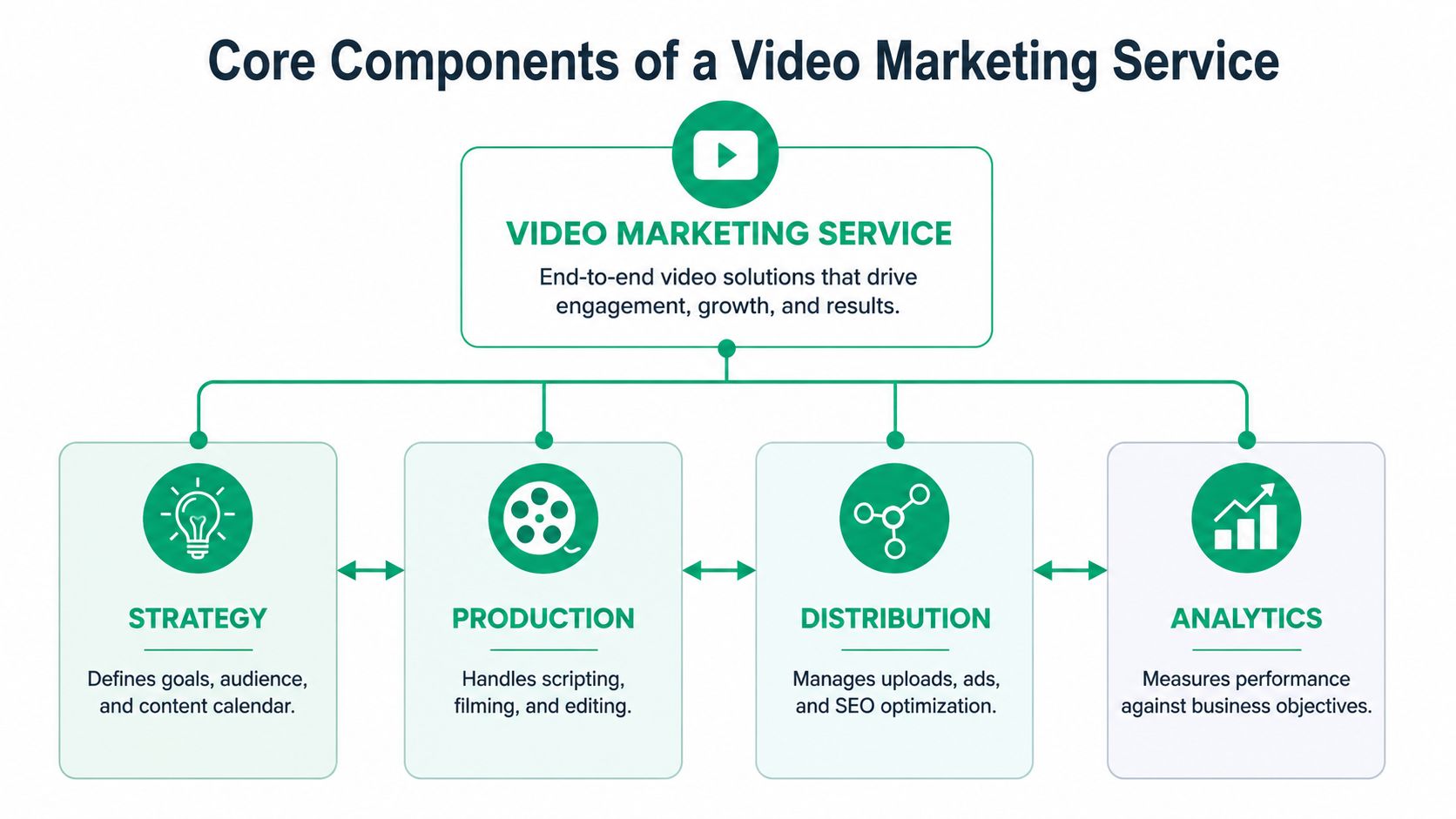
A clean service definition helps you compare vendors on scope, not on slick language. If you’re looking at a production partner and want a wider marketing layer, the service description on Ascendly’s video production for marketing page is a useful example of how those pieces can be framed together. If you need the video itself planned, filmed and edited, see our video production services.
The Main Types of Videos a Service Produces
Different video types solve different problems. A small business usually doesn’t need every format at once, and buying the wrong one wastes budget fast. Brand videos help people understand who you are. Explainers reduce confusion. Demos and tutorials support conversion and retention. Testimonials and case studies add proof. Short social clips keep the funnel active. Event footage and behind-the-scenes content usually serve PR or hiring.
Match the format to the job
A brand video fits early-stage awareness, especially when the buying cycle is long or the category is hard to explain. An explainer works when prospects keep asking, “What do you do?” A product demo or tutorial belongs closer to conversion, onboarding, or support, because it reduces friction after someone has already shown interest.
Customer testimonials and case studies do a different job. They add social proof. They answer the quiet objection that sits in the back of a buyer’s head. That’s why they usually help sales pages, proposal follow-up, and nurture sequences more than top-of-funnel discovery.
Short-form social clips are the workhorse format for reach and remarketing. Mordor Intelligence reported that short-form videos accounted for 60.77% of the video content marketing services market in 2025 and projected 16.56% CAGR through 2031, while Digital Applied’s 2026 data summary says videos under 60 seconds generate 2.5x more engagement per impression than other content types and that 57% of marketing budgets now include a dedicated short-form line item. Those numbers explain why many teams now build around short cuts first, then expand into longer assets.
| Video Formats Matched to Funnel Stage | Funnel Stage | Typical Channel |
|---|---|---|
| Brand video | Awareness | Website, paid social, YouTube |
| Explainer | Awareness to consideration | Landing page, homepage, sales email |
| Product demo | Consideration to conversion | Website, sales deck, onboarding |
| Tutorial | Retention | Help center, customer portal, email |
| Testimonial | Conversion | Sales page, proposal follow-up |
| Short-form clip | Reach and remarketing | TikTok, Reels, Shorts, paid social |
How Strategy, Production, Distribution, and Analytics Work Together
A mature service runs video as a loop, not a one-and-done project. The work starts with concept and scripting, moves into shooting and editing, then shifts into upload, ad placement, and SEO, and ends with reporting that feeds the next brief. If the service treats distribution as an afterthought, the client usually gets pretty assets and weak reach. If analytics are missing, nobody learns what to make next.
The loop that prevents shelf-ware
Concept should answer one question. What does the viewer need to understand or do? Scripting and storyboarding make that answer usable. Production then captures the material in a way that fits later cuts, because most campaigns need more than one version. Distribution then decides where each version lives. A homepage video has a different purpose from a paid social cut, and the edit should reflect that.
A serious monthly report should show more than views and likes. Ask for retention patterns, conversions tied to the video asset, and pipeline contribution where tracking allows it. That’s the level that tells you whether the content helped the business.
Practical rule: if the report doesn’t tell you what to make, what to stop making, and where the video was used, it’s not a reporting system.
For buyers who also run paid media, the distribution side needs to connect with campaign logic. Ascendly’s page on programmatic video advertising is a good reference point for how video can move from a creative asset into an ad format tied to placement and targeting.
Delivery specs matter more than most owners think
Technical quality isn’t optional. LinkedIn sponsored video allows 75 KB to 500 MB files, 3 seconds to 30 minutes duration, and 360 to 1920 px dimensions with aspect ratios from 9:16 to 16:9, according to LinkedIn’s sponsored video specs. The University of North Georgia’s video guidelines recommend 1080p or 4K masters, H.264 distribution, AAC audio, 48 kHz sampling, and frame rates of 24 fps or 30 fps, depending on the use case, in its published video requirements. Good services build for those specs from the start.
How Video Marketing Services Are Priced
Most small businesses will see three pricing models. Monthly retainers cover ongoing work. Per-project fees cover a defined launch or campaign. Performance or hybrid pricing ties part of the bill to outcomes or shared risk. Each model makes sense in a different situation, and each one hides a different kind of cost.
Retainers buy consistency
A retainer fits businesses that need video every month. Think regular social clips, recurring product updates, or a steady stream of sales assets. The advantage is continuity. The downside is that scope needs to stay tight, or you’ll pay for a lot of meetings and revision loops. Budget data shows how mixed real spend can be; Wistia reported that in 2025, 41% of companies spent under USD 20,000 on video promotion and advertising, while 28% spent over USD 20,000, according to Mordor Intelligence’s market summary.
Projects make sense for launches
Project pricing works for one-off needs, like a product launch, a new homepage video, or a testimonial batch. You pay for a defined deliverable, a timeline, and a revision structure. This model is easier to control if you know exactly what you want. It gets messy when the brief keeps changing.
Hybrid pricing needs clean attribution
Performance or hybrid pricing sounds clean, but the buyer still needs a measurement system. That’s where many teams get stuck. If you want a deeper look at how creators think about cost structure in related AI video workflows, what creators pay for AI video gives a useful cost lens to compare with traditional service pricing.
Short version: pay for retainer when you need rhythm, pay for a project when you need a defined outcome, and only chase performance pricing if you can track the outcome cleanly.
Measuring ROI Without Falling for Vanity Metrics
A lot of video pitches lean on views, likes, and shares because those numbers are easy to show. They’re also incomplete. 93% of marketers say video delivers a strong ROI, but 37% cite attribution and measurement as a major challenge, according to Google’s 2026 reporting referenced in this source video. That combination tells you the market wants proof, not applause.

Measure business movement, not just attention
Views and watch time matter, but only as leading signals. The business metrics are assisted conversions, pipeline contribution, and cost per qualified lead. Those tell you whether the video changed buyer behavior. A tutorial that lowers support calls has value. A testimonial that helps close deals has value. A clip that gets clicks but never changes the pipeline doesn’t.
Set tracking before launch. Use UTMs on every link. Tag contacts in the CRM when they hit a video-driven page. Build post-view audiences in ad platforms so you can follow up with people who watched but didn’t convert. Without that setup, attribution turns into a guessing game later.
The right report ties creative to revenue movement. If your vendor can’t show that connection, they’re selling content, not marketing.
How to Choose the Right Video Marketing Agency
A small business can waste a lot of money on a strong-looking video vendor that never clarifies who owns the work. Start with process, not portfolio. A polished reel does not tell you who writes the strategy brief, who handles distribution, or how reporting gets tied back to business goals. Ask those questions before you talk about style. If the answers stay vague, the working relationship will stay vague too.
Questions that reveal the actual process
Who owns the strategy brief? You want one person accountable for audience, message, and channel fit.
Who owns distribution? If the agency stops at delivery, someone else has to handle uploads, ad placement, and SEO.
What reporting cadence do you use? You need a schedule that shows what happened and what changes next.
How do you handle versioning? A service that plans cuts for different platforms saves you a lot of extra work later.
What platform specs do you work from? If they do not know the file and format requirements, quality will suffer.
Ask how they will handle approvals, too. Slow review cycles can drain momentum and turn a clean project into a drawn-out one. You should hear a clear answer about revision limits, turnaround times, and who signs off on final edits. If nobody can explain the workflow, expect delays once the contract is signed.
Red flags to walk away from
A vendor with no measurement plan is guessing. A vendor with no platform spec sheet is winging it. A vendor that leans on stock footage for brand work is probably avoiding the hard part, which is making your business look and sound like your business. If they cannot explain how they will adapt the content to your vertical, the scripts will stay generic.
Price pressure can hide bad service design. Some agencies quote a low production fee, then bill separately for scripting, revisions, cutdowns, captions, uploads, or reporting. That setup looks cheap until the invoice arrives. Ask for a scope that spells out exactly what is included and what triggers extra cost.
A practical due-diligence list is simple. Ask for a sample content calendar, a distribution plan, a reporting template, and examples of work from businesses that resemble yours. For teams comparing service-led options, Ascendly’s digital marketing agency video page is a useful point of reference because it sits in the broader agency category rather than the pure production bucket.
A Recommended Workflow for Small and Mid-Sized Businesses
Start with a month, not a giant campaign. Week one, lock the goal, audience, and message. Week two, script and map assets. Week three, produce and edit. Week four, distribute, review the report, and decide what changes in the next round. That sequence keeps the work grounded in the jobs the video is supposed to do.
The loop restarts every month. If the report shows one format getting traction, make more of that format. If a channel is producing noise but no movement, pull back. The point is steady adjustment, not random posting.
Ascendly Marketing helps small and mid-sized businesses build video into a broader digital growth plan, including strategy, production, distribution, and reporting. If you want a team that treats video as part of measurable marketing instead of a standalone creative task, visit Ascendly Marketing and talk through what a practical video program would look like for your business.