

Multi-channel marketing for SMBs means running a small set of coordinated channels so you reach buyers at every stage of their decision, lower your blended customer acquisition cost, and stop depending on a single traffic source that can disappear overnight. The fastest path to results: get demand-capture running first (Google Search, local listings), then add one demand-creation channel within 60 days.
Here is your immediate action checklist for this week:
- Audit your current channels and identify which ones are capturing existing demand versus building new awareness.
- Set up conversion tracking in Google Analytics 4 and link it to your ad accounts so you have a baseline before spending more.
- Pick one demand-creation channel (paid social or a short CTV test) to layer on top of your capture channels within the next 30 days.
The logic behind this sequence is straightforward. Demand-capture channels like Google Search and Local Services Ads harvest buyers who are already looking for what you sell. Demand-creation channels like YouTube, connected TV, and paid social build awareness among people who are not searching yet. Running both in coordination is what produces the compounding effect most SMBs miss when they run channels independently.
Table of Contents
- Why multi-channel marketing drives growth for SMBs
- How do you build a multi-channel strategy this quarter?
- What technology does your SMB actually need?
- How do you measure performance across channels?
- Ready-to-use campaign playbooks for three SMB types
- How should you allocate a small marketing budget?
- When should you hire an agency versus keep it in-house?
- What legal and privacy rules apply to your multi-channel marketing?
- How do you connect offline and online channels without losing data?
- Key Takeaways
- What we have seen work for SMB clients
- How Ascendly Marketing helps SMBs build and run multi-channel programs
- Useful sources and further reading
Why multi-channel marketing drives growth for SMBs
The business case for coordinated channels comes down to one number: blended customer acquisition cost. When you run channels in isolation, each one carries its full acquisition burden. When they work together, warmed prospects from awareness channels convert faster and cheaper through capture channels.
Campaigns using three or more channels can produce up to approximately 250–287% higher purchase rates compared with single-channel efforts. That is not a marginal improvement. It reflects how buyers actually behave: they see your brand on social, search for you later, and convert through a Google ad or organic listing.
Adding a demand-creation channel to an existing capture-only program often reduces blended cost per customer because warmed prospects convert more efficiently. CTV flights have been shown to lift Google Search ROAS by a notable margin in coordinated campaigns.
The mechanism is simple. A prospect who has already seen your video ad on YouTube or a streaming service recognizes your brand name when your search ad appears. That recognition cuts hesitation. They click, they convert, and your Google Ads ROAS improves without you touching a single bid.
For SMBs with existing customer lists, email frequently yields high ROAS, making it the highest direct-return channel in most programs. Adding SMS to that email program can push total revenue lift by a noticeable amount in benchmarks. Neither channel requires a large budget. Together, they form the retention backbone of any integrated marketing program for small businesses.
Pro Tip: Before you add a new channel, check whether your existing channels share data. If your email platform and your ad accounts are not connected, you are leaving retargeting revenue on the table.
How do you build a multi-channel strategy this quarter?
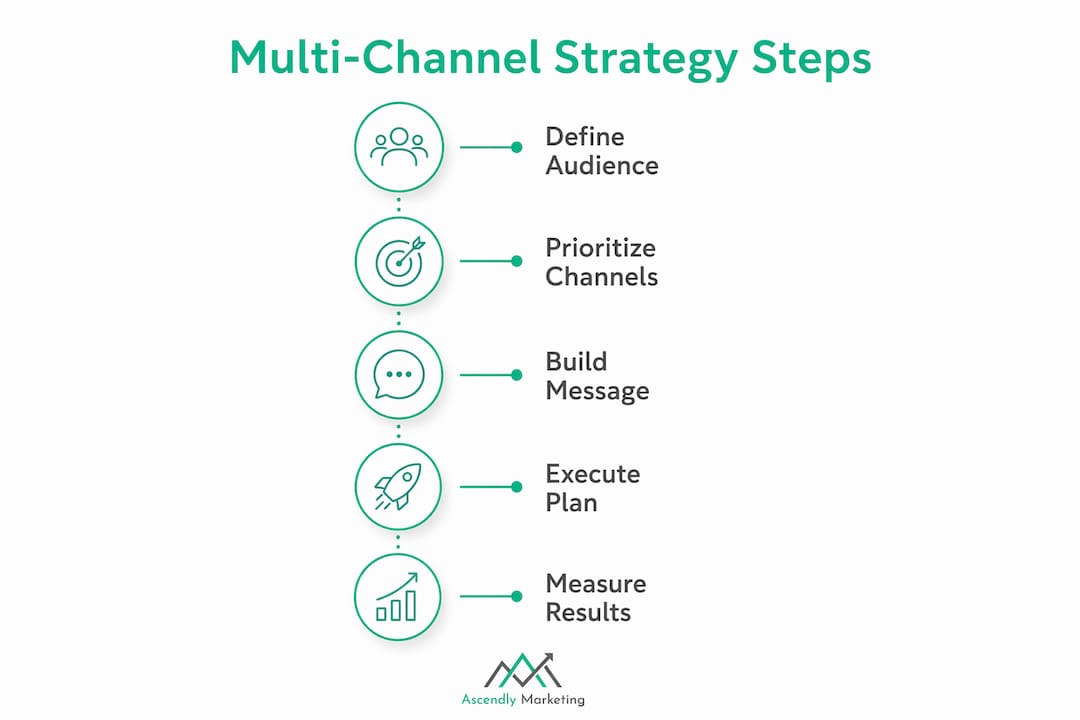
Step 1: Define your audience segments
Most SMBs do not need five personas. Two or three segments, defined by job-to-be-done and channel behavior, are enough to start.

A local service business might segment into: (1) active searchers who are ready to book now, (2) past customers who need a reason to return, and (3) residents who have the problem but have not started searching yet. Each segment needs a different channel and a different message.
Step 2: Prioritize channels with a demand matrix
Channels perform different jobs. Demand-creation channels (YouTube, paid social, CTV) build awareness. Demand-capture channels (Google Search, Local Services Ads, Google Business Profile) harvest active buyers. Both are needed, but the order matters.

| Channel Type | Examples | Primary Job | Recommended Early Budget Share |
|---|---|---|---|
| Demand-capture | Google Search, Local Services Ads, SEO | Harvest active buyers | 50% |
| Demand-creation (social) | Facebook, Instagram, TikTok | Build awareness, retarget | 15–25% |
| Demand-creation (video/CTV) | YouTube, streaming TV | Brand awareness, lift search | 25–35% |
| Retention | Email, SMS | Repeat purchase, LTV | Low cost; prioritize early |
Start with capture. Once your capture channels are converting profitably, shift budget toward creation to grow the top of the funnel.
Step 3: Build your message architecture
One core message. Two channel adaptations. That is the minimum viable message architecture for an SMB.
Your core message is the single reason a customer should choose you over the next option. Every channel adaptation keeps that reason intact but adjusts the format and tone. A Google Search ad is a direct response to a query. A Facebook video ad tells a story. A follow-up email reinforces the promise with social proof.
A practical starting mix for SMBs expanding beyond a single channel: email plus one social platform plus one low-cost offline channel (direct mail or event sponsorship). Test from there before adding complexity.
Step 4: Build a simple automation flow
The most effective automation sequence for an SMB looks like this:
- A prospect clicks a paid search or social ad.
- They land on a dedicated landing page (not your homepage).
- They fill out a form or make a purchase, triggering an automated welcome or nurture email sequence.
- If they do not convert within 7 days, a retargeting ad appears on social or display.
- After purchase, an SMS or email upsell sequence fires at day 14.
Step 5: Run a 90-day rollout checklist
- Weeks 1–2: Set up tracking, launch capture channels, build landing pages.
- Weeks 3–4: Launch email nurture sequences, connect CRM to ad accounts.
- Month 2: Add one demand-creation channel, test two creative variants.
- Month 3: Review blended CAC, cut underperforming creative, scale what works.
Pro Tip: Keep your first quarter to three channels maximum. Spreading budget across five channels with a $3,000/month budget means none of them gets enough data to optimize.
What technology does your SMB actually need?
The goal is a minimal stack that shares data across channels without requiring a full-time ops person to maintain it.
Essential tool categories
- CRM: Tracks contacts, deals, and customer history. HubSpot’s free tier works for most SMBs under 1,000 contacts. Salesforce and Zoho are options as you scale.
- Email and SMS automation: Klaviyo dominates for e-commerce; Mailchimp and ActiveCampaign cover most service businesses. SMS can be layered via Attentive or Postscript for e-commerce, or SimpleTexting for local services.
- Ad pixels and conversion tracking: Google Tag Manager handles pixel deployment across Google Ads, Meta, and any third-party tags without touching code on every page.
- Analytics: Google Analytics 4 is the baseline. Connect it to Google Search Console and your ad accounts for cross-channel visibility.
- Landing page builders: Unbounce and Leadpages let you build and test dedicated campaign pages without developer help.
Budget tiers
Freemium (under $100/month): HubSpot free CRM, Mailchimp free tier, Google Analytics 4, Google Tag Manager, Google Business Profile. This covers tracking and basic email for a brand-new SMB.
Mid-tier ($100–$500/month): Paid email platform with automation (ActiveCampaign or Klaviyo), a landing page builder, and a basic SMS tool. This is the right level for an SMB running active paid campaigns.
Growth tier ($500+/month): A more capable CRM with pipeline automation, advanced attribution tools, and a reporting dashboard that pulls from multiple ad accounts. At this level, you are likely spending enough on ads to justify a dedicated analytics layer.
Integration priority checklist
Connect these first, in this order:
- Google Analytics 4 to your website.
- Google Tag Manager to manage all pixels from one place.
- Your CRM to your email platform (so lead data flows automatically).
- Your ad accounts (Google, Meta) to GA4 for cross-channel reporting.
- Your landing pages to your CRM so form fills create contacts automatically.
Pro Tip: Before you buy any new tool, check whether your existing platforms have a native integration. Most CRMs connect directly to the major email and ad platforms. A $30/month Zapier plan can bridge the gaps that native integrations miss.
AI-assisted tools are increasingly embedded in these platforms. Rapid AI adoption in multi-channel workflows is now standard across 2024–2025 releases, meaning features like predictive send-time optimization and automated audience segmentation are available even at mid-tier price points.
How do you measure performance across channels?
Last-click attribution is the most common measurement mistake SMBs make. It credits the final touchpoint before conversion and systematically undervalues every awareness channel that warmed the prospect. A prospect who saw your YouTube ad, clicked a retargeting ad on Facebook, and then converted through Google Search gets counted as a Google Search conversion. Your YouTube spend looks worthless. You cut it. Your Google ROAS drops three months later.
Core KPIs by channel and timeframe
| Channel | Primary KPI | 30-Day Signal | 90-Day Signal | 180-Day Signal |
|---|---|---|---|---|
| Google Search (paid) | ROAS, CPL | Click volume, CTR | Conversion rate, CAC | Blended CAC trend |
| SEO / organic | Impressions, clicks | Ranking movement | Lead volume | LTV from organic |
| Paid social | CPM, frequency, CTR | Reach, engagement | CPL, retargeting ROAS | Retention from social leads |
| Email / SMS | Open rate, click rate | List growth | Revenue per send | Repeat purchase rate |
| CTV / video | Reach, view-through | Brand search lift | Search ROAS lift | Blended CAC reduction |
Attribution approach for SMBs
A practical attribution stance for a small business: use last-click as your operational metric for capture channels, but run a simple lift measurement alongside it for any awareness channel you are testing.
A basic incrementality test works like this: split your geographic market or your email list into two groups. Show the new channel (say, a CTV campaign) to one group and not the other. After 30 days, compare conversion rates. The difference is the incremental lift from that channel. Blended CAC measurement is more reliable than channel-only CAC for this reason: it captures the system effect, not just the last click.
Simple dashboard wireframe
Build this in Google Analytics 4 or a Google Sheets connected to your ad accounts:
- Row 1: Total revenue and total ad spend this month vs. last month.
- Row 2: Blended CAC (total spend divided by new customers acquired).
- Row 3: Channel breakdown: spend, conversions, and CPL per channel.
- Row 4: Email metrics: sends, opens, revenue attributed.
- Row 5: Retention: repeat purchase rate and average order value trend.
Running channels in silos prevents this kind of cross-channel visibility and leads to budget decisions based on incomplete data. The dashboard does not need to be sophisticated. It needs to exist and be reviewed weekly.
Ready-to-use campaign playbooks for three SMB types
Playbook 1: Local service business (lead generation)
Timeline: 60 days. Audience: Local homeowners or businesses within a 20-mile radius actively searching for your service category.
Channels: Google Search (primary capture), Google Business Profile (free), Facebook retargeting (secondary), email nurture.
Budget split example ($2,000/month): 60% Google Search, 20% Facebook retargeting, 20% email platform and creative.
Creative hook: “Same-day [service] in [city] — book online in 60 seconds.” Pair with a landing page that has one CTA, a phone number, and three customer reviews.
Testing cadence: Run two ad headlines per week for the first month. In week 5, cut the lower performer and test a new variant against the winner.
The most common mistake in local lead gen is sending paid traffic to the homepage. A dedicated landing page with a single offer and a phone number typically converts at 2–4x the rate of a homepage, even with identical ad copy.
Playbook 2: Small e-commerce (acquisition and retention)
Timeline: 90 days. Audience: Segment 1: new visitors from paid social. Segment 2: past purchasers for retention.
Channels: Meta paid social (acquisition), Google Shopping (capture), email + SMS (retention), retargeting on both platforms.
Budget split example ($3,500/month): 40% Meta acquisition, 30% Google Shopping, 20% retargeting, 10% email/SMS tools.
Creative hook for acquisition: Lead with the product’s single most specific benefit, not a brand story. “Lasts 3x longer than [generic alternative]” outperforms “We make quality products” in cold traffic.
Testing cadence: Rotate creative every 14 days on Meta. Keep Google Shopping product titles and images stable for 30 days before testing changes.
Playbook 3: Neighborhood retail (in-store plus events)
Timeline: 60 days around a seasonal event or promotion. Audience: Residents within 5 miles, segmented by past purchase history.
Channels: Google Business Profile (free), Facebook/Instagram local awareness ads, direct mail (one drop), in-store event promotion via email and SMS.
Budget split example ($1,500/month): 40% local social ads, 30% direct mail production and postage, 20% email/SMS, 10% event materials.
Creative hook: Tie the campaign to a specific local event or season. “Join us Saturday for [event] — bring this email for 15% off” creates a trackable offline-to-online loop.
For the best multi-channel tactics for SMBs that combine online and offline touchpoints, the key is giving customers a reason to move between channels, not just a presence on each one.
How should you allocate a small marketing budget?
Budget allocation for an early-stage SMB should follow the demand-capture-first principle. Spend where buyers are already looking before you spend to create new demand.
Suggested allocation tiers
$1,500/month:
- 60% Google Search or Local Services Ads (capture)
- 25% email platform, list building, and basic automation
- 15% one social channel for retargeting only
$3,500/month:
- 45% Google Search and Shopping (capture)
- 25% paid social (acquisition and retargeting)
- 20% email and SMS (retention)
- 10% content or creative production
$7,500/month:
- 35% Google Search (capture)
- 25% paid social (acquisition)
- 20% CTV or YouTube (demand creation)
- 15% email, SMS, and automation
- 5% testing budget (new channel or creative format)
Realistic timeline expectations
- Google Search: Expect initial lead volume within 2–4 weeks of launch. CAC stabilizes around week 6–8 as the algorithm learns.
- Paid social: Expect 4–6 weeks before the algorithm exits the learning phase and CPL becomes predictable.
- SEO: Organic ranking movement typically takes 3–6 months. Online advertising drives SMB growth faster in the short term; SEO compounds over time.
- Email: Revenue lift from a properly segmented list is often visible within the first send. LTV signals appear at 90–180 days.
- CTV/YouTube: Brand lift and search ROAS improvement show up at 60–90 days with consistent flights.
Rolling budget guidance
Review blended CAC every 30 days. If a capture channel’s CAC is dropping, increase its budget before adding new channels. If a demand-creation channel is lifting search ROAS (visible in the holdout test), shift budget from the lowest-performing capture creative to that channel. Never cut a channel based on last-click data alone.
When should you hire an agency versus keep it in-house?
The honest answer: most SMBs should keep strategy and measurement in-house and outsource execution. The people who understand your business best are inside it. The people who know how to run Google Ads efficiently at scale are usually outside it.
Decision checklist
Ask yourself these questions before deciding:
- Do you have someone on staff who can spend 10+ hours per week on paid campaigns?
- Does your team have experience with conversion tracking setup and attribution?
- Can you produce new creative (copy, images, video) at least every two weeks?
- Do you have the budget to test and iterate, or do you need results in 60 days?
- Is your tech stack already integrated, or does it need setup work first?
If you answered “no” to three or more of these, outsourcing execution makes sense. If you answered “yes” to most, an in-house operator with agency consulting support is often the most cost-effective path.
Role-by-role breakdown
- Ads operations (Google, Meta): Best outsourced unless you have a dedicated in-house media buyer. Platform complexity and auction dynamics reward specialists.
- Creative (copy, design, video): Can be split. In-house teams know the brand; freelance designers and copywriters execute faster.
- Email and SMS: Often manageable in-house once sequences are built. Initial setup benefits from specialist help.
- Analytics and reporting: Should stay in-house or with a trusted agency partner. Whoever owns the data owns the strategy.
Questions to ask a potential agency
- What does your onboarding process look like, and what do you need from us in the first 30 days?
- How do you report results, and how often will we review performance together?
- Can we start with a 60-day pilot before committing to a longer engagement?
- What does success look like at 90 days, and how will you measure it?
- Who on your team will actually manage our account day-to-day?
Pro Tip: Any agency that cannot define success metrics before the engagement starts is not ready to manage your budget. Ask for a 30-day pilot with defined deliverables and a clear reporting format before signing anything longer.
For SMBs evaluating whether to bring in outside help for specific functions, knowing when to hire an SEO specialist versus handling it in-house follows the same logic: outsource the technical work, keep the strategy decisions close.
What legal and privacy rules apply to your multi-channel marketing?
Multi-channel marketing collects data across several touchpoints, which means multiple compliance obligations apply simultaneously. Getting this wrong is not just a legal risk. It damages the trust that makes your marketing work in the first place.
Email and SMS consent (CAN-SPAM and TCPA): Under the CAN-SPAM Act, commercial emails must include a physical mailing address, a clear unsubscribe mechanism, and honest subject lines. The Telephone Consumer Protection Act (TCPA) is stricter: you need explicit written consent before sending marketing text messages. Buying a list and texting it is a TCPA violation. Consent must be collected at the point of opt-in, with clear disclosure of what the subscriber is agreeing to receive.
Cookies and tracking pixels (state privacy laws): California’s CPRA and similar laws in Colorado, Virginia, and Connecticut require businesses to disclose data collection practices, offer opt-out rights for data sharing, and maintain a privacy policy that reflects actual practices. If you use Google Tag Manager to fire multiple pixels, each pixel’s data collection is covered by these requirements. A cookie consent banner is not optional for businesses with California customers.
Retargeting and audience data: When you upload customer lists to Meta or Google for custom audience targeting, you are sharing personal data with a third party. Your privacy policy should disclose this practice. Meta and Google both require that you have the right to share the data you upload.
Children’s privacy (COPPA): If any part of your marketing reaches users under 13, the Children’s Online Privacy Protection Act applies. Most SMBs are not in this category, but businesses in education, gaming, or family products need to review this carefully.
Practical compliance steps for SMBs:
- Audit your opt-in forms to confirm they include explicit consent language for each channel (email and SMS separately).
- Post and maintain a current privacy policy that names the tools you use and the data they collect.
- Set up a data deletion process so you can respond to consumer requests under state privacy laws.
- Review your ad platform terms annually, since Meta and Google update their data use policies regularly.
This article is general information, not legal advice. Confirm your specific compliance obligations with a qualified attorney familiar with your state’s privacy laws and your industry.
How do you connect offline and online channels without losing data?
The gap between offline and online is where most SMB attribution breaks down. A customer sees a direct mail piece, visits your website, and converts through a Google Search ad. Your analytics credits Google Search. The direct mail piece looks like a waste.
Use unique tracking mechanisms for offline touchpoints. Every offline channel should drive to a unique URL, phone number, or promo code. A direct mail campaign gets a dedicated landing page URL (e.g., yourdomain.com/spring-offer). A radio spot gets a unique phone number tracked through a call tracking platform like CallRail. An event gets a QR code that fires a specific UTM parameter when scanned.
Connect in-store events to your CRM. When customers attend an in-store event, collect their email at the door (with consent) and tag them in your CRM as event attendees. That tag lets you measure whether event attendees have higher LTV than non-attendees, and it feeds them into a post-event email sequence automatically.
Google Business Profile is the offline-to-online bridge most SMBs underuse. Customers who find you through a physical location or word-of-mouth often search your business name before visiting. A fully optimized Google Business Profile with current hours, photos, and review responses captures that intent and attributes it to local search, giving you a cleaner picture of how offline awareness drives online conversions.
Direct mail with digital retargeting is a high-leverage combination. Mail a postcard to a targeted list, then retarget the same addresses with a matched Facebook or Google audience. The combination of physical and digital touchpoints typically outperforms either channel alone, and the retargeting audience is cheap to build if you already have the mailing list.
For integrating online advertising channels with offline efforts, the principle is always the same: give every offline touchpoint a digital trail, and give every digital touchpoint a way to connect back to a real-world action.
Key Takeaways
Multi-channel marketing for SMBs works when demand-capture channels run first, demand-creation channels are layered on top, and all channels share data through a unified CRM and analytics setup.
| Point | Details |
|---|---|
| Start with demand-capture | Allocate a substantial portion of early budget to Google Search and local listings before adding awareness channels. |
| Layer demand-creation to lower CAC | CTV and paid social flights can noticeably lift Google Search ROAS in coordinated campaigns. |
| Three channels beat one | Campaigns using three or more channels can produce up to approximately 250–287% higher purchase rates than single-channel efforts. |
| Measure blended CAC, not last-click | Last-click attribution undervalues awareness channels; track total spend divided by new customers acquired. |
| Ascendly Marketing supports the full program | Ascendly Marketing maps strategy, execution, and analytics to SMB needs with a pilot engagement option for new clients. |
What we have seen work for SMB clients
Most SMBs arrive at multi-channel marketing after a single channel stops performing. Google Ads costs rise, organic reach drops, or a social algorithm change cuts traffic in half. The instinct is to find the next single channel that works. The better move is to build a system where no single channel carries the whole load.
The most common execution gap we see: businesses that run paid search and email completely independently. The ad account team optimizes for clicks. The email team optimizes for opens. Nobody is measuring whether a prospect who clicked a Google ad and then received three emails converted at a higher rate than one who only received the emails. That connection is where the compounding effect lives, and most SMBs never measure it.
A few pitfalls that consistently show up:
- Messaging mismatch: The ad promises one thing; the landing page says something different. Conversion rates drop, and ad quality scores suffer.
- Siloed channels: Each channel is managed by a different person or tool with no shared data. Blended CAC is invisible, so budget decisions are made on incomplete information.
- Premature channel expansion: Adding a fifth channel before the first three are profitable. More channels with thin budgets produce worse results than fewer channels with adequate spend.
- Ignoring retention: Acquisition gets all the budget. Email and SMS get set up once and never optimized. Repeat purchase rate stagnates.
The fix for most of these is not a new tool or a bigger budget. It is a shared dashboard, a weekly review, and a rule that no new channel gets budget until the existing ones are tracked and profitable.
How Ascendly Marketing helps SMBs build and run multi-channel programs
Running a coordinated multi-channel program takes more than a good plan. It takes consistent execution across strategy, creative, paid media, and analytics, all working from the same data. That is where most SMBs run into capacity problems, not knowledge problems.
Ascendly Marketing has worked with SMBs since 2013, building programs that combine SEO, PPC advertising, social media management, content marketing, and website design into a single coordinated strategy. The difference from managing channels separately: every tactic feeds the same funnel, and every dollar is tracked against blended CAC, not just channel-level metrics.
For new clients, Ascendly Marketing offers a structured pilot engagement: a defined 30–60-day scope that covers channel audit, tracking setup, and the launch of your highest-priority capture channel. You see real performance data before committing to a longer program. No guesswork about what you are getting.
If you are ready to stop running channels in silos and start building a program that compounds, contact Ascendly Marketing to scope a pilot for your business.
Useful sources and further reading
- Multi-Channel Advertising for Small Business (2026) — Covers the demand-creation vs. demand-capture framework and recommended early budget splits for SMBs.
- Small Business Advertising ROI by Channel (2026) — Benchmarks for email ROAS, Google Ads performance, and CTV lift on search campaigns.
- Multi-Channel Marketing Statistics for 2026 — Purchase rate comparisons across single-channel and multi-channel campaigns, plus SMS and email revenue benchmarks.
- Multichannel Marketing Strategies for Small Business Growth — Practical starter-mix guidance for SMBs adding their first additional channel.
- Multi-Channel Marketing Strategies for Greater Reach — Ascendly Marketing’s overview of channel coordination tactics and how they apply to SMB programs.
- What Is Omni-Channel Marketing? A Guide for SMBs — Explains the distinction between multichannel and omni-channel approaches and what SMBs should aim for long-term.
- Step-by-Step Digital Marketing Guide for SMBs — Ascendly Marketing’s broader digital marketing playbook for SMBs who want the full picture beyond channel selection.