

Users form opinions about your website in just 50 milliseconds. That split-second judgment determines whether visitors stay or leave, trust your brand or doubt it, and ultimately convert or move on to competitors. Understanding why professional website design matters helps small to medium-sized businesses make smarter investments that drive measurable growth.
Table of Contents
- Understanding the Importance of Website Design for SMBs
- How Website Design Affects User Experience and Conversion Rates
- The Role of Website Design in SEO and Digital Marketing Integration
- Common Misconceptions About Investing in Website Design
- DIY Vs Professional Website Design: What SMBs Should Consider
- Practical Steps to Invest Wisely in Website Design
- Boost Your Business with Expert Website Design and Digital Marketing
- Frequently Asked Questions
Key takeaways
| Point | Details |
|---|---|
| Design builds trust | Professional design increases customer acquisition by 50% and establishes immediate credibility. |
| SEO integration matters | Strategic design boosts organic search traffic by over 30% when aligned with optimization best practices. |
| Quality beats cost | Smart investment focuses on conversion goals and user experience, not just upfront spending or aesthetics alone. |
| Professional advantage | Expert designers deliver measurably higher trust, traffic, and conversion rates compared to DIY solutions. |
| Continuous improvement | Tracking metrics and iterating design based on data ensures sustained ROI and business growth over time. |
Understanding the importance of website design for SMBs
Your website creates the first impression potential customers have of your business. Research shows that approximately 75% of consumers judge credibility based solely on website aesthetics and usability. Poor design triggers instant distrust, causing visitors to bounce within seconds and seek alternatives.
For small to medium-sized businesses, this creates a critical challenge. Every lost visitor represents missed revenue opportunities and wasted marketing spend. When someone clicks through from a search result or social media ad, your site has one chance to convert interest into action.
Good website design serves multiple business functions simultaneously:
- Establishes brand legitimacy and professionalism instantly
- Reduces bounce rates by creating clear, intuitive navigation paths
- Supports buyer confidence through visual consistency and quality signals
- Enables efficient information discovery that moves prospects toward purchase decisions
The business impact proves substantial. Studies demonstrate that good design increases visitor trust, raising customer acquisition likelihood by up to 50%. This multiplier effect transforms your website from a digital brochure into a revenue-generating asset.
“Design is not just what it looks like and feels like. Design is how it works.” This principle matters because functionality directly influences whether visitors complete desired actions like requesting quotes, signing up for newsletters, or making purchases.
Strong design choices communicate competence before users read a single word. Clean layouts, professional imagery, and thoughtful color schemes signal that your business operates with the same attention to detail customers expect in your products or services.
How website design affects user experience and conversion rates
The connection between design quality and business results runs deeper than aesthetics. Interface improvements can literally double conversion rates by removing friction points that prevent visitors from taking action. Speed matters enormously, with each additional second of load time reducing conversions by up to 7%.

Mobile responsiveness has become non-negotiable. More than 60% of web traffic now comes from smartphones and tablets. Sites that fail to adapt to smaller screens frustrate users and lose sales immediately. Responsive design ensures your message reaches audiences regardless of device choice.
Psychological factors drive many design decisions. Users subconsciously evaluate trustworthiness within 50 milliseconds of landing on a page. Color psychology, whitespace usage, and visual hierarchy all contribute to these snap judgments. Strategic designers leverage these principles to guide attention toward conversion opportunities.
Effective design elements that boost conversions include:
- Clear, contrasting call-to-action buttons placed at decision points
- Streamlined forms that request only essential information
- Trust signals like security badges, testimonials, and professional photography
- Logical information architecture that answers questions in purchase-decision order
- Fast-loading pages optimized for performance across connection speeds
Pro Tip: Run regular speed tests using tools like Google PageSpeed Insights and conduct user testing sessions to identify navigation barriers. Small fixes like image compression or menu simplification often yield dramatic conversion improvements without expensive redesigns.
The relationship between design and experience extends to accessibility. Sites that work well for users with disabilities typically perform better for everyone. Simple considerations like readable fonts, sufficient color contrast, and keyboard navigation create more usable experiences that convert more visitors.
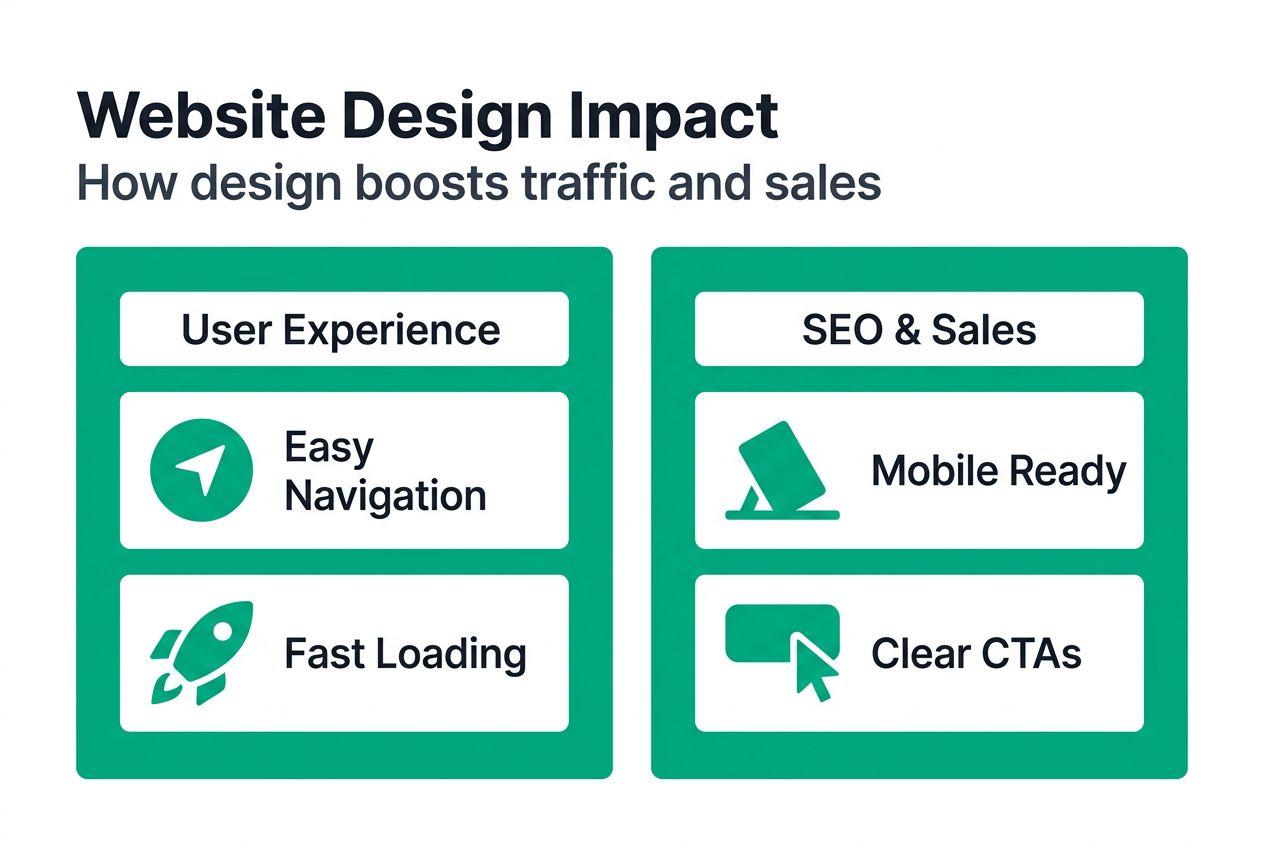
Implementing best UX practices requires understanding your specific audience behaviors. Heat mapping tools reveal where users click, scroll, and abandon. This data informs website design best practices tailored to your business goals rather than generic templates.
Consistent design patterns reduce cognitive load. When navigation works predictably and buttons appear where users expect them, completing desired actions becomes effortless. This ease directly translates to higher completion rates for forms, purchases, and other conversion events. Learning how to improve conversion rates starts with eliminating confusion at every touchpoint.
The role of website design in SEO and digital marketing integration
Search engines reward sites that deliver excellent user experiences. Google’s algorithm considers design factors like mobile-friendliness, page speed, and site structure when ranking pages. Strategic design choices can boost organic search traffic by over 30% compared to sites that ignore these technical requirements.
Mobile optimization proves especially critical for SEO success. Google uses mobile-first indexing, meaning it primarily evaluates your site’s mobile version when determining rankings. Sites that load quickly and display properly on smartphones gain ranking advantages, while poorly optimized competitors fall behind.
| Design element | SEO impact | Marketing benefit |
|---|---|---|
| Mobile responsiveness | +35% organic traffic | 65% higher mobile conversions |
| Page load speed | +25% search visibility | 40% lower bounce rates |
| Clear site structure | +20% crawl efficiency | Improved user journey mapping |
| Quality imagery | +15% engagement signals | Enhanced brand perception |
| Semantic HTML | +10% content relevance | Better accessibility reach |
Site architecture influences how search engines discover and index your content. Logical hierarchies with clear categories help crawlers understand relationships between pages. Internal linking spreads authority throughout your site, improving rankings for deeper pages that might otherwise remain buried.
Design decisions affect technical SEO fundamentals. Schema markup implementation, header tag usage, and image optimization all require coordination between designers and SEO specialists. Sites built without this integration often need expensive retrofitting later to achieve competitive rankings.
Following e-commerce SEO best practices becomes easier when design supports optimization from the start. Product page layouts that accommodate unique descriptions, customer reviews, and structured data perform better than template-driven approaches that duplicate content.
Understanding organic SEO principles helps businesses recognize why design matters for long-term visibility. Paid advertising drives immediate traffic, but organic rankings built on strong design foundations deliver sustained results without ongoing ad spend.
Professional web design services integrate SEO requirements throughout the development process. This prevents common pitfalls like slow-loading elements, poor mobile scaling, or navigation structures that confuse both users and search engines. The result is a site optimized for discovery and conversion simultaneously.
Common misconceptions about investing in website design
Many business owners believe spending more automatically produces better results. This myth leads to either excessive investment in unnecessary features or penny-pinching that compromises effectiveness. Quality design aligns spending with specific business goals rather than following arbitrary budget rules.
Another prevalent misconception treats SEO and design as separate concerns. In reality, these disciplines intertwine completely. Beautiful sites with poor technical foundations rank poorly, while optimized sites with terrible user experiences convert weakly. Successful businesses recognize that design and optimization must work together from project inception.
DIY website builders promise professional results at budget prices. While these platforms suit very simple needs, they typically underperform custom professional design significantly. Template limitations, technical constraints, and lack of strategic customization hold back businesses that need genuine competitive advantages.
Some believe design is purely aesthetic, a nice-to-have rather than business-critical. This misunderstanding ignores measurable impacts on trust, conversion rates, and search visibility. Design serves as the interface between your business capabilities and customer needs, making it fundamental to revenue generation.
Key misconceptions to avoid:
- Assuming all professional designers deliver equivalent value regardless of specialization
- Believing one-time design investments never need updates or optimization
- Thinking stock templates can match custom solutions tailored to specific audiences
- Expecting design alone to drive results without supporting content and marketing strategies
- Prioritizing trendy visual elements over proven conversion-focused layouts
Pro Tip: Evaluate design investments based on projected ROI rather than upfront cost alone. Calculate how conversion rate improvements translate to revenue, then assess whether professional design costs represent smart investments in business growth.
The most damaging misconception suggests that design quality doesn’t influence purchasing decisions. Multiple studies prove consumers make trust judgments within milliseconds based on visual presentation. Businesses that ignore this reality hand competitive advantages to rivals who invest wisely in professional design.
DIY vs professional website design: What SMBs should consider
Do-it-yourself website builders offer attractive entry points for businesses with minimal budgets. Platforms like Wix, Squarespace, and WordPress.com provide templates and drag-and-drop interfaces that create functional sites quickly. However, these solutions come with significant limitations that affect long-term growth potential.
Professional design delivers customization impossible with template-based approaches. Custom sites adapt perfectly to unique business requirements, brand guidelines, and customer journey maps. This flexibility enables optimization strategies that generic templates cannot support, directly impacting conversion performance.
| Factor | DIY approach | Professional design |
|---|---|---|
| Initial cost | $200-$500 annually | $3,000-$15,000 project |
| SEO optimization | Basic, template-limited | Advanced, custom strategy |
| Customization | Constrained by platform | Unlimited possibilities |
| Load speed | Often slow, bloated code | Optimized, lightweight |
| Conversion rates | 1-2% average | 3-5% average |
| Trust perception | Adequate for simple sites | High credibility signals |
| Technical support | Self-service, forums | Dedicated professional help |
DIY sites typically capture only 20% of the organic search traffic potential that professionally designed sites achieve. This happens because template platforms prioritize ease of use over technical SEO excellence. Code bloat, limited schema options, and restricted customization prevent optimal search engine performance.
Considerations when choosing your approach:
- Business stage: Startups testing concepts may start DIY, while established businesses need professional differentiation
- Technical capability: DIY requires ongoing learning and troubleshooting time that diverts focus from core business
- Competitive landscape: Crowded markets demand professional design to stand out from similar offerings
- Growth ambitions: Businesses targeting rapid scaling need foundations that support expansion without complete rebuilds
- Revenue per customer: High-value offerings justify professional investment that maximizes conversion rates
The hidden costs of DIY include time spent learning platforms, troubleshooting issues, and implementing workarounds for missing features. Many businesses eventually migrate to professional solutions after discovering DIY limitations, essentially paying twice: first for the DIY attempt, then for professional redesign.
Professional designers bring strategic expertise beyond technical execution. They understand conversion psychology, accessibility standards, and how design choices impact business metrics. This knowledge prevents costly mistakes that DIY builders often make through trial and error.
Practical steps to invest wisely in website design
Smart website design investment begins with understanding current performance and specific improvement opportunities. Systematic evaluation prevents wasting resources on changes that don’t address real business needs or customer pain points.
- Audit your existing site focusing on speed, mobile usability, and conversion paths using free tools like Google Analytics and Search Console
- Define clear business objectives tied to website performance, such as lead generation targets, average order values, or customer acquisition costs
- Research your target audience behaviors, preferences, and common pain points through surveys, interviews, or competitor analysis
- Identify professionals with proven expertise in your industry and documented results improving metrics that matter to your business goals
- Request detailed proposals outlining specific deliverables, timelines, and how design choices will address your documented needs
- Prioritize responsive design, fast loading speeds, and clear calls-to-action in your requirements specifications
- Plan for ongoing optimization by establishing baseline metrics and scheduling regular performance reviews post-launch
Choosing the right design partner requires evaluating both technical capabilities and strategic understanding. Look for portfolios demonstrating results similar to what you need, not just attractive visual design. Ask about their process for understanding business goals and translating them into effective design decisions.
Budget allocation should balance upfront investment with ongoing optimization resources. Many businesses spend everything on initial design, leaving nothing for the continuous improvement that maximizes ROI. Plan to invest 20-30% of your design budget in post-launch testing and refinement.
Success metrics to track after launching the new design:
- Organic search traffic volume and ranking positions for target keywords
- Bounce rate and average session duration indicate engagement quality
- Conversion rate for primary goals like purchases, leads, or signups
- Page load speed across devices and connection types
- User feedback through surveys, heatmaps, and session recordings
Pro Tip: Implement A/B testing for major design elements to validate improvements with data rather than assumptions. Test one variable at a time, like button colors, headline copy, or form length, to isolate what actually drives better results for your specific audience.
Continuous optimization separates websites that deliver sustained ROI from static sites that gradually lose effectiveness. Consumer preferences evolve, competitors improve their offerings, and search algorithms change regularly. Businesses that treat design as an ongoing strategy rather than a one-time project maintain competitive advantages and maximize return on investment over time.
Boost your business with expert website design and digital marketing
Transforming your website into a powerful growth engine requires more than understanding principles. It demands experienced partners who can execute strategy effectively while measuring results that matter to your bottom line.
Professional top-rated web design services combine aesthetic excellence with conversion optimization and technical SEO integration. This comprehensive approach ensures your site attracts visitors through search, engages them with intuitive experiences, and converts interest into measurable business outcomes. Partnering with experts who understand the complete digital ecosystem accelerates results while avoiding costly missteps that plague DIY efforts.
Ascendly Marketing specializes in creating websites that drive traffic, build trust, and generate sales for small to medium-sized businesses. Our digital marketing services integrate design with SEO, content strategy, and ongoing optimization to deliver sustained growth aligned with your specific business goals. Get measurable improvements backed by transparent reporting and expert guidance every step of the way.
Frequently Asked Questions
What factors determine the return on investment for website design?
ROI depends primarily on conversion rate improvements, organic traffic growth, and lead quality enhancements resulting from better user experience. Track metrics like bounce rate reductions, time-on-site increases, and sales directly attributed to website interactions. Calculate revenue gains from improved conversion rates against design investment costs to measure true financial return.
How often should a small business update its website design?
Most businesses benefit from significant design refreshes every 2-3 years to maintain modern standards and competitive positioning. However, update sooner if performance metrics like conversion rates or search rankings decline noticeably. Major business changes such as new service offerings, rebranding, or target audience shifts also warrant design updates regardless of timeline.
Can DIY website builders be effective for small businesses?
DIY builders work adequately for very simple informational sites with modest traffic expectations and limited conversion goals. They offer cost-effective solutions for businesses just starting or testing concepts before major investment. However, growth-focused businesses requiring advanced SEO capabilities, custom user experiences, or strong brand differentiation typically need professional design to achieve competitive conversion rates and search visibility.
How does website design impact search engine rankings?
Design affects rankings through technical factors like mobile responsiveness, page speed, and site architecture that search engines evaluate when determining page quality. Poor design creates high bounce rates and low engagement, which send negative signals to algorithms. Strategic design implementing proper HTML structure, optimized images, and clear navigation helps search engines understand and rank your content effectively while delivering experiences that keep visitors engaged.