

Most businesses do not need a full YouTube channel strategy. They need a decision about where YouTube fits in the funnel, what they can measure, and how much content they can realistically support. That’s the difference between buying YouTube marketing services that create usable business outcomes and paying for a pile of videos that look active but don’t move revenue.
YouTube is too large to treat casually. In 2024, YouTube’s annual ad revenue reached USD 36.1 billion, up from USD 31.5 billion in 2023, and by 2025 it was reported at more than $40 billion. Its ad reach was estimated at 2.53 billion users, and in the U.S. it captured 12.5% of all TV viewing in May 2025, which means your video strategy now competes in both social and TV-like attention markets. Those numbers make one thing clear: YouTube isn’t a side channel anymore; it’s a core media channel for businesses that can support it. (YouTube marketing statistics)
If you’re a small business owner, the wrong question is, “Should we be on YouTube?” The better question is, “What job should YouTube do for us, and how will we know it worked?” A useful way to think about the channel is to compare a broad content program with narrower uses like sales-enablement clips, customer education, or paid ads only. If you want a simple starting point for that comparison, video marketing services for small businesses offer a practical way to think about scope before you commit to a full program.
Practical rule: if your buyers already use video to compare options, answer questions, or validate vendors, YouTube deserves a real budget. If they don’t, start narrower and prove demand first.
For a business that already has a clear audience and a repeatable offer, a focused YouTube plan can make sense quickly. For a business with an unclear value proposition, weak sales follow-up, or no internal appetite for approving scripts and edits, a full-service approach usually creates drag. If you’re comparing service models, Ascendly Marketing’s video marketing services are a relevant benchmark for how agencies package strategy, production, and distribution into one program.
When YouTube Marketing Services Make Sense for Your Business
A lot of advice assumes every brand should publish weekly and grow a channel. That’s sloppy advice. YouTube marketing services make sense when your buyers use video to research, your team can turn attention into leads or sales, and your content can be reused across search, paid media, and sales conversations.
The businesses that usually get value first
Product-led e-commerce brands tend to benefit because demos, comparisons, unboxing videos, and how-to content reduce friction before purchase. B2B firms also get an advantage when they need to explain a service, teach a process, or support a sales cycle that’s longer than a single call. Service businesses can use YouTube well too, but usually in a narrower way, through educational clips, FAQ videos, and targeted ads rather than a large publishing machine.
The platform’s scale supports that judgment. A 2026 marketing roundup reported that 69% of companies now use YouTube for marketing, while another source found 82% of marketers use it, which shows the channel has moved into mainstream media planning. Consumer reach is also broad, with 85% of U.S. adults using YouTube in 2024, ahead of Facebook at 70% and Instagram at 50% in that dataset. (Vidico’s YouTube marketing statistics)
When to go narrow instead of full service
Some businesses should not buy a big, always-on channel strategy. A local service company with a short sales cycle may do better with a few high-quality explainer videos and geo-targeted ads. A niche B2B firm may only need a small library of customer-education clips that help sales reps answer objections faster.
If your team can’t support scripts, approvals, and follow-up, don’t buy volume. Buy clarity.
The simplest test is this. If your audience already searches for solutions on YouTube, watches product demonstrations, or needs education before speaking to sales, the channel is a fit. If your buyers convert through referrals, direct outreach, or offline relationships, YouTube can still help, but the scope should stay tight.
Core Offerings Within YouTube Marketing Services
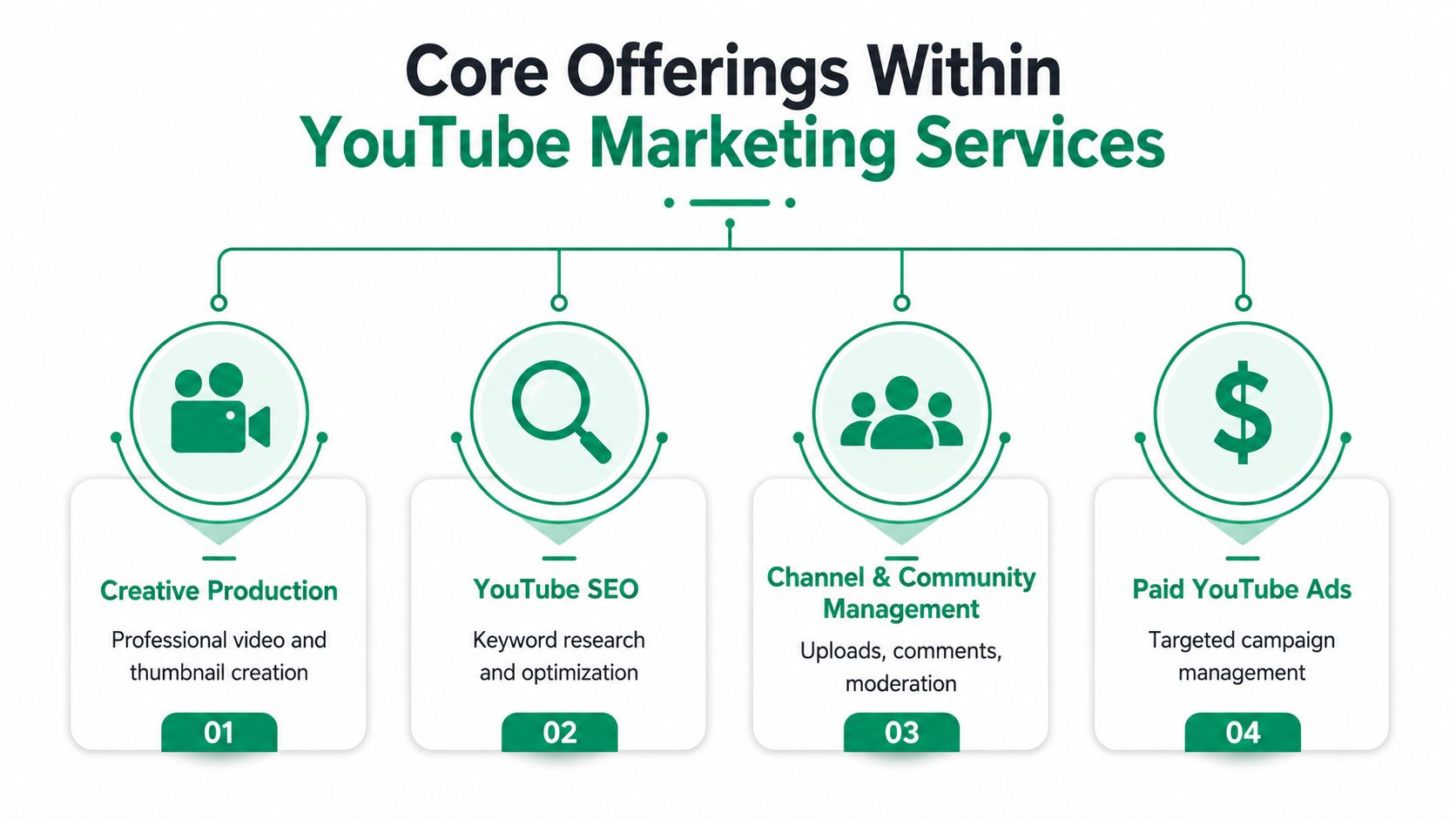
Professional YouTube marketing services usually combine four parts, because one part by itself rarely delivers durable results. Creative work without distribution stalls. SEO without strong packaging underperforms. Paid media without good content burns budget. Channel management without strategy turns into admin.
Creative production and packaging
This covers scripting, filming, editing, motion graphics, thumbnail design, and versioning for different placements. Good agencies do not just make videos. They build videos that fit a channel’s purpose and earn clicks in search and browse surfaces. A thumbnail and title pair is part of production, not an afterthought. If your team needs support with planning, filming, and editing, video production for marketing is where the work gets disciplined fast.
YouTube SEO and discoverability
This is keyword research, title optimization, description writing, tags, chaptering, and topic selection. The goal is simple. Give the algorithm a clear topic signal and give viewers a reason to click. Agencies that understand YouTube know that discoverability starts before publishing, not after.
Channel and community management
This includes upload scheduling, playlist structure, comment moderation, pinned comments, community posts, and channel page cleanup. It sounds operational, but it affects performance because people need a channel that looks coherent and active. A messy channel kills trust quickly. For churches, a church sermon video strategy shows how a focused channel structure can support reach, education, and retention without turning the whole channel into a broad marketing program.
Paid YouTube ads
This is campaign setup, audience targeting, creative testing, retargeting, and budget pacing. Paid promotion works best when the channel already has content that proves a message and a format. Agencies often bundle ads with organic content because the same creative can guide both sides of the strategy.
These four services rarely work in isolation. The strongest results come when the agency connects production, search, channel management, and paid distribution around one clear offer. That is the difference between a channel that looks active and a channel that moves prospects.
Pricing Models and ROI Expectations
Pricing for YouTube marketing services usually follows one of three models, and the model tells you a lot about what the agency thinks it’s selling. Project work suits a defined launch. Monthly retainers suit ongoing content and optimization. Performance-based pricing sounds attractive, but it only works when both sides agree on attribution, and the lead or sales tracking setup is solid.
Compare the pricing structures before you sign
| YouTube Marketing Service Pricing Tiers | Typical Monthly Cost | Best For | Key Deliverables |
|---|---|---|---|
| Project-based | Varies by scope | One-off launches, audits, channel setup | Strategy doc, content plan, video edits, channel optimization |
| Monthly retainer | Varies by scope | SMBs that need ongoing publishing and testing | Content planning, production, SEO, reporting, campaign management |
| Performance-based | Varies by agreement | Teams with strong attribution and conversion tracking | Agreed deliverables tied to qualified leads, sales, or media outcomes |
A fair quote usually reflects how much strategy, editing, media buying, and reporting the team has to do. Costs go up when the agency has to do everything from scratch, produce more assets per month, or manage both organic and paid work. They go down when you already have footage, brand guidelines, and a clear offer.
What to expect in 90 days and what takes longer
In the first 90 days, expect setup work, positioning decisions, topic selection, first-round production, and early signal gathering. You should see whether titles, thumbnails, and topics are getting attention, and whether the channel is attracting the right traffic. Don’t expect the channel to become a mature lead engine that quickly.
By 12 months, the picture should look very different if the work is disciplined. You should have a clearer content library, better audience fit, more usable data, and a repeatable process for turning video into traffic or leads. If you want a structured way to judge value, how to calculate marketing ROI is a useful reference for connecting spend to business outcomes.
How to Select the Right YouTube Marketing Agency
Choosing an agency is less about flashy editing and more about whether the team can connect video work to business goals. A polished reel means very little if the team can’t explain why a thumbnail works, how a target audience is defined, or how a video becomes a lead.
Ask for proof that matches your goal
Start with portfolio review, but don’t stop at visuals. Ask what the agency was trying to achieve, what part of the funnel the content supported, and how they measured success. If they can’t explain that clearly, they’re selling video production, not YouTube marketing services.
Ask for the last five decisions they made, not just the final result.
Then look at the team structure. You want to know who handles strategy, who handles production, who handles ad buying, and who writes the reporting. A single generalist can help in simple cases, but complex programs usually need a split between creative and performance roles.
Verify their process before you buy
A serious agency should be able to answer these questions without stumbling:
- What does your keyword research process look like? They should talk about search intent and topic selection, not just “SEO.”
- How do you test thumbnails and titles? They should explain click behavior and iteration.
- What reporting do I get each month? You want clarity on metrics, timing, and access.
- How do you handle approvals? Slow approvals can damage cadence, so the workflow matters.
- What happens if a video underperforms? You need to hear about packaging changes, topic adjustments, or paid amplification.
The right partner will also be honest about fit. A niche-specific agency can be useful if your business has technical buyers or a long sales cycle. A generalist firm can still work if the offer is straightforward and the content needs are simple. What matters is whether the team can show a repeatable process, not whether they claim to know every industry.
The YouTube Marketing Execution Workflow
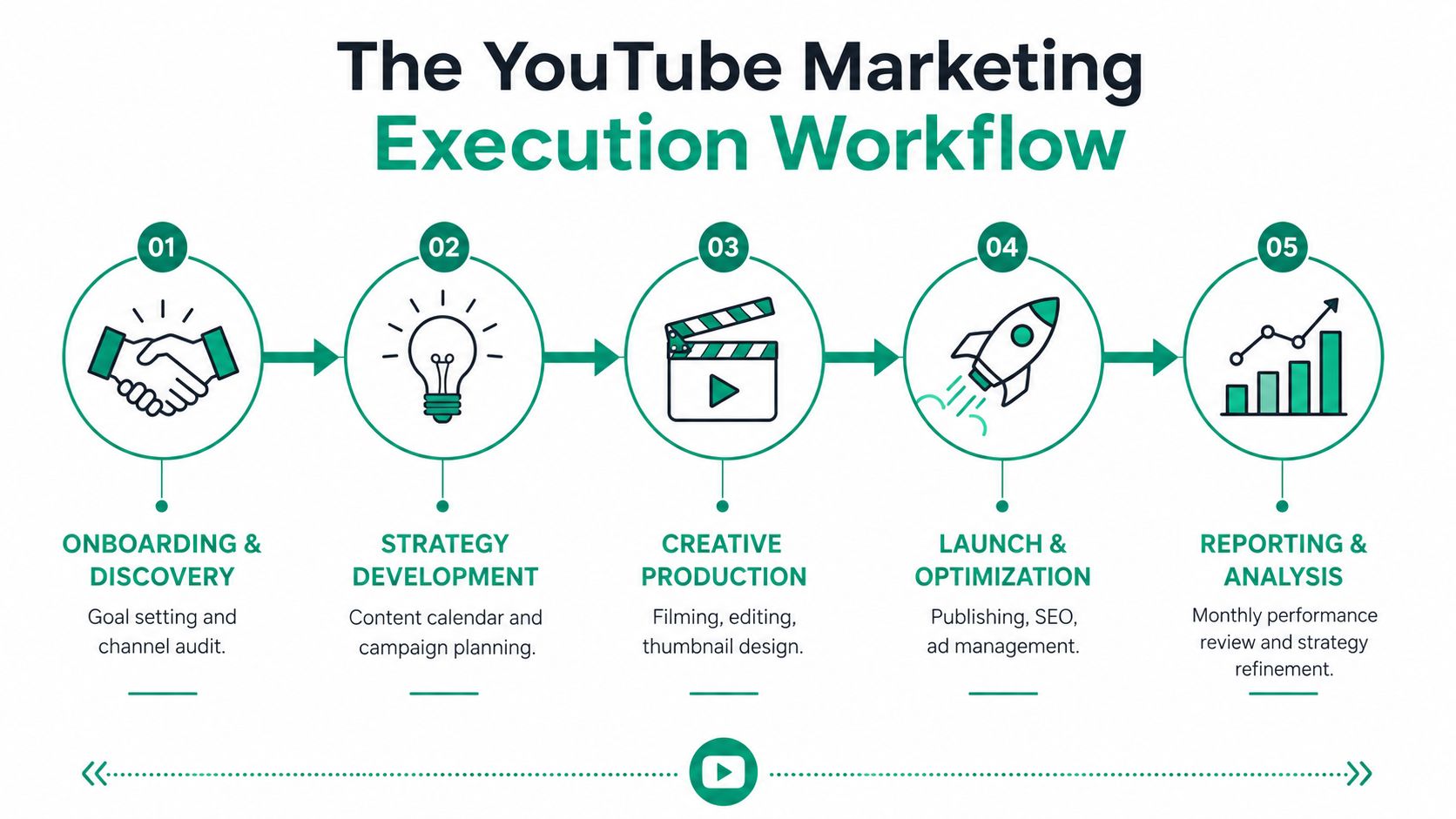
A well-run YouTube engagement should feel structured, not chaotic. The best agencies move from discovery to production to optimization without forcing the client to rewrite the strategy every week. That rhythm protects the work from constant opinion drift.
What happens first
Kickoff usually starts with discovery, channel review, and goal setting. The agency should ask what counts as a qualified lead, what content already exists, and what the internal approval path looks like. If those answers are fuzzy, the campaign will be fuzzy too.
After that comes strategy development. A good team will define content buckets, decide whether the work is organic, paid, or both, and map video topics to buyer questions. Then comes scripting, production, editing, thumbnail creation, and upload preparation.
Where you stay involved
You should be involved in messaging decisions, approvals, and any claims that need internal validation. You should not have to micromanage every edit. The agency should handle channel optimization, metadata, paid campaign setup, and routine reporting.
The smoothest projects don’t move faster because the team is rushed. They move faster because approvals are clear.
Launch usually brings the first real test. Early performance tells you whether the topic is right, whether the thumbnail is earning the click, and whether the video holds attention. The agency then uses those signals to refine the next round of content and ad spend.
The platform itself rewards this kind of discipline. YouTube’s ad business, creator ecosystem, and broad viewing habits make it a stable place to build repeatable media programs, not a one-off experiment. That’s why workflow matters more than volume.
Measuring Success with the Right KPIs
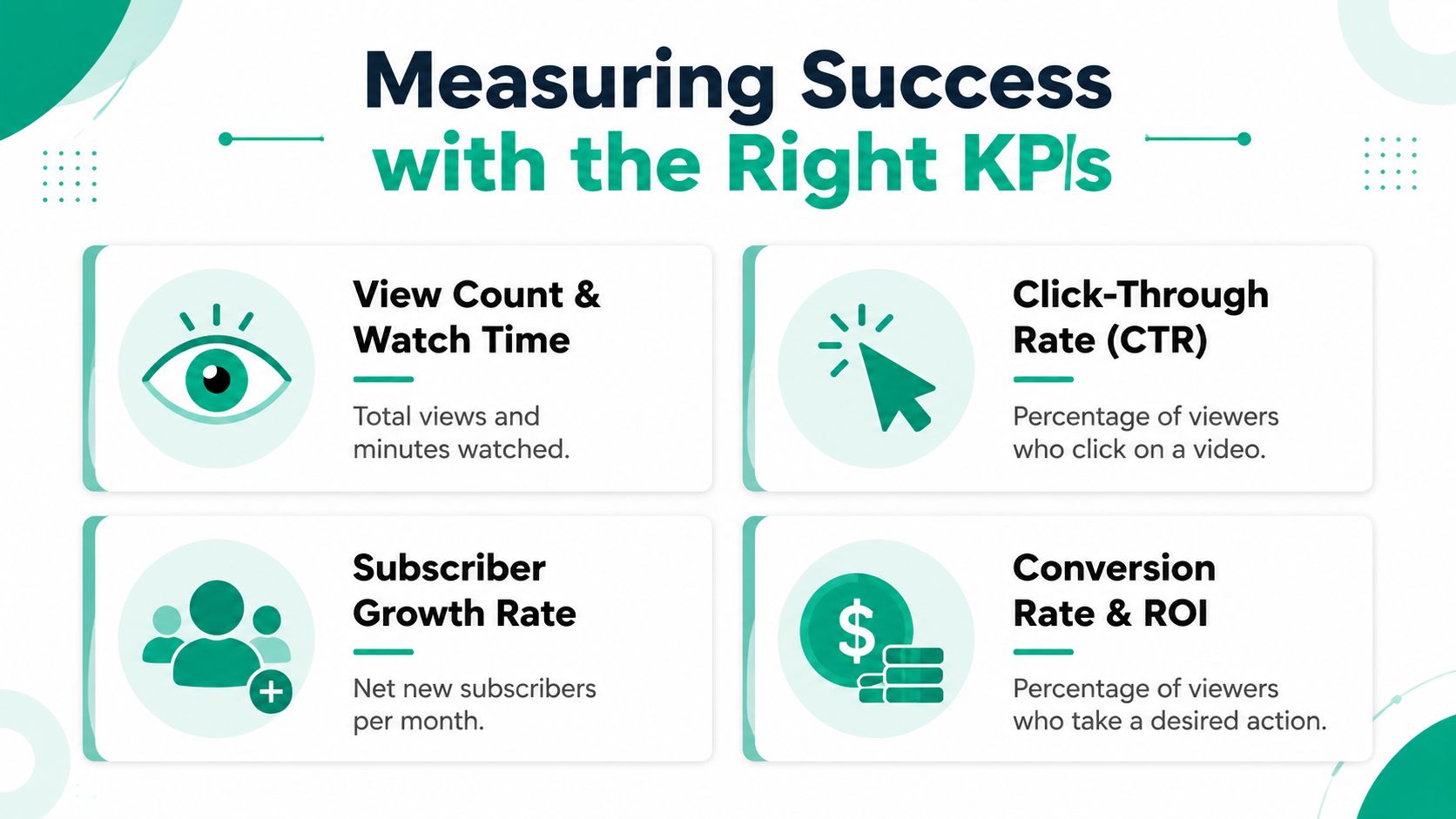
A YouTube dashboard can mislead you if you read the wrong numbers. Views feel good, but they don’t tell you whether the right people watched, clicked, or converted. The right KPI set depends on the job the video is doing.
Read the metrics in context
For awareness campaigns, watch time and reach matter most. For consideration campaigns, retention and traffic quality matter more. For direct-response work, you need to connect clicks to downstream leads or sales, not just to views.
Industry guidance for brands treats CTR in the 4% to 7% range as a practical target, average view duration around 40% to 50% of long-form length as healthy, and traffic-source mix as a diagnostic signal. A strong profile often shows 30% to 50% browse or suggested traffic and 15% to 25% search traffic. Those are not vanity numbers; they tell you whether YouTube is distributing the video and whether the content matches what viewers wanted. (YouTube analytics for brands)
Build the report around decisions
The useful report is not a spreadsheet dump. It answers a few blunt questions. Did the thumbnail earn the click? Did the video keep attention? Did the traffic do anything useful after the view?
If the click rate is weak, the package needs work. If retention falls early, the opening is losing people. If traffic looks fine but leads don’t improve, the issue is probably the offer, the landing page, or the follow-up sequence.
Use UTM parameters on links in descriptions and pinned comments so you can trace watch-to-action behavior. That lets you compare the effect of YouTube against other channels instead of assuming views equal value.
Real Applications Across Business Types
An e-commerce brand usually needs a mix of product demos, comparison videos, and paid promotion. The content supports both discovery and conversion, especially when shoppers need reassurance before they buy. Success looks like better product understanding, stronger traffic quality, and more clicks into the store.
A B2B company should think differently. Thought leadership, problem-solving videos, and customer-education clips often work better than broad entertainment-style content. The timeline is longer, but the payoff comes from qualified attention, sales enablement, and a channel that helps buyers trust the team before the first call.
Local service businesses should stay selective. Many of them do not need a full publishing engine. A small set of educational videos, FAQ clips, and targeted ads is usually enough to support calls, form fills, and local trust. For some of these businesses, the best use of YouTube is narrow and practical, not expansive.
Startups need discipline more than ambition. They can use YouTube for brand building, founder credibility, and content reuse across other channels, but the budget has to match the available team bandwidth. If there’s no one to keep scripts moving or track follow-up, the channel will stall.
Match the service mix to the business model, not to the platform’s popularity.
The best fit is the one that aligns content volume, sales cycle, and measurement. That’s how you avoid buying more video than your business can use.
Ascendly Marketing builds YouTube marketing services around strategy, production, paid media, and reporting, so the work connects to leads and sales instead of stopping at views. If you want a practical plan for your business, visit Ascendly Marketing and ask for a consultation that matches your goals, your budget, and your timeline.