

You publish a solid article, a useful guide, or a case study your sales team can use. A week later, traffic is flat, nobody shared it, and the pipeline didn’t move. That usually isn’t a content quality problem. It’s a distribution problem.
Content teams often still treat distribution as the final checkbox after publishing. Post the link on LinkedIn, drop it into the newsletter, maybe boost it if someone remembers. Then they wonder why strong content performs like a hidden page on an abandoned site.
A working content distribution strategy fixes that. It turns content from a one-time asset into a repeatable system tied to reach, lead flow, and sales conversations. The shift is simple. Stop asking, “How do we get more traffic to this piece?” Start asking, “Which audience should see this, on which channel, in which format, and what action should follow?”
Why Your Best Content Gets Zero Attention
A team publishes a strong guide, gets a few internal compliments, shares it once on LinkedIn, and watches it disappear. The problem starts before launch. No channel plan, no format plan, no owner, no follow-up.
That is why high-effort content so often produces low-impact results.
Teams treat publishing like the finish line when it is only the handoff. The asset goes live, but nobody has decided which audience should see it first, which channel fits the buying stage, or what conversion step should come next. So even useful content ends up buried in the blog archive while sales asks for better collateral and paid media keeps reinventing offers from scratch.
Publishing isn’t distribution
A blog post on your site is inventory. A webinar recording on a landing page is inventory. A whitepaper behind a form is inventory too. Distribution starts when each asset has a job, a target audience, a format for the channel, and a clear CTA tied to revenue.
The practical takeaway is direct. Distribution shapes lead flow. If a piece is supposed to generate pipeline, it needs a defined route into the funnel through search, email, social, paid amplification, partner placement, sales enablement, or a mix of those plays.
Practical rule: If you can’t name the audience, channel, format, and CTA before launch, the content isn’t ready.
This is also where weak planning shows up fast. Teams overvalue channels that feel active and undervalue channels that produce qualified conversations. A post might get likes on LinkedIn and still contribute nothing to pipeline. A niche newsletter sponsorship might send fewer visits and produce better SQLs. That trade-off matters more than vanity reach.
Attention follows a delivery system
Content gets traction when the distribution plan shapes the asset before it is published. A guide meant for email nurture needs a different structure than one built for search. A page intended for paid traffic needs tighter copy, sharper proof, and less friction than an article designed to earn shares or backlinks.
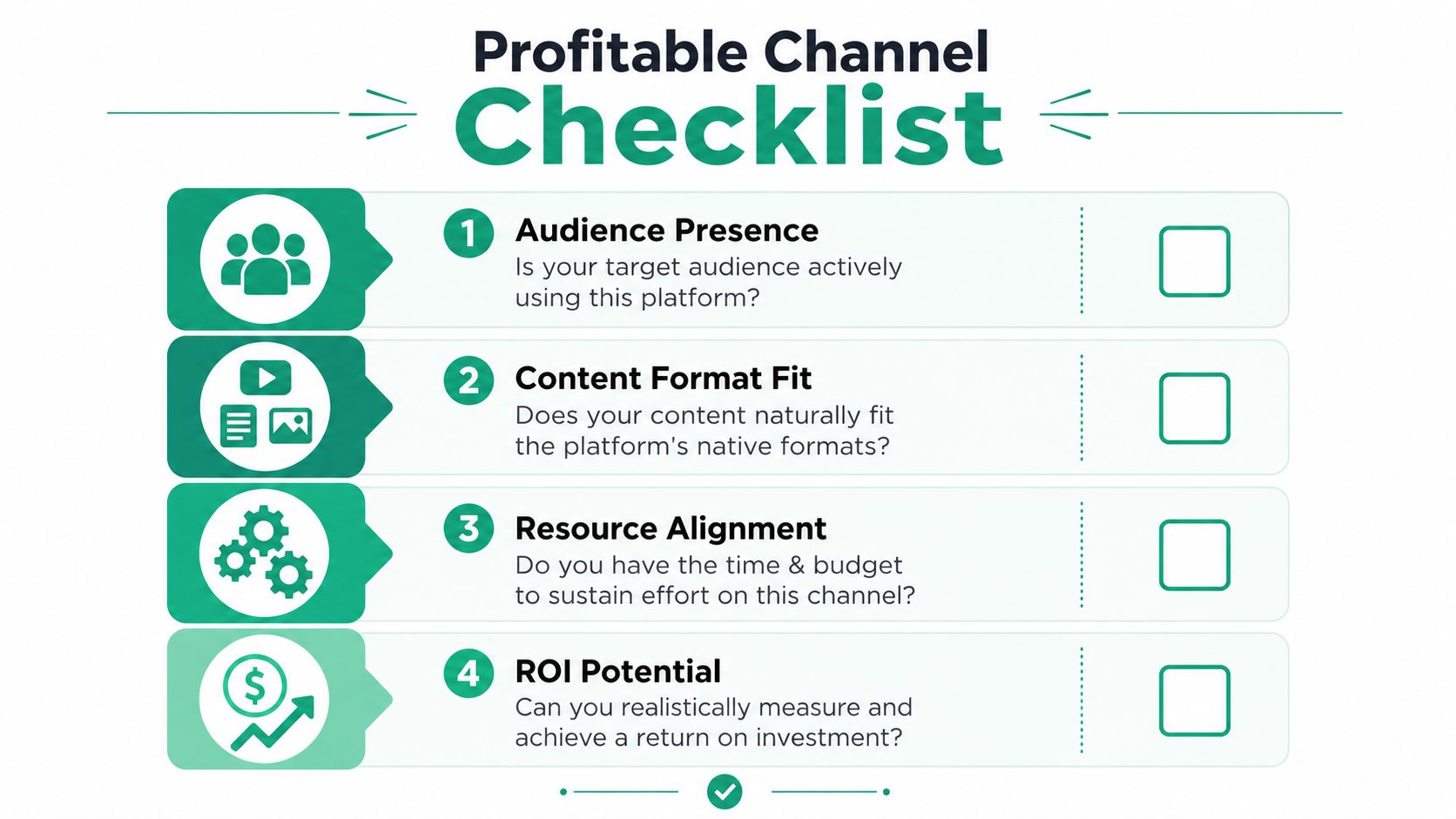
The stronger approach is to score channels before you promote anything. We use a Channel Profitability Audit. It ranks each option against two questions: does the audience use this channel during the buying journey, and does the channel have real potential to generate leads, not just impressions? That process keeps teams from spreading effort across every platform and helps them commit budget and time where results are realistic.
Visibility now depends on more than a blue link in search results. Buyers discover content through AI summaries, platform search, communities, forwarded emails, and creator recommendations. That is one reason smart teams now improve your website’s AI Visibility as part of distribution planning, not as a separate SEO side task.
A reliable content distribution strategy gives every asset a delivery system. Without that, even your best content stays invisible.
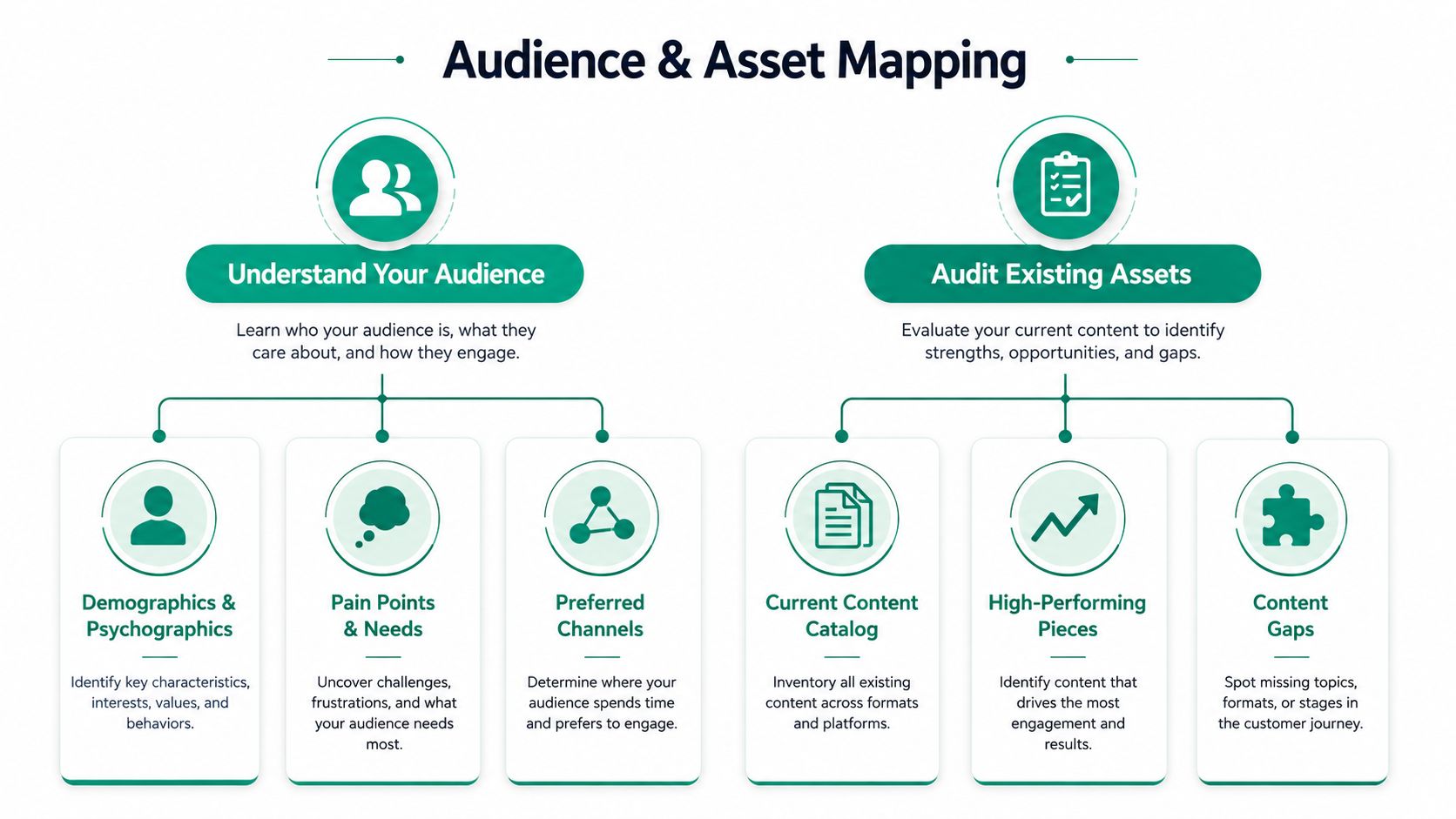
Map Your Audience and Audit Your Assets
Most channel decisions fail before the first post goes live. The team never got specific about who they wanted to reach, and they never checked what content already had traction.
Start with a lean ICP, not a bloated persona deck. You need a working profile your team can use every week.
Build an audience map you can use
Focus on behavior, not decoration. Job title matters in B2B. Product category matters in e-commerce. But channel behavior matters more when you’re choosing where to distribute.
Ask questions like these:
- Where do they already pay attention? List the platforms, newsletters, podcasts, communities, and search behaviors that show up in real buying journeys.
- What problem are they trying to solve right now? Map your content to active pain points, not broad interests.
- Which format do they prefer when evaluating vendors? Some audiences read comparison pages. Others want short video explainers or demos.
- What language do they use internally? Pull wording from sales calls, reviews, support tickets, and CRM notes.
When teams skip this step, they default to channels they personally like. That leads to effort on platforms with activity but little buying intent.
Audit assets before creating more
Most companies already have useful content buried in the archive. Product pages, recorded demos, founder interviews, onboarding docs, webinar decks, old blog posts, and case studies often contain strong material that was never properly redistributed.
A practical way to audit is to review recent content first, not your entire library. A rigorous content distribution methodology begins with a 90-day resurfacing calendar that includes auditing the last 20 assets to map original publication points against redistribution channels, specifically tracking metrics like dwell time, scroll depth, saves, and direct sales usage to identify winners for reinvestment, based on this breakdown of content distribution methodology.
That gives you a short list of assets worth pushing harder.
| Asset type | What to check | What usually makes it a winner |
|---|---|---|
| Blog post | Dwell time, scroll depth, organic entry pages | Strong problem-solution fit |
| Webinar | Sales reuse, audience questions, watch behavior | Clear expertise and reusable clips |
| Case study | Sales team usage, CTA clicks, page engagement | Specific objection handling |
| Guide or whitepaper | Form fills, nurture engagement | Mid-funnel education |
| Product page | Conversion behavior, bounce pattern | High-intent relevance |
One strong asset repackaged well will outperform five average assets posted once.
Separate winners from fillers
During the audit, label each asset in one of three buckets:
Promote now
These assets already show signs of interest and need more reach.Refresh then distribute
Good topic, outdated framing. Update the intro, examples, CTA, and visuals.Retire or merge
Thin pieces that don’t support any current search, sales, or campaign goal.
A real content distribution strategy starts to feel less chaotic. You stop guessing what deserves promotion. You already know which assets earned another round.
Find Your Most Profitable Distribution Channels
Most advice on channel selection is too broad to be useful. It gives you a list of options, then leaves you with the same problem you had before. Which channels produce customers?
The fix is a Channel Profitability Audit. Instead of asking where you can post content, ask where your audience already discovers, evaluates, and trusts information.
Score channels instead of collecting them
One 2026 playbook on maximizing reach recommends scoring channels on customer usage, lead discovery, and organic engagement to define a primary distribution tier, and notes that this approach is missing from 90% of strategy articles. That framework is useful because it forces a harder conversation than “Should we be on TikTok?” or “Do we need a podcast?”
Use three scoring questions for every channel under consideration:
Customer usage
Do current customers spend time here, or are you assuming they do?Lead discovery
Does this channel show up early in qualified lead journeys?Organic engagement
Can your team participate consistently in a way that earns attention without buying every impression?
That creates a shortlist. For most small and mid-sized companies, the answer won’t be six channels. It will be 1–2 primary channels supported by a few secondary ones.
What this looks like in practice
Here’s a simple way to think through it.
A B2B service firm may find that buyers read founder posts on LinkedIn, click through to detailed service pages, and convert after seeing a case study in email follow-up. In that case, LinkedIn and email become primary distribution channels, while the website acts as the conversion hub. If your team needs examples for platform-specific execution, this guide to LinkedIn content strategy covers the mechanics well.
An e-commerce brand may discover that product education performs best through short-form social video and email, while community mentions support trust but don’t drive first discovery as often. That business shouldn’t split equal effort across every social platform. It should invest where product consideration begins.
Use a primary tier and a support tier
A useful channel model looks like this:
| Tier | Purpose | Typical action |
|---|---|---|
| Primary | Main distribution engine | Publish consistently and allocate most resources |
| Support | Extend reach and reinforce messages | Repurpose top assets selectively |
| Experimental | Test new ideas | Run limited tests, then decide quickly |
That structure keeps teams from spreading effort too thin.
Don't ask which channels are popular. Ask which channels appear in real customer paths.
Paid channels need the same discipline
A lot of wasted ad spend comes from amplifying content on weak channels because the platform has scale. Scale without fit is expensive. If you're pressure-testing paid support for your primary channels, AdStellar AI's paid media insights are useful because they focus on strategic alignment rather than random boosting.
Another source sharpens the channel decision further. Content RevOps' guidance on effective content distribution recommends selecting 1–2 primary channels where the ICP already pays attention and committing to sustained, human participation while hosting the core asset on a landing page that clearly states the audience and the problem it solves.
That's the benefit of the Channel Profitability Audit. It narrows the field, exposes weak assumptions, and gives you a reason to say no to channels that look busy but don't move deals.
The Art of Content Repurposing and Repackaging
Creating a fresh asset for every platform sounds disciplined until the team burns out. Then posting gets inconsistent, quality drops, and the calendar turns into a pile of half-finished drafts.
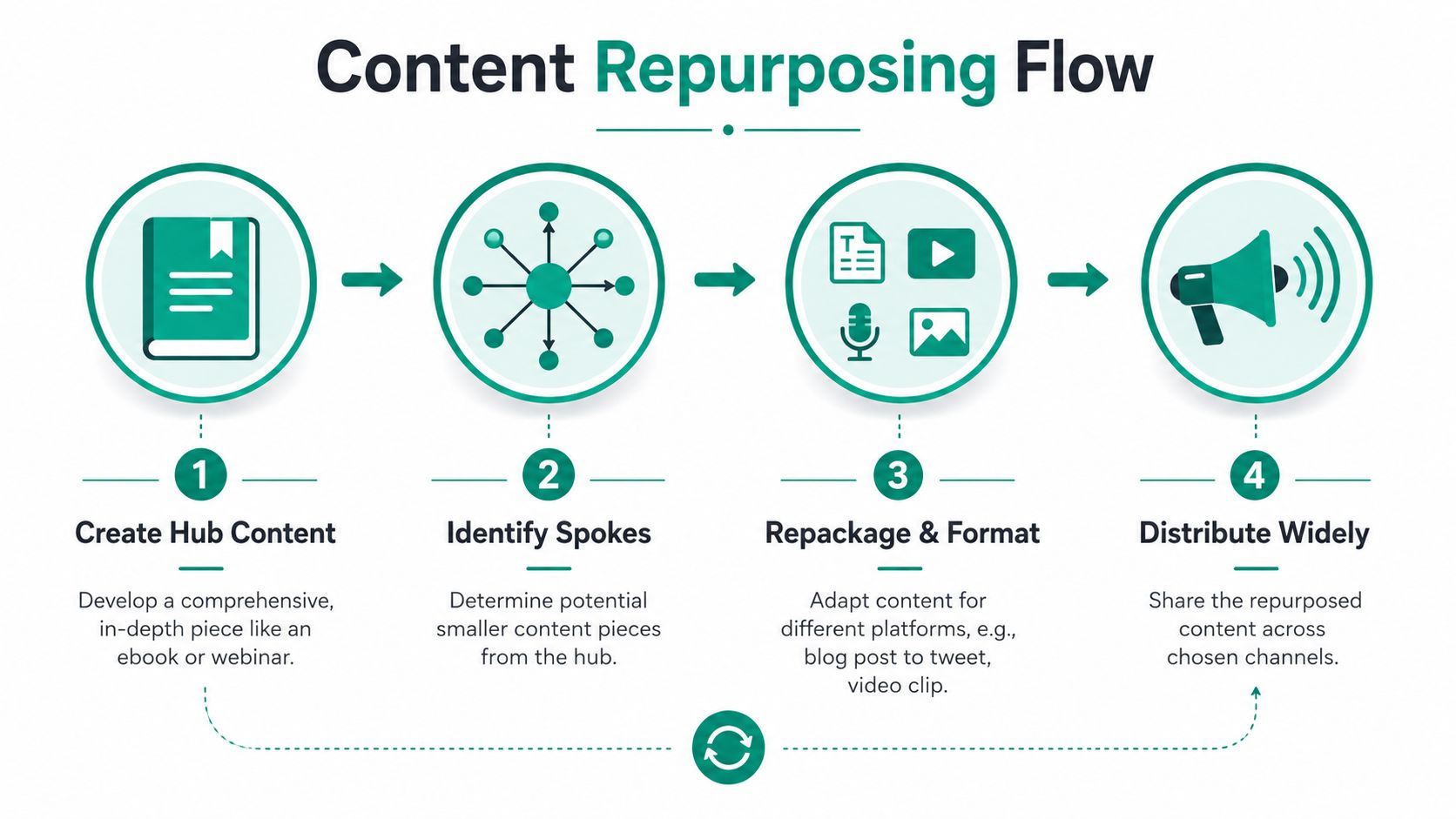
A better system starts with one substantial piece and turns it into multiple assets built for different channels. That's the hub and spoke model. One core asset carries the main idea. Smaller pieces pull out angles, clips, quotes, examples, and objections for distribution elsewhere.
Start with a hub asset that can carry weight
The best hub assets usually do one of these jobs well:
- Teach a process through a webinar, guide, or long-form article
- Handle objections through a case study or comparison page
- Show proof of work through a demo, teardown, or customer story
Once the hub exists, break it apart by audience need rather than by format alone.
For example, a webinar can become:
- a blog post built around the strongest section
- short video clips for social
- a slide deck for sales follow-up
- pull quotes for image posts
- an email sequence tied to the landing page
- FAQ snippets for product or service pages
That's far more efficient than inventing isolated content every week. If your repurposing plan includes video, this resource on video production for marketing is a practical reference for turning a single recording session into multiple usable assets.
Repackaging isn't copy-paste work
Each spoke needs a native fit. A LinkedIn post can't read like a paragraph lifted from a whitepaper. An email intro can't feel like a webinar transcript. The message should stay consistent, but the delivery should change.
Use this adaptation grid:
| Original asset | New format | What to change |
|---|---|---|
| Webinar | Short video clip | Tighten the hook, add captions |
| Blog post | Email send | Lead with the problem, shorten the copy |
| Case study | Carousel post | Pull out stages, proof points, and lessons |
| Guide | Sales one-pager | Remove theory, keep decisions and outcomes |
Here's a useful example of repurposing in motion:
Keep a refresh ratio in the calendar
A lot of teams underuse strong content because they think reposting equals laziness. It doesn't. Reuse done well is distribution discipline.
According to WG Content's article on content distribution strategy, the most common pitfall is failing to measure and iterate, with teams neglecting the 80/20 rule where 80% of social content is new and 20% is recycled. The same source also points to a 70% proven, 20% trending, 10% experimental hub-and-spoke mix that balances reliability with testing.
Repackaging works when you change the wrapper, not the substance.
That means refreshing intros, changing the hook, updating examples, and adjusting CTAs. It doesn't mean posting the same caption and link every few weeks.
Amplify Your Reach with Organic and Paid Tactics
A common failure point looks like this. The team publishes a strong asset, shares it once on the company page, sends one email, and calls distribution done. Two weeks later, performance looks weak, so they assume the content missed the mark.
Usually, the content was not the problem. The promotion plan was too thin, and the Channel Profitability Audit was never applied at the amplification stage. High-scoring channels deserve repeated, intentional distribution. Low-scoring channels do not need more effort just because they are familiar.

Organic reach comes from active distribution
Organic reach still produces results, but only when the team participates where buyers already spend time. Posting a link and waiting for pickup rarely works, especially for B2B offers with longer consideration cycles.
The highest-yield organic tactics are usually the least automated:
- Direct community participation in niche groups, forums, Slack communities, and comment threads tied to the problem your asset solves
- Employee distribution from subject matter experts and client-facing team members who can add a point of view, not just repeat brand copy
- Partner and customer mentions that connect the asset to a real implementation or outcome
- Email sequencing that introduces the same asset from different angles across the buying journey
Teams waste good content by publishing broadly instead of distributing selectively.
A practical rule is simple. Match effort to channel score. If your audit shows LinkedIn drives qualified conversations and email drives return visits, put your best operators there first. If a channel gets impressions but no serious engagement, reduce effort and reassign it. Seedance's guide on social engagement is useful here because it focuses on the interaction patterns that result in increased response, not just posting frequency.
Paid reach should back channels and assets with proof
Teams that have had a bad experience with paid distribution often dismiss it entirely. In client accounts, the primary issue is usually one of three things: weak audience targeting, a landing page that asks for too much, or an asset that was never strong enough to earn attention in the first place.
Paid support works best after some evidence already exists. Use the Channel Profitability Audit here too. If an asset is already getting saves, replies, demo clicks, or assisted conversions through organic distribution, paid can help you reach more of the same audience faster.
Strong paid candidates usually include:
- gated guides tied to a specific buying problem
- webinar replays with clear mid-funnel intent
- comparison pages built for active evaluation
- case studies used in retargeting sequences
Paid media should speed up content that has already shown promise.
Test with control, then expand
Small tests beat early overspend. Start with one asset, two audience segments, and a small set of creative variations. Change one major variable at a time so the result is usable.
Everywhere Marketer's guidance on content distribution strategies recommends starting with limited-budget tests across creative, headlines, and audience segments, then reviewing early indicators such as click-through rate, bounce rate, and conversion rate before increasing spend.
That process is worth keeping. It prevents a common mistake: scaling distribution before message-channel fit is clear.
Organic and paid tactics also need calendar support. The strongest teams build planned reshares, paid bursts, and follow-up email sends into a content calendar for distribution and promotion instead of improvising after publication.
The goal is not maximum visibility. It is profitable visibility on the channels that earn attention, leads, and pipeline.
Measure What Matters and Build Your Workflow
A content distribution strategy gets sharper when reporting changes behavior. If your team reviews metrics but keeps making the same weak channel choices, the workflow is broken.
The strongest systems close the loop between planning, publishing, and performance. They don't stop at impressions, likes, or vague “reach.” They track what happened after the click and use that information to reallocate effort.
Build a simple operating rhythm
Pepper's guide to content distribution strategy notes that marketers who systematically implement a framework of research, auditing, channel selection, KPI setting, content creation, distribution, and analysis report higher engagement and conversion outcomes.
That's the structure many organizations need. Not more tools. Better sequencing.
A clean workflow often looks like this:
| Weekly task | Owner | Output |
|---|---|---|
| Review active assets | Content lead | Promotion priorities |
| Schedule channel distribution | Social or demand gen lead | Channel-ready posts and sends |
| Check UTM-tagged traffic and conversions | Analyst or strategist | Channel performance notes |
| Flag assets for refresh or reuse | Content lead | Updated resurfacing list |
| Meet with sales for feedback | Marketing and sales | Objection and CTA insights |
Use tools that expose behavior, not vanity
Google Analytics and Google Search Console are enough to build discipline if you use them well.
Track:
- Landing page conversion behavior by traffic source
- Bounce patterns after distribution pushes
- Search queries and page visibility for owned assets
- Assisted conversions for pages that support longer buying cycles
- UTM-tagged campaign traffic so channel comparisons mean something
The data should answer practical questions. Which channel brought the right audience? Which content format held attention? Which landing page turned interest into action? Which asset helped sales, even if it wasn't the last click?
Put the calendar and the review in the same system
A content calendar that only lists publish dates is incomplete. Distribution needs its own schedule, with channel variants, asset refresh dates, paid support windows, and review checkpoints.
If your team needs a working model, this guide on how to create a content calendar is useful because it treats scheduling as an operating system, not just a spreadsheet.
For social specifically, engagement quality matters more than raw post volume. Seedance's guide on social engagement is a helpful companion because it focuses on interaction patterns that make distribution more effective after publishing.
A working distribution workflow usually includes:
-
A monthly audit window
Review assets worth resurfacing, refreshing, or retiring. -
A weekly distribution block
Prepare variations for primary and support channels. -
A post-launch check
Watch clicks, bounce patterns, and conversion behavior early. -
A channel review meeting
Move effort from weak channels to the ones producing actual movement.
The difference between inconsistent content marketing and a dependable content engine is simple. One publishes and hopes. The other measures, learns, and reallocates.
If your team wants a content distribution strategy that connects content, paid media, SEO, and conversion into one working system, Ascendly Marketing can help build it, run it, and keep it accountable to business results.