

TL;DR:
- Social proof influences consumer decisions by transferring trust and reducing perceived risk.
- It boosts conversions when placed strategically, with five reviews increasing purchase likelihood significantly.
Social proof is defined as the psychological phenomenon where people copy the actions of others to validate their own choices, making it one of the most powerful forces in consumer behavior. The role of social proof in marketing is to transfer trust from credible sources to your brand, reducing buyer uncertainty and accelerating purchase decisions. Five or more product reviews can increase purchase likelihood by up to 270%. 97% of consumers read online reviews before choosing a local business. These numbers are not coincidences. They are the measurable output of a psychological mechanism that every marketer needs to understand and use deliberately.
What is the role of social proof in consumer decision-making?
Social proof works because buying decisions carry risk. When consumers face uncertainty, they look to the behavior of others as a mental shortcut to reduce that risk. Psychologists call this informational social influence: the tendency to assume that other people’s actions reflect correct behavior in ambiguous situations.
Two conditions amplify this effect. First, uncertainty: the less confident a buyer feels, the more weight they give to outside signals. Second, similarity: people trust the opinions of others who resemble them more than they trust strangers. A small business owner reading a case study from another small business owner will find it far more persuasive than a generic endorsement.
“Social proof works by transferring trust from existing credible sources or individuals to the brand, with each type of social proof appealing to different buyer psychology. The mechanism is not passive — it actively reshapes how buyers perceive risk and value.”
This transfer of trust explains why customer reviews drive, on average, 3.5x better conversions than no reviews at all. The review does not just inform. It reassures. Understanding that distinction is the foundation of every effective social proof strategy.
Different social proof types trigger different psychological responses. Expert endorsements signal authority. Celebrity associations signal aspiration. Peer reviews signal personal validation. Matching the right type to the right buyer mindset is where most marketers leave conversion gains on the table.

Six types of social proof and when to use each
The six recognized types of social proof each serve a distinct function in the buyer journey. Knowing which one to deploy, and when, separates average campaigns from high-performing ones.
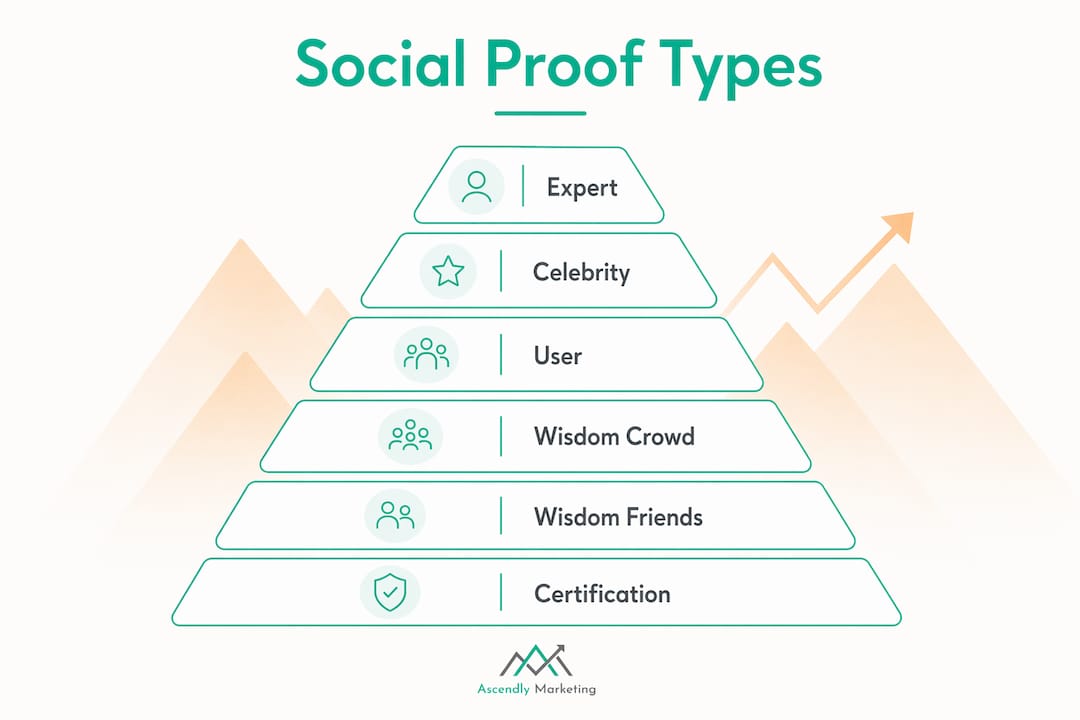
Expert social proof uses authority figures, industry analysts, or credentialed professionals to validate a product. It works best at the top of the funnel when buyers are still evaluating whether a category solution is legitimate.
Celebrity social proof transfers aspiration. A well-known figure associating with your brand signals status and desirability. It is most effective for consumer products where identity and self-image drive purchase decisions.
User social proof includes customer reviews, testimonials, and ratings. This is the most versatile type and the highest-volume driver of conversions across both B2B and e-commerce. Friend and family referrals convert up to 4 times better than other marketing channels, making peer-level trust the gold standard.
Wisdom of the crowd uses aggregate numbers: “10,000 customers served,” “4.8 stars from 2,400 reviews.” It signals safety in numbers and works well for buyers who need reassurance that a product is widely accepted.
Wisdom of friends is the most personal form. Social sharing, referral programs, and “your colleague uses this” prompts tap into existing relationships. This type converts at the highest rate because experts transfer authority, celebrities transfer aspiration, and friends transfer personal validation.
Certification and trust badges from recognized bodies (BBB, SSL certificates, industry associations) reduce friction at the point of purchase. They are especially effective for first-time buyers who have no prior relationship with your brand.
Pro Tip: Stack three to five complementary types rather than relying on one. Combining testimonials with logos produces an 84% conversion lift versus 43% for logos alone. The combination nearly doubles the impact.
For B2B buyers, the mix shifts toward detailed case studies, peer reviews, and ROI-focused data. B2B buyers cross-check an average of 4.4 review sites before contacting a vendor. A single testimonial will not close that gap. A structured library of case studies, third-party ratings, and expert endorsements will.
How to build a social proof strategy that actually converts
Effective social proof is not just about collecting reviews. It is about placing the right evidence in the right location for the right visitor at the right moment.
1. Prioritize volume and recency
Aim for at least five reviews per product or service page. Below that threshold, the conversion lift is marginal. Recency matters equally. A page with 50 reviews from three years ago performs worse than one with 20 reviews from the past 90 days. For local businesses, fresh reviews signal that the business is active and trustworthy.
2. Target the optimal star rating
A perfect 5.0 rating triggers suspicion. 46% of shoppers distrust perfect scores, and a 4.4-star rating with many reviews consistently outperforms a flawless one. Aim for a 4.2 to 4.5 star average. That range signals authenticity without raising red flags.
3. Place social proof adjacent to your CTA
Social proof placed next to primary CTAs can yield over 60% lift in conversions. Do not bury testimonials at the bottom of the page. Put star ratings above the fold, place a short testimonial directly beside your “Buy Now” or “Book a Call” button, and repeat trust signals at every decision point.
4. Optimize for mobile
79% of reviews are read on mobile devices. A star rating that renders beautifully on desktop but collapses into a broken layout on a phone is worse than no rating at all. Mobile-first design for social proof elements is not optional in 2026.
5. Personalize by visitor segment
Visitor-segmented social proof can lift conversion by up to 260%. Show enterprise logos to enterprise visitors and SMB case studies to small business visitors. Generic social proof is better than none, but personalized social proof is in a different performance category entirely.
6. Respond to negative reviews
One in three unhappy customers upgrades their rating after a thoughtful response. Negative reviews handled well become proof of your customer service quality. Ignoring them signals indifference. A visible, gracious response to criticism builds more trust than a page of five-star praise.
Pro Tip: Adding star ratings to email subject lines can lift open rates by approximately 17%. Test this in your next campaign before investing in more complex social proof infrastructure.
For a deeper look at how these principles apply to your website’s conversion architecture, the conversion rate optimization strategies guide from Ascendly Marketing covers the full framework.
Real-world examples of social proof driving marketing results
The impact of social proof is not theoretical. Across industries, specific implementations produce measurable, repeatable lifts in conversion and revenue.
E-commerce product pages with robust user-generated content and reviews see the most dramatic gains. The 270% conversion lift from five or more reviews applies directly to product detail pages where buyers make final decisions. Brands that actively request post-purchase reviews consistently outperform those that wait passively.
B2B SaaS landing pages that feature case studies with named companies and specific ROI figures convert significantly better than those with anonymous quotes. B2B buyers trust peer reviews over vendor claims and convert 60% more when case studies feature companies similar to their own. The similarity principle is the engine here.
Referral programs built around the wisdom-of-friends model produce outsized results because they activate existing trust networks. When a colleague recommends a tool, the recipient skips the skepticism phase entirely. Building a referral program that makes sharing frictionless is one of the highest-return investments in social proof.
Social media and influencer campaigns work when the influencer’s audience genuinely overlaps with the brand’s buyer profile. Mismatched influencer partnerships produce impressions without conversions. The trust transfer only works when the audience perceives the influencer as a peer or aspirational figure, not as a paid spokesperson with no authentic connection to the product.
Local service businesses benefit most from review volume on Google Business Profile and industry-specific directories. For a local business, 97% of consumers reading reviews before making contact means that a thin or outdated review profile is effectively invisible. Consistent review generation is not a marketing tactic for local businesses. It is a survival requirement.
For practical guidance on crafting testimonials that convert, Ascendly Marketing’s resource library covers the structure and language that makes customer quotes actually persuasive.
Key Takeaways
Social proof is the single most cost-effective trust signal available to marketers, and placement, volume, and authenticity determine whether it converts or gets ignored.
| Point | Details |
|---|---|
| Volume drives conversion | Five or more reviews can lift purchase likelihood by up to 270% compared to zero reviews. |
| Optimal rating beats perfect | A 4.2 to 4.5 star average converts better than a perfect 5.0, which triggers buyer suspicion. |
| Placement is decisive | Social proof adjacent to CTAs yields over 60% conversion lift; above-the-fold placement on mobile is non-negotiable. |
| Stacking multiplies impact | Combining testimonials with logos produces 84% conversion lift versus 43% for logos alone. |
| Personalization compounds gains | Segmenting social proof by visitor type (enterprise vs. SMB) can lift conversion by up to 260%. |
What I’ve learned about social proof after years of watching it work and fail
The businesses that get the most from social proof share one trait: they treat it as a system, not a decoration. They collect reviews on a schedule, respond to every negative comment within 24 hours, and test placement the same way they test ad copy. The businesses that struggle treat social proof as a one-time setup task, paste a few testimonials on their homepage, and wonder why conversion rates stay flat.
The trend I watch most closely right now is the collapse of tolerance for fake or inflated social proof. Fabricated testimonials and inflated review counts cause permanent trust erosion. Consumers in 2026 are more skeptical than ever, and they are better at detecting inauthenticity. A page with 847 five-star reviews and zero negative feedback reads as suspicious to anyone paying attention.
The counterintuitive truth is that visible imperfection builds more trust than apparent perfection. A 4.3-star rating with a mix of detailed reviews, including a few critical ones with thoughtful responses, signals a real business with real customers. That is what buyers are looking for.
Mobile-first social proof is the other shift that most businesses are still underestimating. If your star ratings do not render cleanly on a phone screen, or if your testimonial carousel breaks on iOS, you are losing trust at the exact moment a buyer is ready to act. The investment in mobile optimization for social proof elements pays back faster than almost any other conversion improvement.
My honest recommendation: start with review generation, fix your placement, and then layer in personalization. Do not try to build the full system at once. Get the fundamentals right, measure the lift, and then add complexity.
— Ascendly Marketing
How Ascendly Marketing helps you build social proof that converts
Building a social proof system that actually moves revenue requires more than collecting a few testimonials. It requires knowing which types to use, where to place them, and how to keep them fresh and credible over time.
Ascendly Marketing has worked with businesses across industries since 2013 to build digital marketing strategies that include testimonial management, referral program setup, review generation workflows, and conversion-focused website design. The team brings together SEO specialists, content creators, and conversion strategists who understand how social proof fits into the full buyer journey. If you want a marketing partner who treats social proof as a system rather than an afterthought, Ascendly Marketing is worth a conversation.
FAQ
What is the role of social proof in marketing?
Social proof reduces buyer uncertainty by showing that other people have already made and validated the same purchase decision. It transfers trust from existing customers or credible sources to your brand, accelerating conversions.
How many reviews does a business need to see a conversion lift?
Five or more reviews can increase purchase likelihood by up to 270% compared to zero reviews. Below that threshold, the impact is minimal.
What star rating converts best?
A rating between 4.2 and 4.5 stars consistently outperforms a perfect 5.0. Forty-six percent of shoppers distrust perfect scores, making a slightly imperfect rating more credible and more persuasive.
Which type of social proof converts best for B2B?
B2B buyers respond most strongly to peer case studies featuring companies similar to their own, combined with expert endorsements and third-party review site ratings. They cross-check an average of 4.4 review sites before contacting a vendor.
Does responding to negative reviews actually help?
One in three unhappy customers upgrades their rating after receiving a thoughtful response. Responding to criticism publicly demonstrates accountability and builds trust with future buyers who read the exchange.