

TL;DR:
- User experience influences conversion rates and revenue by creating smoother, accessible interactions. Testing with five users and focusing on speed, navigation, and accessibility significantly improves business outcomes. Continuous measurement and iteration are essential for maintaining effective UX and maximizing return on investment.
User experience (UX) is defined as the overall perception and reaction a person has when interacting with a product, service, or digital system. The ISO 9241 standard and the Nielsen Norman Group both frame UX as covering emotions, perceptions, usability, and the full arc of interaction. For digital marketers, startups, and business owners, this definition carries a direct financial weight. UX investment returns up to $100 for every $1 spent through increased conversions and reduced support costs. That ratio makes UX one of the highest-return activities in any marketing budget.
What is user experience design, and what does it include?
User experience design is the practice of shaping every touchpoint a visitor encounters on your website or product. It covers visual layout, content clarity, navigation logic, load speed, accessibility, and the emotional response those elements create together. UX is not the same as user interface (UI) design, though the two overlap. UI handles the visual layer: buttons, colors, and typography. UX handles the full interaction: whether a visitor can complete a task, feels confident doing it, and wants to return.

The seven core UX principles
Good UX rests on seven principles that guide every design decision:
- Consistency: Buttons, labels, and layouts behave the same way across every page. Inconsistency forces visitors to relearn the interface constantly.
- Hierarchy: Content is organized so the most important information appears first and draws the eye naturally.
- Context: Design adapts to where and how a visitor is using the product, including device type and task stage.
- User control: Visitors can undo actions, go back, and correct mistakes without losing progress.
- Accessibility: Content is usable by people with visual, motor, or cognitive differences. This is not optional. 95.9% of top homepages contain detectable accessibility errors, meaning most websites fail this principle entirely.
- Usability: Tasks are completable with minimal friction and without requiring instructions.
- Feedback: The interface confirms that an action worked, or explains clearly why it did not.
Two psychological principles reinforce these seven. Hick’s Law states that more choices slow decision-making. Fewer menu items and cleaner checkout flows convert better because of this. The Goal Gradient Effect shows that people accelerate effort as they approach a goal. Progress bars and step indicators in checkout flows use this directly.
Pro Tip: Audit your navigation menu. If it has more than seven top-level items, visitors are likely slowing down before they even reach your content.
How does user experience impact marketing and business outcomes?
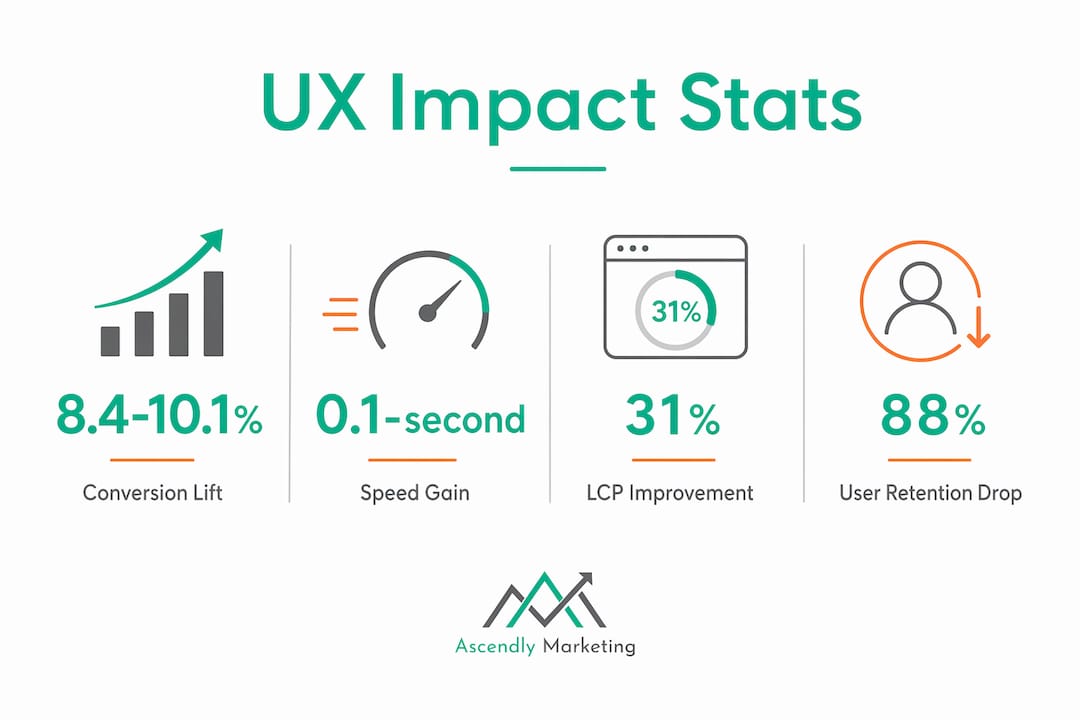
Poor UX is a financial liability, not just a design flaw. 88% of users will not return to a website after a bad experience. That statistic means a single frustrating visit permanently removes a potential customer from your funnel.
Speed is the most measurable UX variable for marketers. A 0.1-second speed improvement increases retail conversions by 8.4% and travel site conversions by 10.1%. Those are not marginal gains. They represent real revenue from visitors who were already on your site. A 31% improvement in Largest Contentful Paint (LCP), the metric Google uses to measure how fast the main content loads, drives an 8% increase in sales.
“Separating UX from business goals is no longer feasible. Design and business strategy must integrate comprehensively to survive in competitive digital markets.”
The revenue gap between companies that invest in design and those that do not is measurable. Top-quartile design companies achieved 32% higher revenue growth and 56% greater total shareholder returns compared to their peers. Design quality at that level is not about aesthetics. It is about how well a product serves the people using it.
| UX Factor | Business Impact |
|---|---|
| 0.1-second speed gain | 8.4–10.1% conversion lift |
| 31% LCP improvement | 8% sales increase |
| Poor UX encounter | 88% of users do not return |
| $1 invested in UX | Up to $100 returned |
| Top-quartile design | 32% higher revenue growth |
The buyer’s journey is now largely digital, which means UX shapes purchase decisions at every stage. A visitor who hits a slow page, a confusing checkout, or an inaccessible form does not call your support team. They leave and buy from someone else.
Pro Tip: Run your site through Google PageSpeed Insights and fix the top three LCP issues first. Speed improvements deliver faster ROI than most design overhauls.
What practical techniques can marketers use to improve user experience?
Improving UX does not require a full redesign or a large budget. The most effective changes are often the smallest. Here is a prioritized sequence for marketers and business owners:
- Run usability tests with five users. Testing with as few as five users surfaces approximately 85% of usability problems. You do not need a research lab. A screen-sharing call with five customers asking them to complete a task on your site will reveal more than months of internal debate.
- Simplify navigation. Apply Hick’s Law directly. Reduce top-level menu items, remove redundant pages, and make the primary call to action visible without scrolling.
- Optimize page speed. Compress images, reduce JavaScript load, and use a content delivery network. Every 0.1 second you save translates to measurable conversion gains.
- Improve content hierarchy. Use clear H1 and H2 headings, short paragraphs, and white space. White space and typography changes can increase content comprehension by up to 20%. Readers who understand your content convert at higher rates.
- Fix accessibility errors. Add alt text to images, check color contrast ratios, and test keyboard navigation. Accessibility improvements also benefit SEO, since search engines read the same structural signals that screen readers use.
- Make your site fully responsive. A layout that breaks on mobile loses the majority of your traffic. Responsive design is a baseline requirement, not a feature.
- Align UX with conversion rate optimization. Every UX improvement should tie to a measurable goal: form completions, time on page, or checkout completions. Read Ascendly Marketing’s guide on conversion rate optimization strategies to see how UX and CRO work together.
Pro Tip: First impressions form in approximately 50 milliseconds. Your homepage hero section is doing more work than any other page element. Treat it accordingly.
How can startups measure and maintain strong UX over time?
Measuring UX is not a one-time audit. It is an ongoing process that connects design decisions to business metrics. The key metrics to track are:
- Bounce rate: A high bounce rate on a landing page signals that visitors are not finding what they expected. It is a UX signal before it is a traffic signal.
- Conversion rate: The clearest measure of whether your UX is working. If visitors arrive but do not act, the experience is failing them somewhere.
- Customer satisfaction score (CSAT): Short post-interaction surveys reveal friction points that analytics cannot show.
- Task completion rate: In usability testing, this measures whether users can actually finish what they came to do.
- Session duration and scroll depth: These show whether content is engaging visitors or losing them partway through.
About 45% of companies conduct no UX testing at all. That means nearly half of all businesses are making design decisions without any user feedback. The cost of that gap shows up in lost conversions and support tickets.
| Metric | What It Reveals |
|---|---|
| Bounce rate | Mismatch between visitor expectations and page content |
| Conversion rate | Overall UX effectiveness at driving desired actions |
| CSAT score | Emotional satisfaction after an interaction |
| Task completion rate | Whether users can accomplish their goals |
| Session duration | Depth of content engagement |
Continuous iteration is the best practice for maintaining UX quality. Run a usability test after every major site change. Track your core metrics monthly. Connect your marketing ROI measurement process to UX data so design decisions have financial accountability. Accessibility compliance also requires monitoring. Standards evolve, and new content can introduce errors that were not present in the original build.
Key Takeaways
Strong user experience is the single most cost-effective investment a digital marketer or business owner can make, returning up to $100 for every $1 spent while directly driving retention, conversions, and revenue growth.
| Point | Details |
|---|---|
| UX definition | UX covers emotions, usability, and the full interaction a visitor has with your site. |
| ROI of UX | Every $1 invested in UX returns up to $100 through conversions and reduced support costs. |
| Speed matters | A 0.1-second speed gain lifts retail conversions by 8.4% and travel conversions by 10.1%. |
| Test with five users | Five-user tests surface 85% of usability problems at a fraction of full research costs. |
| Measure continuously | Track bounce rate, conversion rate, and CSAT monthly to catch UX problems before they cost revenue. |
Why UX is the most underrated business decision you will make
At Ascendly Marketing, we have worked with startups and established businesses since 2013, and the pattern is consistent. Companies treat UX as a design expense. They budget for it reluctantly, cut it first when margins tighten, and then wonder why their paid traffic is not converting.
The uncomfortable truth is that UX is a revenue decision, not a design decision. When we audit a client’s site and find a three-second load time, a checkout with eight required fields, and a mobile layout that breaks on Android, we are not looking at aesthetic problems. We are looking at a leaking funnel. Every dollar spent on ads is partially wasted because the destination is failing the visitor.
The other mistake I see constantly is treating UX as a launch task rather than an ongoing discipline. A site that tested well in 2023 may be failing visitors in 2026 because the audience changed, the device mix shifted, or new content broke the original hierarchy. The businesses that grow consistently are the ones that schedule quarterly UX reviews the same way they schedule financial reviews.
My strongest advice: start with five users and a screen-sharing tool. You will learn more in two hours than in two months of internal meetings. Then connect every finding to a metric. Stakeholders fund what they can measure, and UX improvements are very measurable when you track them correctly.
— Ascendly Marketing
How Ascendly Marketing builds UX that converts
Ascendly Marketing designs websites and marketing programs where UX is built into the foundation, not added afterward. Every site we build starts with user research, load speed benchmarks, and accessibility checks before a single visual element is finalized.

Our team of designers, SEO specialists, and content creators works from the same performance data your business tracks: conversion rates, bounce rates, and revenue per visitor. If your current site is losing customers to slow load times, confusing navigation, or poor mobile design, our website design services address each of those directly. We also integrate organic SEO with UX improvements so that better rankings bring visitors to a site that actually converts them. Book a consultation with Ascendly Marketing to see what a UX audit reveals about your current site.
FAQ
What is user experience in simple terms?
User experience is the overall feeling a person has when using a website, app, or product. It covers how easy, fast, and satisfying the interaction feels from start to finish.
What is the difference between UX and UI?
UI (user interface) refers to the visual elements like buttons, colors, and layouts. UX covers the full interaction, including whether those elements help users complete their goals efficiently and without frustration.
How does user experience affect marketing results?
Poor UX directly reduces conversions and retention. 88% of users will not return to a site after a bad experience, and a 0.1-second speed improvement alone can lift conversions by up to 10.1%.
How many users do I need to test UX effectively?
Testing with as few as five users surfaces approximately 85% of usability problems. Large-scale research panels are not required for meaningful UX insights.
What UX metrics should marketers track?
The most relevant metrics are bounce rate, conversion rate, customer satisfaction score, task completion rate, and session duration. Together, they show where visitors are succeeding and where they are dropping off.