

Your inbox already tells the story. A sales rep leads with a pitch, asks for a meeting in line two, adds generic claims in line three, and wonders why nobody replies. An unread email creates nothing. No conversation, no qualification, no pipeline.
Most B2B cold emails get deleted for one simple reason. They center the sender instead of the buyer. They talk about services before context, push a call before offering value, and use vague language that could’ve gone to any company in the same industry. Prospects see that in seconds. Then they move on.
The fix isn’t writing “better copy” in the abstract. It’s choosing the right structure for the right situation, then building your message around a specific trigger, a single ask, and a credible reason to respond. That is where a useful cold email template B2B strategy starts. Not with swipe files. With fit.
The seven frameworks below are built for actual outreach situations. Some work when you’ve identified a pain point. Some work when you have proof, a referral, or a useful asset to offer first. Each one gives you a working angle, a sample template, follow-up logic, test variables, and a benchmark mindset so you can judge what is working instead of guessing. If you want more starting points before customizing your own, browse these email outreach templates.
1. The Problem-Agitation-Solution Cold Email for Service-Based B2B

PAS works when the prospect already feels friction. You don’t need to educate them from zero. You need to show that you understand the operational drag they’re dealing with and that your fix is practical.
An agency selling conversion work to e-commerce teams can use this well. So can a SaaS vendor selling automation to manufacturers still managing inventory with manual workflows. The email lands when the pain is visible, and the wording is specific.
How to frame the message
Start with one issue the buyer would recognize without debate. Then tighten the screw. Show what that issue causes inside the business. After that, offer one narrow next step, not a catalog of services.
A simple version looks like this:
Practical rule: If the prospect could forward your email to three other companies without editing it, it isn’t specific enough.
Example template
Hi [First Name],
Noticed [specific trigger], and it often points to [clear problem].
That usually creates [business consequence], which slows [team outcome] and makes [cost or inefficiency] harder to control.
We help [company type] fix that through [short solution]. If useful, I’m happy to share a quick view of where [Prospect Company] may be losing momentum.
Open to a 20-minute conversation next week?
[Name]
Follow-up sequence and test points
The first follow-up shouldn’t repeat the same wording. Add a sharper angle. If email one focused on the problem, email two should show the cost of waiting. Email three should reduce friction with a lighter ask, such as permission to send a short audit summary.
Use one CTA only. Technical testing of 2026 B2B cold email templates found that messages with 75 to 125 words, subject lines of 3 to 7 words, and exactly one clear CTA reached a 6.7% response rate and 48% open rate in a test on 8,500 B2B leads, outperforming longer emails with multiple CTA options, according to Leadfeeder’s cold email template benchmark.
For practitioners, that changes how you write PAS emails:
- Test the pain angle: Use one operational problem per segment, not several.
- Test the CTA format: Compare “open to a brief call?” against “want the audit summary?”.
- Test the first line: Pull from a website change, hiring pattern, product update, or messaging shift.
If you want sharper execution on this style, these cold email tips from Ascendly Marketing are a solid companion.
2. The Social Proof and Case Study Cold Email

This format lowers skepticism. The buyer doesn’t have to imagine whether your offer might work. They see that a similar company had a similar issue and got a result.
The mistake is choosing proof that’s impressive but irrelevant. A manufacturing VP won’t care about your e-commerce win. A mid-market SaaS leader won’t care about a giant enterprise case if the buying conditions are different. Match by industry, size, and challenge first. Metrics come second.
The email structure that earns replies
Use the proof early. Put it in the first or second sentence. Then connect that proof to the recipient’s world and ask for a low-friction next step.
Example template
Hi [First Name],
We recently helped a company in [similar industry] address [specific issue].
The change that mattered was [brief intervention]. That gave their team a cleaner way to handle [business challenge].
You may be looking at something similar at [Prospect Company]. If helpful, I can send the short breakdown and walk through what might translate.
Worth sending over?
[Name]
A case study cited by Unkoa reported that a value-first hook paired with vertical-specific proof moved response rates from 4.2% to 9.8%, while bounce rates dropped to 1.1% and open rates held at 42% across 15,000 prospects in the US and UK, according to Unkoa’s B2B cold email campaign example.
What to include and what to leave out
The strongest version of this cold email template B2B format includes only the proof that helps the buyer decide whether to engage. Extra details weaken it.
- Lead with the nearest comparison: Same role, same market, or same operational issue.
- Keep the proof brief: One result, one mechanism, one next step.
- Save the full story for later: Offer the full case study in follow-up instead of cramming it into one email.
Buyers trust proof that feels adjacent to their own environment.
When the prospect asks, “Has this worked for a company like us?” this format answers that question fast. If you want to sharpen the trust element behind these emails, review Ascendly Marketing’s guide to social proof in marketing.
3. The Personalized Research and Compliment Cold Email
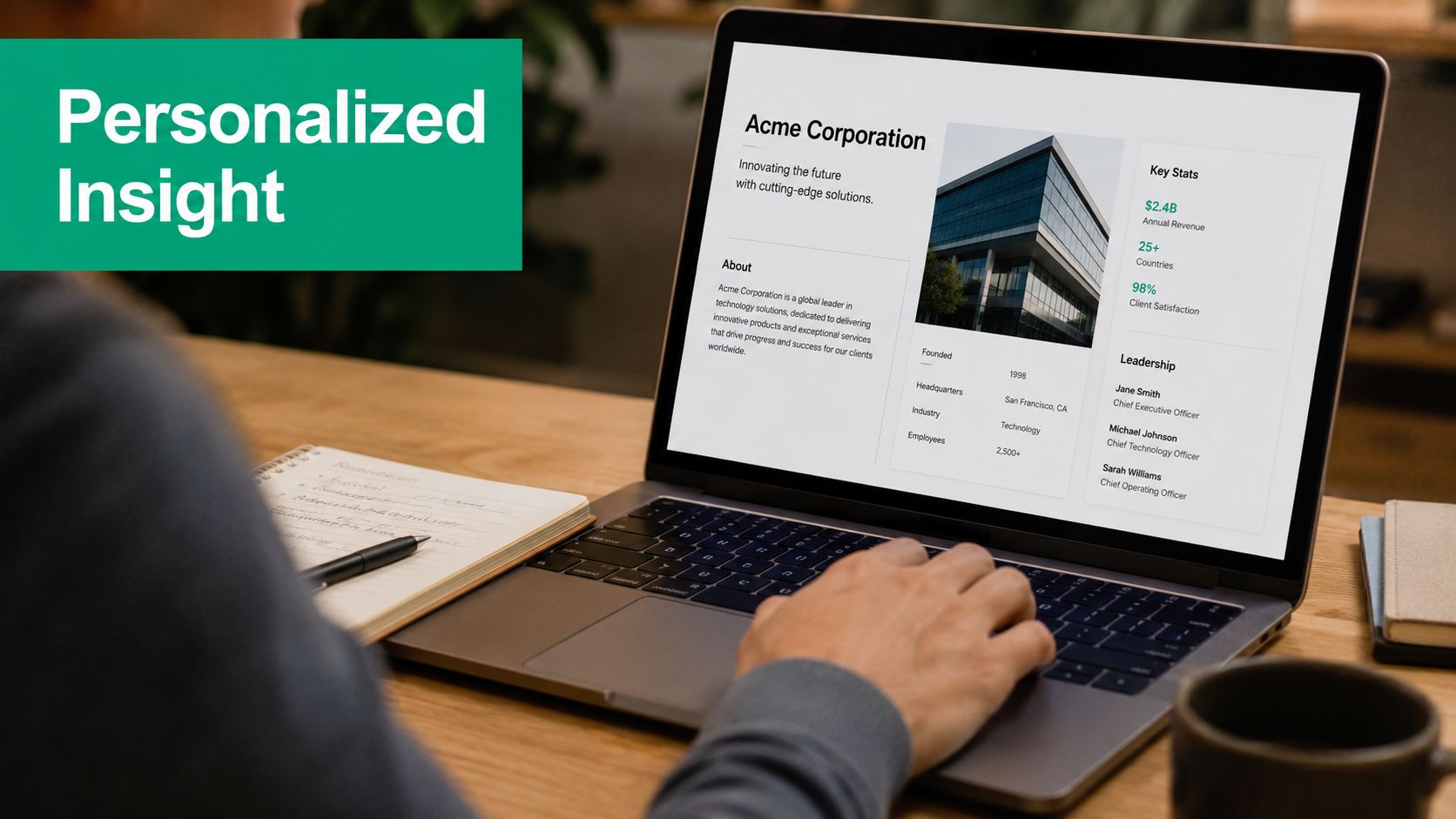
This one fails when the compliment is lazy. “Loved your website” is filler. “Saw your post” is filler. Real personalization names a specific decision, message, launch, or point of view and ties it to the reason you’re reaching out.
The best use case is when the target account is publishing, hiring, repositioning, launching, or speaking publicly. You have something concrete to reference, which makes the email feel earned instead of sprayed.
What good research looks like in the inbox
A marketing leader posts about supply chain messaging. An e-commerce founder writes about reducing cart abandonment. A product team releases a new onboarding flow. Those are all workable entry points because they reveal priorities.
Example template
Hi [First Name],
Read your recent [post/article/update] on [specific topic]. The point about [specific observation] stood out.
That usually connects with [problem or opportunity], especially for teams trying to improve [relevant KPI or workflow].
We help [similar companies] tackle that area with [brief capability]. Open to a short conversation, or would a one-page teardown be more useful?
[Name]
A persona-based approach matters here. A source discussing persona-level templates argues that role, department, and market segment should shape the message, and it states that 90% of current template guides fail to differentiate copy by role-specific KPIs or stakeholders, as covered in this discussion on persona-level cold email personalization.
Follow-up without sounding robotic
The second touch should reference the original research point again, but from a different angle. If the first email mentions a post, the second can mention what that post suggests about current priorities. If the first email compliments messaging, the second can connect that messaging to a concrete opportunity.
Field note: Prospects forgive outreach. They don’t forgive fake familiarity.
Use this framework when you can do real homework. Don’t use it when your team is pulling generic snippets from a scraper and dropping them into a template. That reads like automation because it is automation.
If you’re segmenting this by role, buyer persona development will help you tighten the connection between the research point and the ask.
4. The Value-First Cold Email
Sometimes the fastest route to a reply is removing the meeting request. Offer something useful first. A teardown, a custom audit, a short benchmark note, a competitor positioning summary, or a tool that solves a small problem.
This works because the first yes is smaller. You’re not asking the buyer to commit time on a calendar. You’re asking whether they’d like access to something relevant.
The low-friction version
The value has to stand on its own. If the audit is just bait for a pitch, the buyer will see it immediately. The asset needs to be useful even if they never take a call.
Example template
Hi [First Name],
I reviewed [Prospect Company]’s [site/process/messaging] and noted a few areas that may be slowing [relevant outcome].
I put the findings into a summary with a few practical fixes. No form or meeting needed.
Want me to send it over?
[Name]
A broad industry benchmark says that a 5% to 15% reply rate is strong for well-targeted B2B cold outreach, while the average reply rate across industries is about 3.43%. The same source notes that bounce rate should stay below 2% to protect sender reputation, according to Marin Software’s cold email benchmark overview.
Where teams get this wrong
The value-first angle gets abused in two ways. First, reps promise a “custom audit” that is really a generic PDF. Second, they attach too much content and bury the ask.
Keep it clean:
- Offer one asset: Audit, teardown, or short report. Not all three.
- Make access easy: No heavy gate, no attachment pile, no long explanation.
- Use the follow-up to learn: Ask what stood out or whether they want the next layer.
This format is especially effective when you’re entering accounts that don’t know you and don’t owe you a call. Start by being useful. Then qualify interest based on how they engage with the asset.
5. The Referral and Warm Introduction Cold Email
This is the easiest framework to misuse and the hardest one to recover if you do. A referral line only works when the reference is real, current, and relevant. If “John suggested I reach out” turns out to be vague or outdated, trust drops fast.
When it is real, though, this format shortens the path to a response. The buyer no longer has to process you as a total stranger. Someone inside their circle has already created a small amount of credibility.
The opening line does the heavy lifting
Put the referrer near the top. Don’t hide them in paragraph two. Explain why they thought the conversation made sense, not just that they know you.
Example template
Hi [First Name],
[Referrer Name] suggested I reach out. They mentioned your team is looking at [specific challenge or initiative].
We’ve been helping companies work through that area with [brief service or solution], especially when [specific condition].
If it makes sense, I can send a short outline of what we’ve seen work in similar situations.
[Name]
This is not the place for a long pitch. The referral buys you attention, not a right to over-explain. Keep the trust chain intact.
What to do after the first email
Follow-ups should still be useful. Mention the referral once, then move to substance. Share a short observation, a relevant breakdown, or a suggested next step tied to the original introduction.
A few practical rules help:
- Confirm the intro first: Always make sure the referrer wants their name used.
- State the reason clearly: “Thought you two should speak” is weaker than a specific business reason.
- Stay proportionate: Warm intro does not mean hard close.
If you don’t have a real referral, don’t fake one with “we work with people in your network.” Buyers can tell the difference. Use another framework instead.
6. The Multi-Channel Touchpoint Cold Email
One email rarely carries a campaign by itself. That doesn’t mean you should blast the same message repeatedly. It means your outreach should create familiarity across channels, each one doing a different job.
Email handles detail. LinkedIn supports visibility and context. A phone call can create urgency or clarify fit. Used together, they feel coordinated. Used badly, they feel invasive.
A practical sequence
A simple version works like this. Day 1, send the cold email. Day 3, engage with a relevant LinkedIn post or company update. Day 5, send a short LinkedIn message that references the original angle. Day 7, send a follow-up email with one new insight or a lighter ask.
A source focused on follow-up strategy notes that most replies happen after the second or third message, not the first, and points out that many template collections ignore the follow-up stage entirely, according to Konsyg’s guide to B2B cold email follow-ups.
Timing, channel role, and testing
You don’t need a complicated cadence. You need a sequence that has intent. One useful operating rule is to send Monday through Thursday between 8 and 10 AM in the prospect’s time zone, then pause a campaign after 100 sends if results are underperforming so you can reassess against a meaningful sample, based on guidance in Growleads’ B2B cold email strategy benchmarks.
One channel gets attention. Repeated, coordinated touches create recall.
Test this framework by varying one thing at a time:
- Channel order: Email first versus LinkedIn-first warm-up.
- Message angle: Same problem across channels versus one new angle per touch.
- CTA type: Reply request in email, connection request on LinkedIn, voicemail callback on phone.
The strongest multi-channel sequences don’t repeat. They advance.
7. The Specific Offer or Limited-Time Value Cold Email
Urgency works when the offer is concrete and believable. It fails when the deadline is fake, the value is vague, or the message sounds like a coupon.
Use this format when you have a defined offer that fits a narrow buyer group. A conversion audit for a small set of e-commerce brands. A messaging review tied to a recent launch window. A competitive gap analysis for companies entering a new segment. The value has to be clear before the timer matters.
Structure the urgency around a real offer
The offer goes near the top. The reason for the limit should make sense. Then ask for one small action.
Example template
Hi [First Name],
I’m opening a small number of [specific audits/reviews/workshops] for companies working on [specific initiative].
For [Prospect Company], I’d focus on [specific area] and send back a short action plan your team can use right away.
If you’d like one of the remaining spots, reply with “send it,” and I’ll share the details.
[Name]
This works better than the usual “book this week” language because it gives the buyer a clear picture of what they’re getting. Scarcity without specificity reads like pressure. Specificity without pressure reads like a normal value-first email. This format needs both.
Keep the copy short
Across a large dataset of 5.5 million cold emails, subject lines with only 2 to 4 words reached a 46% open rate, and shorter email bodies in the 40 to 60 word range outperformed longer versions, according to Prospeo’s analysis of B2B cold email performance.
That doesn’t mean every urgent offer should be ultra-short, but it does mean clutter hurts. For this framework:
- Use a tight subject line: Clear beats clever.
- Name the offer fast: The reader shouldn’t hunt for it.
- Give one response path: Reply, not three options.
If the offer is real, a short note can do the job. If the offer needs several paragraphs to sound appealing, it probably isn’t strong enough yet.
7-Point B2B Cold Email Template Comparison
| Template | Implementation complexity | Resource requirements | Expected outcomes | Ideal use cases | Key advantages |
|---|---|---|---|---|---|
| The Problem-Agitation-Solution (PAS) Cold Email | Moderate, requires tailored problem framing and compelling copy | Time for prospect research, industry benchmarks, templated messaging | Engaged prospects who recognize the pain; higher reply intent | Businesses with identifiable operational or revenue pain (e-commerce, B2B services) | Resonates emotionally; outcome-focused; positions sender as expert |
| The Social Proof and Case Study Cold Email | Moderate, assemble relevant case studies and permissions | Verified case studies, metrics, client approvals, concise storytelling | Increased credibility and reduced skepticism; qualified responses | Prospects who need validation (mid-market to enterprise) | Builds trust with measurable proof; persuasive through comparison |
| The Personalized Research and Compliment Cold Email | High, one-to-one customization per prospect | Significant research time, tools (LinkedIn/news), skilled outreach reps | Higher open rates and rapport; conversational replies | High-value accounts, account-based campaigns, executive outreach | Stands out through genuine personalization; builds immediate rapport |
| The Value-First (Content or Tool Offer) Cold Email | Moderate–High, creation and delivery of real assets | Content/tool development, hosting/delivery, tracking systems | Higher initial engagement; self-qualified warm leads | Top-of-funnel outreach, content-driven acquisition, lead nurturing | Low-friction entry; demonstrates expertise and generates engagement data |
| The Referral and Warm Introduction Cold Email | Low–Moderate, depends on existing network and coordination | Network cultivation, referrer confirmation, brief contextualization | Significantly higher response and trust; faster conversations | When mutual connections exist; professional services and B2B referrals | Immediate credibility via endorsement; higher conversion likelihood |
| The Multi-Channel Touchpoint Cold Email (Email + LinkedIn + Secondary Channel) | High, coordinated sequencing and message variation | Multi-channel tools (email, LinkedIn, phone), monitoring, scheduling | Greater visibility and recall; improved overall response rates | Hard-to-reach or high-value prospects requiring persistence | Increases touch frequency across channels; adapts to prospect preferences |
| The Specific Offer or Limited-Time Value Cold Email | Moderate, define limits and enforce deadlines | Offer creation, capacity planning, tracking and follow-up sequences | Faster decision-making and short-term responses; potential lead influx | Time-limited promotions, filling calendar slots, targeted campaigns | Creates urgency and clarity; simplifies internal justification for prospects |
From Template to Pipeline Testing and Optimization
Templates save time. They do not create results on their own. The difference between a dead sequence and a working one usually comes from testing discipline, list quality, and whether the message fits the account you sent it to.
Start with one framework per segment. Don’t mix PAS, social proof, and a value-first giveaway into the same opening message. That creates noise. Pick one angle based on what you know about the prospect. Then test one variable at a time. Subject line first, opening line second, CTA third. If you change all three, you won’t know what moved performance.
Benchmarks help when you use them correctly. For well-targeted campaigns, a reply rate in the strong range is very different from the broad average. But the point isn’t to chase an industry number in isolation. The point is to compare your own variants against each other. If one subject line format lifts opens and one CTA lifts replies, combine those learnings in the next round. Then look beyond opens. Signal-to-meeting rate is the measure that tells you whether interest is turning into pipeline.
Body length is another place where teams overcomplicate the problem. One benchmark says 6 to 8 sentences produce a 42.67% open rate and a 6.9% reply rate, while first-touch emails under 80 words with a single CTA perform best for initial engagement, based on Galadon’s B2B cold email template data. That’s useful because it gives you a working constraint. Your message should fit on one screen, carry one idea, and ask for one action.
Operationally, use a clean process. Segment by persona. Write separate versions for founders, marketing leaders, operations leaders, and revenue teams. Review bounce rate, reply quality, and meeting booked rate together. If a sequence underperforms, don’t just rewrite the copy. Check targeting, timing, and offer relevance. Sometimes the problem isn’t the email. It’s the list.
Track everything somewhere simple and visible. A lightweight CRM for Google Workspace users is enough if your team updates it. The outreach programs that improve fastest aren’t always the ones with the most software. They’re the ones where reps can see what they sent, who replied, which angle worked, and what changed in the last test cycle.
If your team needs a cold email system that goes beyond templates and turns outreach into a measurable lead generation channel, Ascendly Marketing can help build the strategy, messaging, testing process, and supporting assets that make campaigns worth sending.