
Programmatic advertising is the automated buying and selling of digital ad inventory through real-time auction software. It replaces manual insertion orders with impression-level decisions made in milliseconds, so your budget can move through web, mobile, video, apps, social, and TV or audio channels through a system instead of a stack of emails and PDFs.
If you’ve ever sat in a meeting where someone says, “We should run programmatic,” and nobody in the room can explain what that means in plain English, you’re not alone. The simplest way to think about the programmatic advertising definition is this: software checks each available impression, compares it against your campaign rules, and decides whether to bid before the ad slot disappears.
What Programmatic Advertising Means
A common source of confusion is that many advertisers mention programmatic without clarifying whether they mean RTB, private marketplace deals, or guaranteed placements. Programmatic advertising is the automated way digital ad inventory is bought and sold, and the buyer sets the rules while software handles the impression-by-impression decision. That shift matters because it replaces manual back-and-forth with a transaction layer that can respond to privacy changes, audience signals, and inventory availability much faster than human trafficking alone. Benefits of programmatic ad buying are a helpful starting point if you want to compare that buying model with other paid media options.
The plain-English version
A reservation through a sales rep locks in space ahead of time. Programmatic works more like a live market, where software checks each impression, compares it with your targeting and budget rules, and decides whether to bid before the slot disappears. The choice is made at the impression level, not for the whole campaign at once, which is why the system can react to context, device, location, and timing so quickly. Techtarget’s definition of programmatic advertising describes that automation clearly.
Practical rule: If a buyer cannot explain who sets the audience rules, who decides the bid logic, and how the creative gets selected, the setup is not clear enough yet.
That matters because a client does not buy “programmatic” as a vague idea. The client buys access to a transaction system that can place a message in front of the right impression under the right conditions, while the advertiser still controls strategy, budget, and campaign rules. Programmatic is less about handing media buying to a machine and more about moving human decision-making into a faster operating system. EMARKETER’s overview of programmatic advertising shows how widely this model now shapes display buying.
The same logic also explains why real-time bidding gets so much attention. RTB is one buying method inside the broader programmatic system, while the larger category also includes private deals and other transaction paths that do not depend on the open auction every time.
How the Programmatic Buying Chain Works
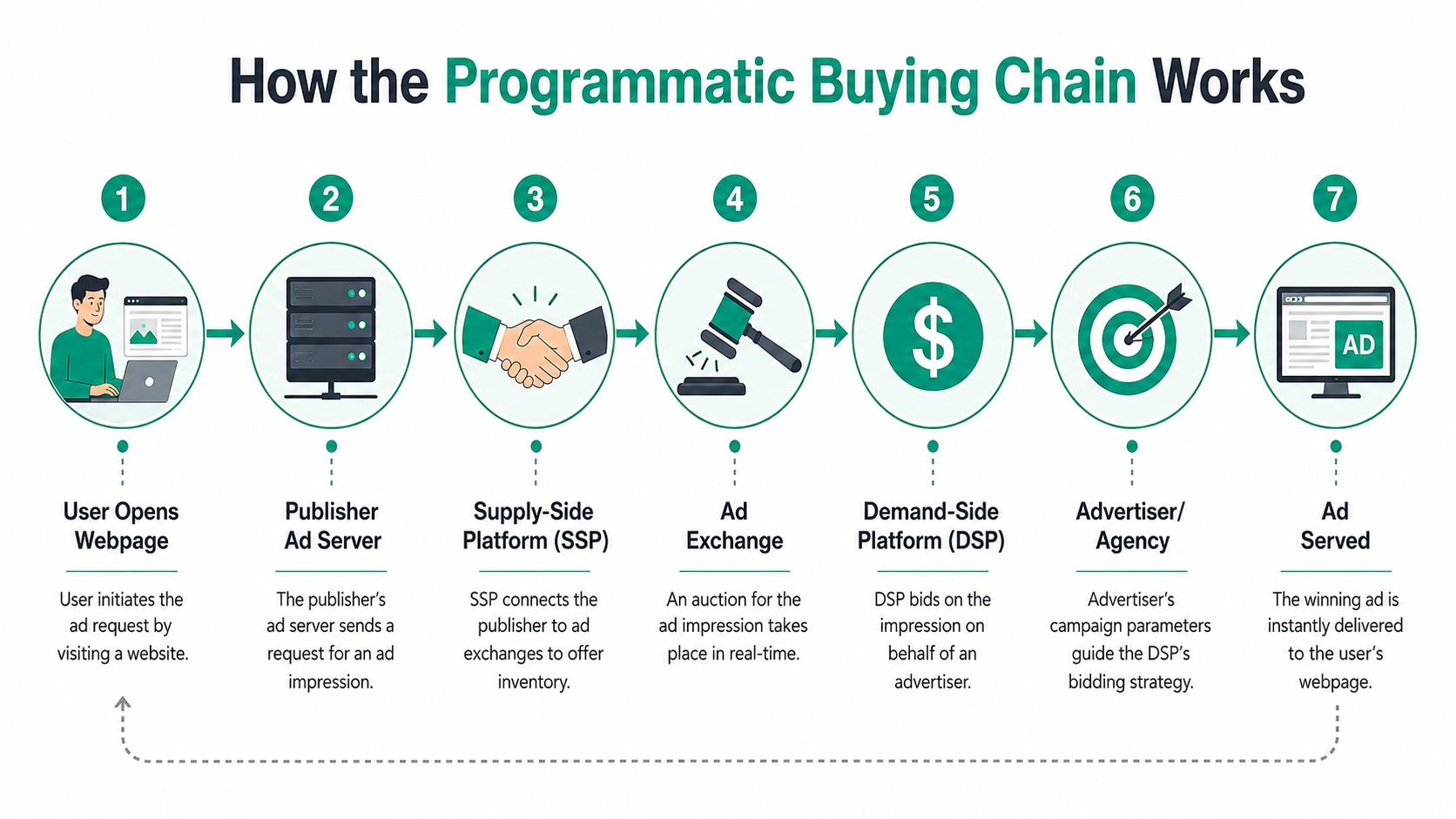
A user opens a page, and the request for an ad impression starts moving through a chain of systems before anything appears on screen. The sequence is easier to follow if you treat it like a relay race. The page creates the opportunity, the supply side passes it along, the buying platform decides whether to run, and the winning ad finishes the handoff.
Who handles what
The usual path runs through a publisher ad server, an SSP, an ad exchange, and a DSP before the winning ad is served. Appsflyer’s programmatic overview describes this chain as a set of connected systems that evaluate impressions using audience signals such as location, browsing behavior, shopping patterns, and other data sources.
Here is the sequence in plain language.
- User opens the page. The page load creates the ad opportunity.
- Publisher ad server sends the request. The inventory is made available for sale.
- SSP exposes the impression. The publisher’s supply tool connects the slot to exchanges.
- Ad exchange runs the auction. Competing bids are matched in real time.
- DSP evaluates the opportunity. The buyer’s platform checks the impression against campaign settings.
- Advertiser parameters guide the bid. Audience rules, timing, and creative logic shape the decision.
- The winning ad is served. The chosen creative appears on the page.
The auction step is the part many new buyers hear about first. Real-time bidding is one way that decision can happen, but it is only one piece of the broader buying chain.
The buyer controls the rules, not the page.
That distinction clears up a common point of confusion. The advertiser does not manually pick every page view one by one. Instead, the buyer sets bidding rules, audience settings, exclusions, creative rotation, frequency controls, and performance goals. The ecosystem then handles execution across many impressions at once. In practice, that means the control sits with the media buyer, while the systems do the fast matching work that would be impossible to manage by hand.
The Four Main Types of Programmatic Deals
Not every programmatic buy uses the same access or pricing model. Open auction buying gives you the broadest reach, while private and guaranteed options trade some openness for more control. For a small or mid-sized business, the choice usually comes down to how much certainty you want around placement, price, and inventory quality.
| Deal Type | Auction Access | Pricing | Best For |
|---|---|---|---|
| Open RTB | Broad, open auction access | Variable, auction-based | Testing, reach, flexible budgets |
| Private Marketplace | Invite-only auction access | Usually higher than open auction | Brand-safe inventory and tighter control |
| Preferred Deals | One-to-one access before open auction | Pre-negotiated | Specific premium placements with flexibility |
| Programmatic Guaranteed | Directly reserved inventory | Fixed and negotiated | Planned campaigns that need certainty |
How to choose without overcomplicating it
Open real-time bidding works well when you want scale and room for testing. It’s the broadest door into the market, which is why many SMBs start there. Private marketplaces narrow the inventory pool and give the buyer more confidence about where the ad can appear. Preferred deals sit between the two, since the buyer can access inventory before the general auction, but without fully reserving it. Programmatic guaranteed deals reserve inventory in advance, which suits campaigns that need a known placement and steady delivery.
For a local business, the open auction often makes sense when the goal is to learn quickly without locking into a large commitment. For a brand with stricter placement requirements, the private or guaranteed route gives more control. The trade-off is simple: more control usually means less openness and less flexibility.
Buyers get caught by language. “Programmatic” does not mean “always cheapest,” and it does not mean “always fully automated with no human oversight.” The deal type shapes how much the buyer can steer the campaign and how much uncertainty remains in the process. The best choice depends on the goal, the creative, and the level of risk the business can accept.
Formats and Channels Programmatic Covers
Programmatic is a buying method, not one ad format. In practical terms, it spans display, native, in-app mobile, online video, connected TV, over-the-top streaming, digital audio, social, and other environments that use automated buying. Adobe’s overview of programmatic advertising made simple lists that channel breadth clearly, and Amazon Advertising also describes programmatic across web, mobile, apps, video, and social media.
What that looks like in daily life
A display ad might appear while someone reads the news on a laptop. A native placement can sit inside a content feed and match the surrounding layout. In-app mobile inventory shows up during app use, often between actions. Video can run before or during streaming content. Audio can appear during a playlist or podcast session. Social placements use the same buying logic, even though the creative environment feels very different from a standard web banner.
Beginners often assume programmatic means display banners, but the system also powers video, CTV, and audio inventory. The buying method stays the same while the screen, or speaker, changes. That means one campaign strategy can move across multiple environments without becoming a different media model each time. For a short explainer on one of the most common high-engagement formats, see programmatic video advertising.
Some channels need a different creative rhythm. Video has motion and sound. Audio relies on voice and timing. Native ads depend on matching the surrounding content without looking forced. Display asks for fast recognition. Social can demand tighter audience and creative alignment because people are already in a scrolling mindset.
That channel-specific rhythm matters because the buyer still controls the target, the bid logic, the budget split, and the creative version tied to each placement. A local retailer might use short display copy for site visits, then pair it with stronger motion in video placements. A B2B team might keep the same audience criteria but adjust the message for native articles, in-app placements, and streaming environments.
When clients understand that breadth, they stop treating programmatic as a single slot in the media plan. They start treating it as a buying system that can follow a user across moments, screens, and contexts.
Benefits and Common Pitfalls to Watch For
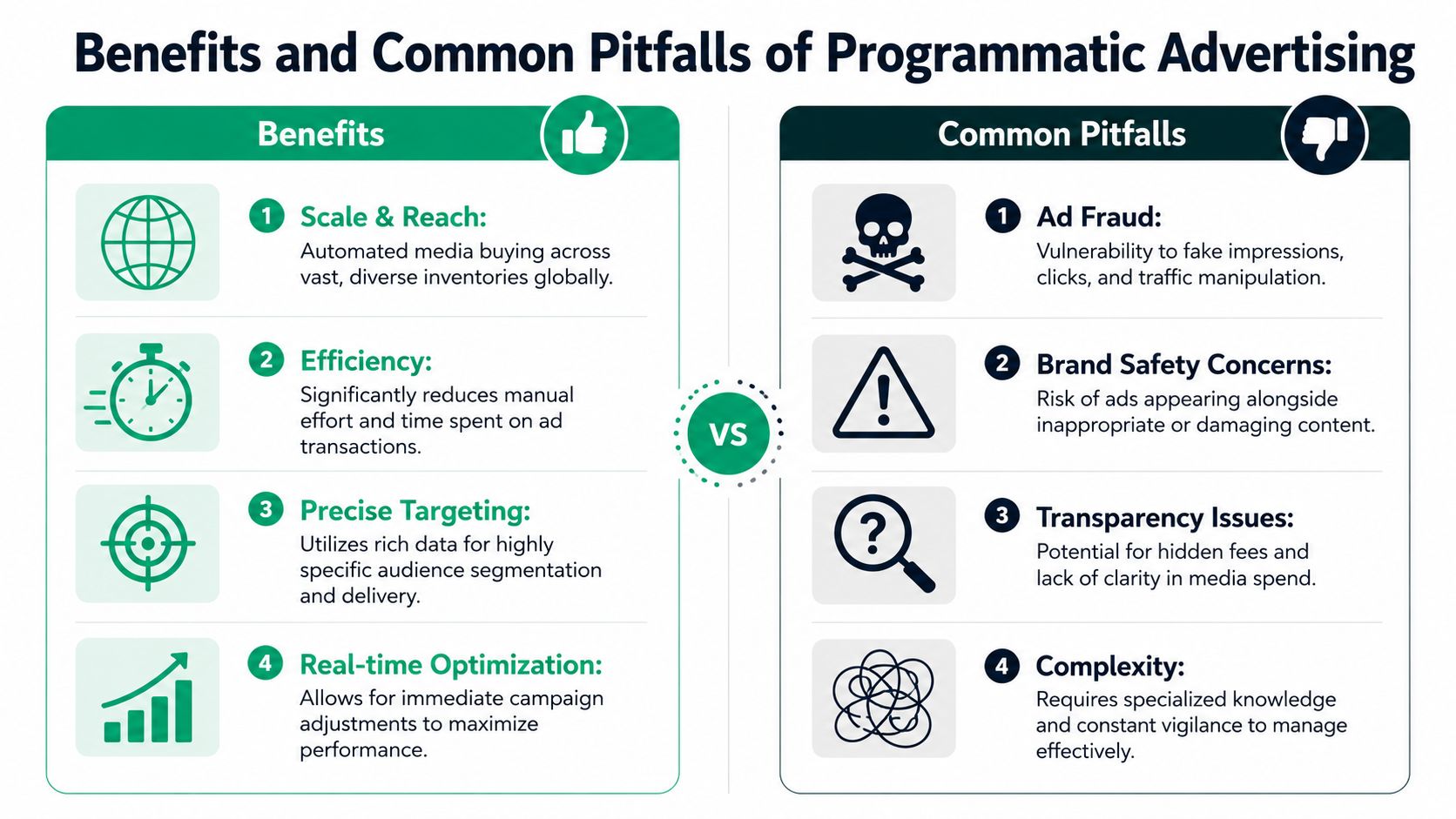
Programmatic won its place because it lets buyers work faster and more selectively than manual buying. The upside is obvious when a team wants broad reach, continuous optimization, and a cleaner way to match inventory to audience signals. The downside is also real, because automation can hide problems if nobody checks quality, placement, and measurement carefully.
What buyers gain
Scale and reach come from automated access to many inventories at once. Efficiency comes from removing manual back-and-forth in the buying process. Precise targeting comes from audience and contextual signals. Real-time optimization comes from the ability to adjust bids, creatives, and placements as the campaign runs. Appsflyer’s overview of programmatic buying explains how DSPs and SSPs use those signals to shift budget toward more valuable placements and reduce wasted spend.
Where campaigns get messy
The first issue is ad fraud, which can make traffic look better than it is. The second is brand safety, since an ad can appear beside content that does not fit the brand. The third is transparency, because buyers sometimes struggle to see every fee or every inventory path. The fourth is complexity, since the system demands setup discipline and ongoing review.
Identity loss and privacy changes make this harder in 2026. Amazon Advertising notes that programmatic is moving toward first-party data, identity resolution, and contextual targeting as third-party identifiers weaken. That shift changes how buyers think about audience reach, measurement, and personalization. For SMBs, the practical question is no longer only “What is programmatic?” It is “How do I use it when tracking is harder, and audience signals are more limited?”
Practical rule: If a buyer cannot explain where the ads ran, what signals drove the bid, and how fraud was screened, the campaign needs a closer review.
That balance is the story. Programmatic is powerful because it is automated. It still needs a human who knows how to question the data.
Metrics That Actually Matter in a Programmatic Campaign
A dashboard can fill up fast, but not every metric deserves equal attention. A new buyer usually gets distracted by impression volume first, then starts chasing clicks without asking whether those clicks lead anywhere useful. The better habit is to watch a small set of metrics that show both delivery and business quality.
The core numbers to read
Impressions tell you how often the ad was served. Click-through rate tells you whether the creative gets attention. Viewable CPM helps you compare cost against viewable inventory rather than raw delivery alone. Cost per acquisition shows what a conversion costs. Return on ad spend connects media cost to revenue. View-through conversions matter when users see an ad and convert later without clicking. Frequency shows how often the same person keeps seeing the ad.
A useful rule for SMBs is to look for consistency before trying to chase aggressive efficiency gains. If impressions rise but conversions stay flat, the campaign may be buying attention without buying outcomes. If frequency climbs too high, the audience can get worn out. If CPA improves while volume falls sharply, the buy may be too narrow for the business goal.
| Metric | What It Tells You | What Usually Needs Attention |
|---|---|---|
| Impressions | Delivery volume | Weak reach or overdelivery |
| CTR | Creative response | Low relevance or weak message |
| CPA | Cost per conversion | Poor audience quality or landing page mismatch |
| ROAS | Revenue relative to spend | Weak conversion value or poor margin fit |
| Frequency | Exposure per person | Ad fatigue or wasted spend |
For a broader view on how performance metrics reveal profit quality rather than surface-level traffic, reveal true profitability is a useful phrase to keep in mind when you review reports.
When the numbers disagree, trust the business outcome first. A campaign that drives a lot of activity but has weak conversions usually needs better audience rules, better creative, or a different landing page. The dashboard is only useful when it helps you make that call.
Programmatic in Action for Small and Mid-Sized Businesses
A regional service business usually needs local demand, not broad awareness for its own sake. A plumbing company, for example, can use geofenced display inventory to reach homeowners in selected zip codes when service demand is slow. The goal is simple: keep the brand visible in the right area and prompt inquiries from people nearby. For a tighter look at audience strategy, why use targeted advertising to grow your SMB fits naturally with this use case.
Two common setups
A mid-sized e-commerce brand uses programmatic differently. It can combine retargeting with prospecting through a DSP, then use first-party email audiences to reconnect with known shoppers. The setup usually splits attention between people who already visited the site and people who resemble high-value buyers. That gives the brand a way to speak to warm users without ignoring new demand.
The buying decisions differ in each case. A service business may keep the audience narrow, lean on local relevance, and focus on inquiries. An e-commerce brand may prioritize product pages, cart abandoners, and category shoppers, then use creative that reflects the items people already viewed. The first buyer wants local intent. The second wants purchase recovery and demand capture.
A small budget works harder when the audience list is specific and the goal is narrow.
That principle helps both businesses avoid waste. A broad campaign can look active and still miss the business objective. A focused campaign may look smaller in the dashboard and still produce cleaner traffic, better relevance, and a clearer path to conversion.
Hiring a Programmatic Partner and Getting Started
A business can buy programmatic in-house, but the process works better when someone owns the setup, the reporting, and the cleanup. The first step is an audit of inventory, audience data, and conversion tracking. The second is choosing between a self-serve DSP and a managed service model. The third is deciding how the team will judge success before any budget goes live.
A practical launch plan looks like this.
- Audit the audience data: Check what first-party lists, site visitors, and customer segments you can use.
- Define the outcome: Pick one goal, such as leads, purchases, or remarketing recovery.
- Set measurement first: Confirm conversion tracking, attribution settings, and reporting access.
- Start with a test budget: Keep the first cycle small enough to learn, then expand based on evidence.
- Review placements and exclusions: Check where ads ran and remove poor-quality inventory.
A partner can help with setup, but the buyer still needs control over goals and guardrails. Ascendly Marketing works through a discover, plan, execute, report process, and that structure fits programmatic because the channel needs clean inputs and steady review. The same team can also connect paid media, SEO, content, and analytics so the ad spend doesn’t sit in a separate reporting island.
When you’re ready, ask for a media audit, a tracking review, and a short test plan before you commit to a longer flight. That keeps the campaign grounded in data, not assumptions. It also gives you a clear view of whether the programmatic channel fits your funnel and your budget.
If you want help turning programmatic into a working media plan rather than a jargon-heavy slide deck, visit Ascendly Marketing and ask for a consultation. The team can review your audience data, check your tracking setup, and map a programmatic plan that connects with PPC, SEO, and content instead of running on its own.