

Most voice search advice is stuck in an older search model. It tells you to chase featured snippets, add a few FAQ blocks, and wait for Siri or Google Assistant to reward you. That still matters, but it no longer covers the whole system.
A business can rank well in standard search and still lose voice answers. That happens because modern assistants don’t just pull a blue link. They often synthesize an answer, compare sources, and choose the page that is easiest for a machine to interpret. Recent data shows voice search now drives 27% of all queries, yet 80% of voice optimization articles still focus on older snippet tactics while modern assistants increasingly pull answers from AI overviews. That’s the gap.
The shift is simple to describe and harder to execute. Old voice search optimization focused on matching phrases. Current voice search optimization rewards machine-ready answers, strong topic coverage, and clear structure that works for both search engines and generative systems. If you need a practical parallel, this e-commerce guide to AEO in 2026 is useful because it frames the same change through the lens of answer engines rather than just rankings.
A plumber is a good example. The old approach targeted terms like “emergency plumber Houston.” The newer approach still includes that service intent, but it also answers spoken questions such as “why is my water heater making a popping sound” or “who can fix a burst pipe near me tonight.” One is a keyword target. The other is a customer problem stated the way real people talk.
Beyond the Beep: The New Rules of Voice Search
The common advice says this: Win the snippet and you’ll win voice. That advice is incomplete.
Voice search optimization now sits inside a wider search environment where Google Assistant, smart speakers, mobile assistants, and AI answer tools all need content they can extract fast and trust enough to cite. That’s why Generative Engine Optimization, or GEO, matters. You’re no longer optimizing only for a search result page. You’re optimizing for systems that rewrite, summarize, and speak.
What changed in practice
When someone types, they often compress intent. When they speak, they expand it.
A typed query might be “drain cleaning The Woodlands.” A spoken query becomes “who can unclog a kitchen sink in The Woodlands today.” The page that wins isn’t always the page with the strongest exact-match phrase. It’s often the page that:
- States the service clearly in plain language
- Answers the question directly near the top of the section
- Supports the answer with context that helps an AI system trust what it found
- Connects the service to place and scenario instead of just repeating a city term
Before and after for a local service page
| Version | What it looks like | What happens |
|---|---|---|
| Old page | “We offer plumbing, repair, maintenance, installation, and more in Houston.” | Too broad. Weak answer extraction. |
| Revised page | “Need a plumber for a running toilet in The Woodlands? A running toilet usually points to a worn flapper, fill valve issue, or float problem. A plumber can diagnose the cause and stop ongoing water waste.” | Clear spoken query match. Better extraction. |
Practical rule: Build pages around customer questions and service situations, not isolated keywords.
This doesn’t mean snippets are dead. It means snippet logic is now only part of the job. The stronger strategy is to make every important page answer-ready for both classic search and AI-generated responses.
How to Research Conversational Keywords
The first job isn’t “find high-volume keywords.” The first job is to map how your customers talk when they want help. By 2025, voice assistants are projected to handle over 3.5 billion voice searches per day globally, and smartphones account for 56% of all voice-search device usage. That changes keyword research because mobile voice behavior is immediate, specific, and often question-based.
Start with your existing keyword process if you already have one, then adapt it for spoken language. If your team needs a broader foundation first, this guide on keyword research for marketers is a useful baseline before you shift into voice-specific patterns.

Use spoken language sources, not just SEO tools
Standard tools still help, but they don’t tell the full story on their own. The better inputs usually come from places where customers phrase questions naturally.
Use a mix of:
- People Also Ask results to find how Google frames follow-up questions
- AnswerThePublic to surface question patterns around a service or product
- Reddit, forums, and community threads to spot the language people use before they know the technical term
- Sales calls and support logs because they show the exact wording buyers use when they need help now
A typed seed term like “plumber Houston” should become a cluster of spoken queries:
- Price questions such as “how much does it cost to fix a running toilet in The Woodlands”
- Urgency questions such as “who can repair a burst pipe near me tonight”
- Diagnostic questions such as “why does my faucet squeal when I turn it on”
Build answer-ready targets
Don’t just collect questions. Group them by intent and assign each group to a page or section.
A simple framework works well:
- Core service
- Spoken modifier
- Location or scenario
- Direct answer block
Poor structure:
“Plumbing services include repairs, inspections, leak checks, and many other solutions for homeowners across the area.”
Better structure:
“Why does my toilet keep running? A running toilet usually means the flapper, fill valve, or float isn’t working correctly. A plumber can inspect the tank components, replace worn parts, and stop continuous water flow.”
That opening answer is short enough to extract and specific enough to satisfy the query.
Later in the process, review this walkthrough for a different perspective on spoken-query content planning:
Ask one blunt question during research: “Would a customer actually say this out loud?” If the answer is no, rewrite the target phrase.
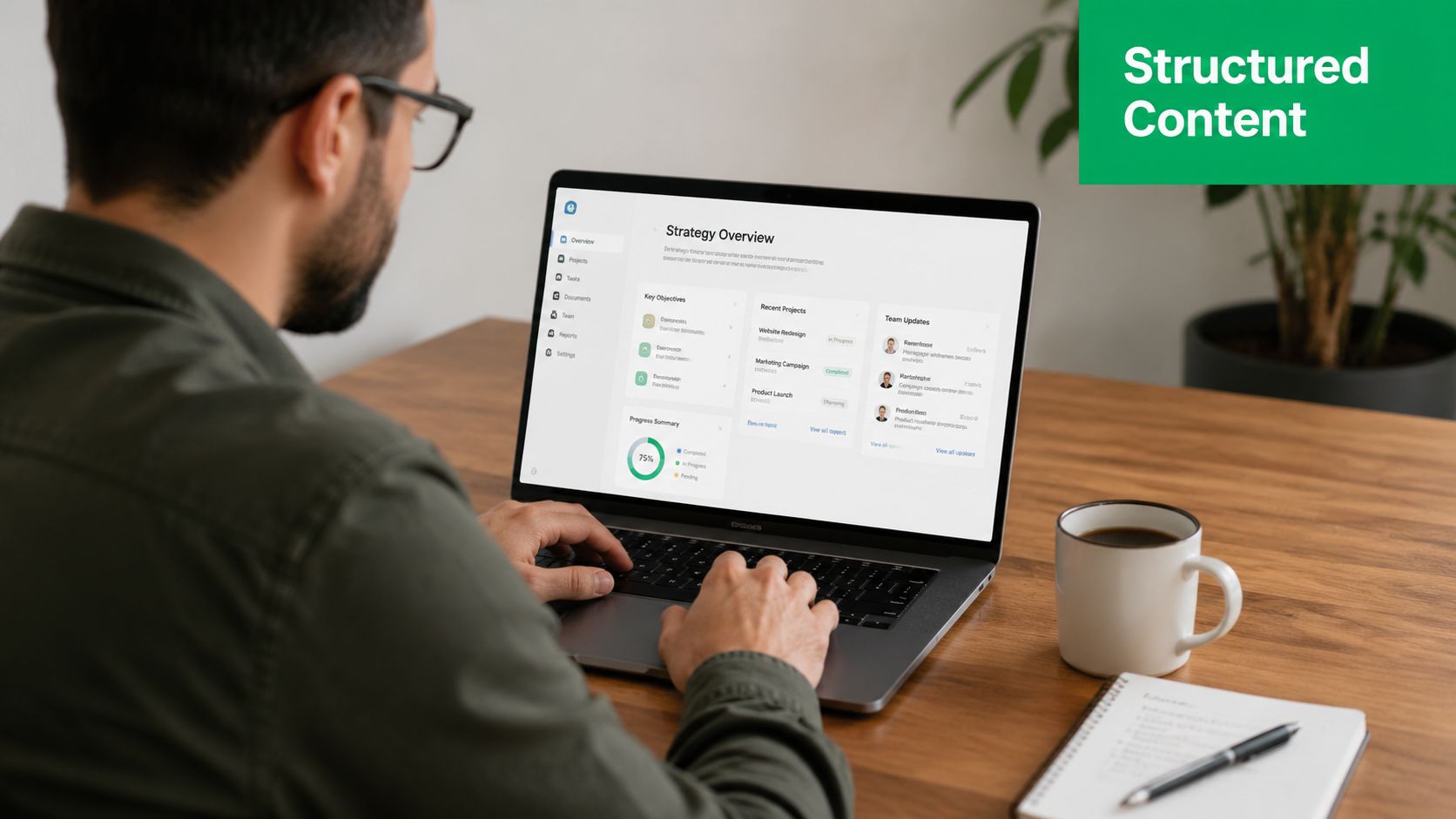
Structuring Content for AI Comprehension
Once you’ve mapped conversational keywords, the page has to become easy for a machine to parse. That’s where most voice search optimization projects fail. The research is decent, but the content is still written as a long service pitch with no clean extraction points.
For voice search optimization, success is measured by capturing position zero, and that requires concise answers of 29 to 43 words directly under clear headings. That range is useful because it forces discipline. You stop rambling. The answer becomes visible to both the user and the system reading the page.
The page structure that works
A strong voice-ready section usually has four parts:
- A heading that matches the spoken question
- A direct answer block under that heading
- Supporting detail in short paragraphs or lists
- Related follow-up questions nearby
Here’s the difference.
Weak version
Water Heater Repair Services
We provide dependable water heater repair services for homeowners dealing with all kinds of issues. Our team handles many common water heater problems and can help diagnose the cause quickly.
This is readable. It isn’t answer-ready.
Improved version
Why is my water heater making a popping sound?
A popping sound from a water heater usually means sediment has built up in the tank and is trapping water beneath it. A technician can inspect the unit, flush buildup if appropriate, and check for overheating or component wear.
Then add the support below:
- Common cause: sediment accumulation in the tank
- What to check next: unit age, water temperature, and performance changes
- When to book service: recurring noise, inconsistent hot water, or visible leakage
Treat schema, speed, and mobile as one system
Too many teams split this work into separate buckets. Content writes the answer. SEO adds schema later. Development checks speed if there’s time. That sequence causes delays and weak execution.
A better workflow treats them as one publishing system:
| Element | What it does for voice readiness |
|---|---|
| Clear headings and answer blocks | Gives assistants a direct extractable response |
| Schema markup including Speakable | Labels important sections for machine interpretation |
| Fast, clean mobile rendering | Reduces friction when assistants evaluate the source |
If you're testing tools that help you prototype voice interactions or compare implementation paths, this resource to compare Voiceflow for your stack can help frame what belongs in the content layer versus the conversational interface layer.
A page should answer the first question fast, then make the second question easy to find.
That's how human readers behave. It's also how AI systems assess whether your page is a reliable answer source.
Technical SEO for Voice Readiness
For most local businesses, this is the part that decides whether voice search optimization produces visibility or stays a slide in a strategy deck.
Local voice behavior is direct and transactional. According to Synup's voice search statistics, 76% of smart speaker users perform local voice searches at least weekly, and 72% of smart speaker owners use voice search to find information about local businesses. If your site is slow, hard to parse, or inconsistent across technical signals, a cleaner competitor can win even with thinner content.
The technical side isn't glamorous. It does win answers.

Start with the three technical priorities
Teams should focus on these in order.
-
Schema markup
Add structured data that tells search engines what the page contains. FAQ, LocalBusiness, Service, and relevant article markup all help. Where appropriate, use Speakable schema to flag content sections built for spoken playback. -
Speed
The assistant can't wait around while your page struggles to load. Compress heavy assets, reduce clutter above the fold, and simplify templates that bury answers under design elements. -
Mobile usability
Voice often starts hands-free and ends on a screen. The page has to render cleanly on a phone, with readable text, clear tap targets, and no layout confusion.
Why local businesses feel this first
A local service company usually competes on response clarity, trust signals, and proximity. Technical SEO supports all three. If your business hours, service areas, and contact details are hard to crawl or inconsistent, voice platforms have less confidence in your listing and pages.
That's why I usually push technical cleanup earlier than many content teams expect. A polished FAQ page on a messy site won't carry the project.
For a deeper look at how AI-oriented search overlaps with technical signals, these AI search optimization strategies are worth reviewing alongside your broader site audit. If your team also needs a more standard performance checklist, this breakdown of technical SEO and site performance fills in the operational side.
What to fix first
| Priority | What to inspect | What good looks like |
|---|---|---|
| First | Page templates | Important answers appear high on the page |
| Second | Structured data | Services, locations, FAQs, and business details are labeled clearly |
| Third | Mobile rendering | No broken layouts, hidden text, or slow visual load |
Voice-ready technical SEO isn’t a separate channel. It’s the condition that lets your content get chosen.
Dominating Voice Search for Local Businesses
Local voice search isn’t measured well by standard rank tracking alone. That’s where many teams misread performance.
Traffic might rise. It might not. Calls and direction requests might increase without a neat “voice search” label attached. The better frame is answer ownership. When someone asks for a nearby provider, do you appear in the answer path consistently enough that your business becomes the default choice?
The local assets that matter most
Your Google Business Profile does more work in voice than many websites do. Keep the business name, address, phone, hours, categories, and service descriptions aligned with the website. Add current photos. Use the Q&A area to answer real customer questions in plain language.
Then support that profile with local pages that are actually local. Not “areas we serve” pages spun out by template logic. Real pages that connect a service to a place and a problem.
Examples:
- Neighborhood service pages that mention actual service context
- FAQ blocks that answer questions about availability, common issues, and local service scenarios
- Map and contact pages that remove ambiguity about location and coverage
If your team is tightening local visibility broadly, this guide on ranking higher on Google Maps fits directly into voice search work because both depend on consistency and local trust signals.
How to think about ROI without guessing
Use a mixed measurement model. Don’t rely on one dashboard.
Track:
- Question-query impressions and clicks in Google Search Console
- Google Business Profile interactions such as calls, direction requests, and website visits
- Answer ownership reviews done manually, where you test target spoken questions and record whether your brand appears
- AI result visibility by checking whether your business is cited or summarized in generated answers
A ranking report that says you’re in position three for a city keyword doesn’t tell you whether a voice assistant chooses you as the answer. Local voice performance is closer to share of answer than share of traffic.
What doesn’t work well?
Thin city pages. Duplicate location templates. Generic service descriptions copied into every market. Those tactics create crawlable pages, but they rarely create trustworthy spoken answers.
If a local page sounds like it was generated for a search engine, a voice assistant won’t want to read it aloud.
Measuring the Impact of Your Voice Strategy
Voice search measurement is messy if you expect a clean channel report. It’s manageable if you treat it like an operating rhythm.
With over 1 billion voice searches performed each month globally and 27% of people worldwide using it on mobile devices, measuring visibility inside that query stream has become a key performance indicator for modern SEO. The practical problem is that analytics platforms don’t label every spoken interaction neatly. So you need a triage system.
Do this week
Start small and manual. Pull your top pages that should win spoken answers, then pair each one with a short list of spoken-query targets.
Do three checks:
- Search Console review for question-style queries that already earn impressions
- Manual answer tests on your phone and smart speaker for priority questions
- Page inspection to confirm each target page has a clear answer near the relevant heading
Create a simple sheet with columns for query, target page, current visibility, and answer quality. That’s enough to spot obvious gaps.
Do this month
Build a repeatable reporting layer.
Use Search Console to watch:
- Impressions for question-based queries
- Click patterns on conversational searches
- Pages that gain visibility after answer-block rewrites
Then add a separate review for People Also Ask and AI-generated result appearances. This part won’t be perfect, but it will show whether your brand is showing up in answer environments rather than only in standard rankings.
A short internal dashboard should include:
| Metric | Why it matters |
|---|---|
| Question-query impressions | Shows whether your answer targets are entering relevant search pools |
| CTR on conversational queries | Indicates whether the wording and snippet presentation are working |
| AI or answer-surface mentions | Tracks visibility where classic rankings don’t tell the full story |
Do this quarter
Quarterly work is where you stop reacting and start improving the system.
Review which pages consistently earn visibility for spoken questions. Expand those pages into stronger topic clusters. Consolidate weak pages that compete with each other. Refresh business FAQs based on support conversations and new objections from sales.
Then audit answer ownership by category:
- Brand questions
- Local service questions
- Comparison questions
- Problem-diagnosis questions
That gives you a fuller picture than “we moved up two spots.”
The right KPI for voice isn’t just rank. It’s whether your business gets selected as the answer.
Your Prioritized Voice Search Action Plan
Many teams don’t need a massive voice search program on day one. They need an ordered plan that fixes the highest-impact problems first.
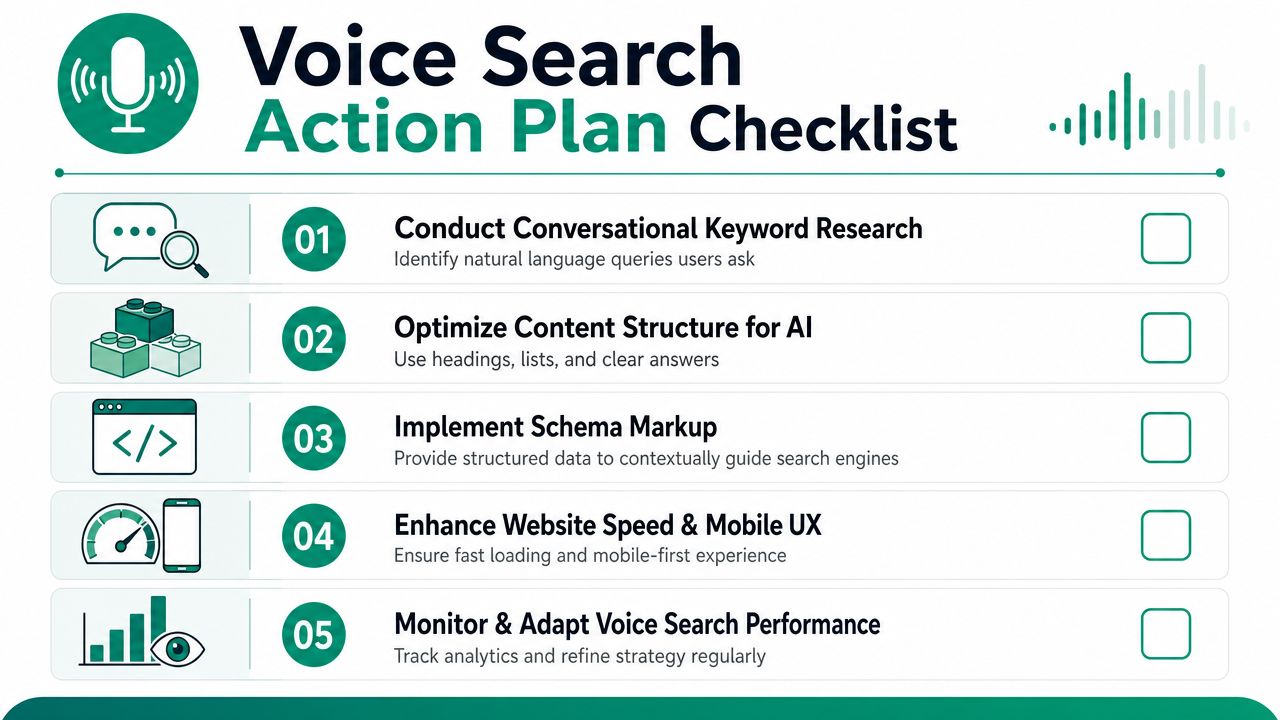
This week
Audit the assets already closest to a voice result.
- List your top customer questions from sales calls, support emails, live chat, and Google Business Profile Q&A
- Test your current answers by speaking those questions into your phone
- Check your local business data so business name, address, phone, hours, and services match across your site and listings
Pick five questions only. More than that, and teams drift into research mode instead of implementation.
This month
Turn your most valuable pages into answer-ready pages.
Rewrite service sections so each one includes:
- A spoken-question heading
- A direct answer block
- Supporting detail below the answer
- Relevant schema markup
If you’re a local business, your homepage, core service page, and strongest location page usually come first. If you’re B2B or e-commerce, product-category and high-intent solution pages usually deserve the first pass.
This quarter
Build the system, not just the page edits.
That usually means:
- Create a usable FAQ library based on real questions, not filler content
- Standardize content templates so every new page includes answer blocks and machine-readable structure
- Review technical friction on mobile, template speed, and structured data coverage
- Track answer ownership across your most valuable query groups
What to ignore for now
Not every trend deserves immediate effort.
Avoid:
- Publishing dozens of thin FAQ pages
- Stuffing pages with awkward question variations
- Treating voice as separate from AI search
- Obsessing over one assistant platform
The pages that perform well are usually the ones that are useful, structured cleanly, technically reliable, and written in the language customers use.
Voice search optimization works when content, local signals, and technical execution support the same outcome. You want the assistant to find your page, understand it fast, and trust it enough to use it.
If your team wants help turning this into a working search program, Ascendly Marketing can build the plan, clean up the technical issues, and rewrite priority pages so they’re ready for both voice search and AI-driven search experiences.