

Monday starts the same way in a lot of manufacturing teams. Sales waits for RFQs that may or may not arrive, the website sits there like a brochure nobody opens, and the trade show spreadsheet gets another round of follow-up notes that never turn into quotes. Meanwhile, buyers are already searching, comparing, and shortlisting suppliers before anyone on your side sees their name.
A working lead generation engine for manufacturers in 2026 does not rely on one channel. It combines digital demand capture, disciplined outbound, and qualification that reflects how plants buy. That means the first question is not “How many leads did we get?” It’s “Can this prospect really buy what we make?”
The market has already moved in that direction. A 2022 IndustrialSage survey reported that 98% of industrial manufacturers generate sales-qualified leads through digital marketing, with 69% using organic search, 69% using social media, and 43% allocating budget to PPC, while 18% said email was their best-performing channel, ahead of trade shows at 16% and social or online ads at 14% (Lead Forensics summary of the IndustrialSage survey). That mix says a lot. Popular channels are one thing, but manufacturing pipelines still depend on fit, timing, and a sales cycle that rewards discipline.
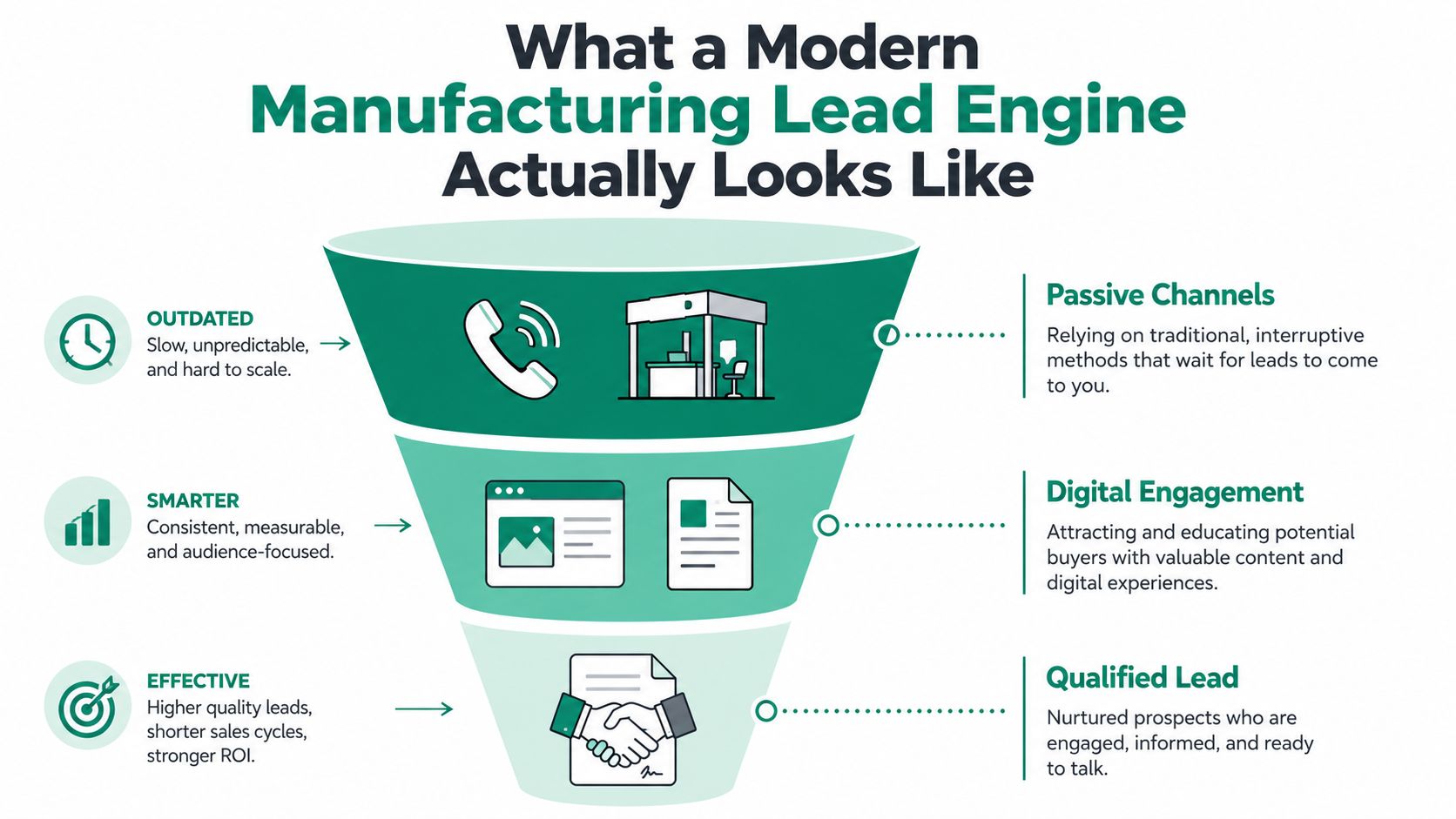
The practical model is simple. Demand gets created, captured, qualified, and handed off. If any one of those pieces is weak, the rest of the system degrades fast. A useful place to start is a predictable process like building a predictable lead generation, then adapt it to industrial buying instead of generic B2B assumptions.
Your website matters here too. If buyers land on a homepage that says almost nothing useful, they bounce. A clearer industrial site structure, like the kind discussed in industrial web design, gives visitors a path from interest to inquiry without forcing sales to rescue every visit.
What a Modern Manufacturing Lead Engine Looks Like
A plant manager does not wake up thinking about “marketing channels.” Monday shows up in concrete form. A distributor email arrived late, an engineer wants a quote with no specs attached, and a trade show lead is still buried in a spreadsheet with no source tag. That is what a broken lead engine looks like. It creates motion, but not useful motion.
A modern setup changes the flow. Demand comes from search, paid media, outbound, referrals, and follow-up. Capture happens on pages and forms built for the buyer’s question. Qualification separates quote-ready work from people who are still researching. Handoff sends the right record to the right rep, with enough context to respond properly.
The four moving parts that have to work together
The first part is demand. That can come from long-tail search terms, targeted outbound, trade show follow-up, or referral introductions. The second part is capture, which means the page or message has to match the buyer’s intent. If someone is looking for a specific capability and lands on a generic homepage, the conversion path gets muddy.
The third part is qualification. Manufacturing buyers do not all need the same thing, and title alone does not tell you whether the lead can buy. The fourth part is handoff. Once a lead is ready, sales needs the source, the context, and the next step. Without that, the CRM becomes a contact warehouse.
Practical rule: If a channel creates names but not quote conversations, it is not a lead engine yet. It is just activity.
The reason generic B2B advice falls flat is simple. Manufacturing buyers care about process, tolerances, lead time, batch size, and operational fit. They are not browsing for inspiration. They are checking whether your plant can solve their problem.
A useful engine starts with fit, then volume. That order keeps outbound, SEO, paid, and trade show follow-up tied to the same commercial reality instead of a pile of disconnected leads.
A practical starting point is to build a predictable lead generation process, then adapt it to industrial buying instead of generic B2B assumptions. The same discipline applies to the website itself. If buyers land on a homepage that says almost nothing useful, they bounce. Clear industrial site structure, like the approach covered in industrial web design, gives visitors a path from interest to inquiry without forcing sales to rescue every visit.
Building the Buyer Map and Qualification Model
The buyer map in manufacturing usually has more moving parts than the average marketing team expects. Engineering wants technical proof, operations wants capacity and timing, procurement wants supplier confidence, finance wants risk control, and an executive sponsor wants the deal to move without surprises. If you start outreach at the C-suite and ignore the plant or purchasing side, you usually create polite silence.
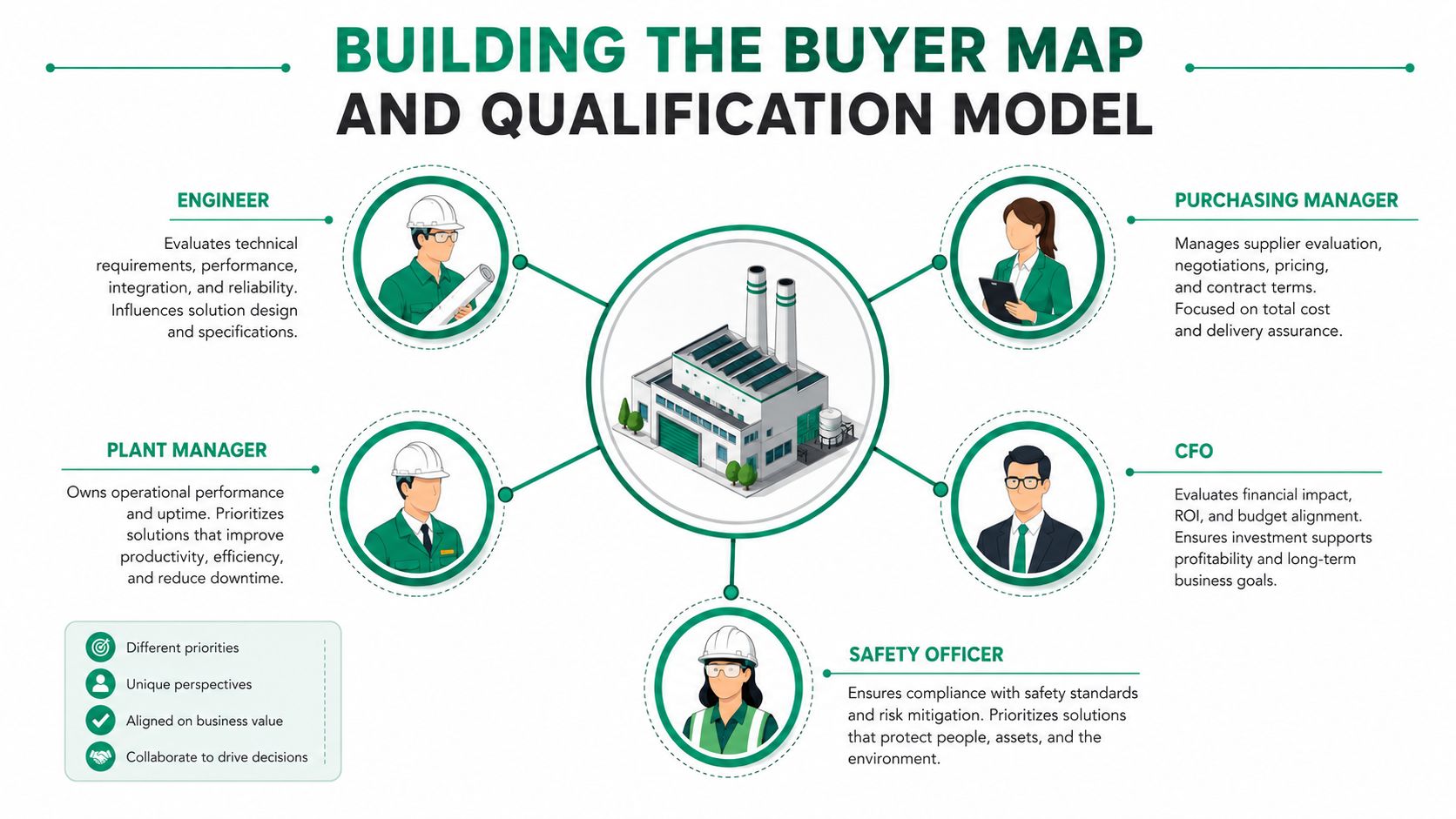
The better starting point is often procurement and operations. Those roles live closer to the actual purchase, and they can tell you whether the lead fits the reality of your process. A qualification model built around operational fit gives sales a cleaner queue and keeps the team from wasting time on mismatched requests.
Build the persona around buying reality
Use one persona template for each buying role, then anchor the questions to what that role approves or rejects. Here’s a compact version a team can copy.
| Role | What they care about | Qualification question |
|---|---|---|
| Engineer | Specs, tolerances, application fit | Does the requirement match our process limits? |
| Purchasing Manager | Price, supplier risk, lead time | Is this a supplier we can source from on schedule? |
| Plant Manager | Throughput, downtime, operational fit | Can this work inside our production window? |
| CFO | Risk, contract exposure, spend control | Does this deal fit our commercial thresholds? |
| Safety Officer | Compliance, certification, safe use | Do we meet the required compliance standards? |
That model needs hard disqualifiers too. Sub-sector matters. Geography matters if service or logistics are constrained. Certifications matter when the buyer requires them. So do tolerances, batch sizes, and lead times, because those are often the gatekeepers.
A lead that looks good on title can still be dead on operational fit.
A useful form should ask for part, material, volume, and timeline first. You can add notes fields later, but the early questions should reveal whether the inquiry belongs in ready to quote, researching, or tire-kicker. That structure keeps the sales queue clean and gives marketing a routing model instead of a pile of emails.
For teams that want a sharper buyer map, the YouTube walkthrough below is a useful reference point.
Choosing the Right Channel Mix for Your Sales Cycle
Manufacturing teams often ask for the wrong thing. They want a channel recommendation before they’ve decided what kind of demand they’re trying to create. A catalog parts business, a custom fabrication shop, and a process services company do not need the same mix. The right answer depends on sales cycle length, buyer intent, and how much technical explanation the offer needs.
Compare the channels by how they behave in the real world
SEO and content work well when buyers search by process, material, or application. That’s where long-tail keywords matter, because specific queries usually signal stronger intent than broad terms. A phrase like “biodegradable bubble wrap supplier GCC” is a different buying signal than “bubble wrap,” and the source guidance on manufacturing keyword strategy points exactly to that kind of specificity (Leads.sa on lead generation for manufacturers).
PPC can move faster, but only when the landing page and search intent match. LinkedIn is useful for account targeting and light social proof, not for pretending every buyer wants to chat. Email outreach stays valuable in long sales cycles, especially where there’s a real buying committee. Trade shows still matter for relationship-heavy sales, though they’re weaker when you need speed. Referrals sit in their own category, because they usually arrive with more trust already attached.
Short cycles reward clarity. Long cycles reward repetition and credibility.
A practical starter mix for a small or mid-sized manufacturer is usually one intent channel, one outbound channel, and one follow-up channel. That might mean SEO with a few high-intent pages, a targeted outbound sequence, and a disciplined email nurture flow. Trade shows can stay in the mix, but the follow-up has to be structured, or the leads vanish into admin work.
For custom work, focus first on long-tail search, outbound to named accounts, and dedicated landing pages. For catalog parts, search and PPC usually deserve earlier attention because buyers already know what they’re looking for. For process services, outbound and email often do the heavy lifting because the buyer usually needs more explanation before they submit anything.
Running Outbound Without Burning Your Domain
A manufacturing outbound program usually breaks for the same operational reasons across teams. The list is too broad, the send pace is too aggressive, and the contacts are not mapped to the buying committee. Then the copy gets blamed, even though the core issue sits in sequence design, mailbox behavior, and account selection.
Start with a Tier 1 target list of 20 to 30 accounts, then map 3 to 4 contact records per account across engineering, operations, procurement, finance, and executive stakeholders (Alex Berman on lead generation for manufacturing). That gives sales enough coverage to reach the people who influence tolerances, batch size, lead time, and price approval without blasting a long list of weak prospects.
Sequence math that holds up
A workable cadence uses 8 to 12 touches over 4 to 6 weeks, spread across email, phone, and light LinkedIn outreach (Alex Berman on lead generation for manufacturing). The same guidance recommends ramping mailbox volume over 2 to 3 weeks so sending behavior stays stable, and sampling 25 records before launch to check fit, role coverage, and bounce risk (Alex Berman on lead generation for manufacturing).
The point is not to keep dripping forever. The point is to create enough contact pressure to earn a reply without looking machine-built. That means a short sequence, a tight list, and a reason for outreach that sounds like your plant understands the buyer’s process.
For a small test, one source recommends a three-message sequence over two weeks aimed at 25 selected accounts in one vertical, with a one-page landing page using their language and one proof point (Right Left Agency). That baseline is useful because it forces the message, the offer, and the audience to line up before you scale anything.
A good outbound stack often needs support from a service that can execute the motion end to end. Ascendly Marketing offers done-for-you lead generation, including cold email outreach, which fits teams that want execution support rather than another dashboard. Their outbound B2B lead generation approach is only useful if the list, sequence, and offer all point at the same buyer problem.
Manufacturers also need to think about domain health before they start pushing volume. If the sending domain is new, warm it gradually, keep reply handling clean, and avoid mixing high-volume cold email with unrelated marketing blasts. A flagged inbox does not just lower delivery for one campaign; it makes every later send harder to trust.
That trade-off matters because outbound is often the fastest route to named accounts, but it is also the easiest channel to damage through impatience. Trade shows create warmer conversations, SEO builds slower but compounds, and paid channels can fill gaps only if the landing page and qualification rules are already in place. Cold email sits between those options, useful for reach, but unforgiving when the sequencing is sloppy.
Direct mail can support the sequence when the account list is tight and the buying committee is hard to reach. A service like modern direct mail campaigns can add physical touchpoints after the first email or call, especially for higher-value accounts where a sample, printed capability sheet, or plant-specific note gets noticed. The key is to keep it targeted, because broad mail drops waste budget the same way broad email wastes domain reputation.
If the list is precise and the handoffs are disciplined, outbound stays useful instead of expensive. If the list is loose or the cadence is rushed, the domain pays for it long after the campaign ends.
Landing Pages and Forms That Qualify on the First Click
A homepage is a weak place to send a manufacturing buyer who already has a problem in mind. It tries to serve everyone and ends up serving no one well. Dedicated landing pages work better because they match the buyer language, the vertical, and the offer.
The source guidance on industrial lead generation recommends sector-specific landing pages, targeted campaigns for prospects actively searching for the solution, detailed negative keyword lists, and conversion tracking to measure lead quality and ROI (Leadspicker on industrial leads). That combination matters because traffic, page, and intent need to match. If they don’t, the form fills up with people who were never close to buying.
The four fields that change the quality of the lead
The first fields should be part, material, volume, and timeline. Those four pieces tell sales whether the request is even in range. They also give marketing a clean way to route the lead before someone burns time on back-and-forth emails.
A form that asks for only name, email, and message creates noise. A form that asks for the buyer’s actual requirements creates a route. Once the submission comes in, segment it immediately into ready to quote, researching, or tire-kicker. That classification decides who gets called first and who goes into nurture.
The form should do part of the qualification job before anyone opens the inbox.
For scoring, fit beats volume. A smaller request with the right material, timeline, and operational fit can outrank a bigger inquiry with fuzzy specs. Negative keyword lists help protect the traffic source, while conversion tracking shows which pages create useful opportunities and which ones just collect form fills.
If your team wants a dedicated page structure that matches this approach, B2B lead generation landing pages are the right internal reference to review before you build the next campaign.
CRM, Lead Scoring, and the Nurture-to-Handoff Workflow
A CRM is not a contact dump. In manufacturing, it should work like a routing system. Every record needs enough detail for sales and marketing to know whether the lead belongs in a quote queue, a nurture flow, or a disqualification list.
The minimum fields should include capability fit, volume band, lead time tolerance, last touch, and next action. That gives you the basics of prioritization without turning the CRM into a spreadsheet with a login screen. Combine those fields with behavior data, then score leads by both fit and activity.
Three buckets that keep the pipeline sane
A ready-to-quote lead has the right fit and enough urgency to deserve fast follow-up. A researching lead has potential, but needs more context before sales can push. A tire-kicker lead doesn’t match the operation or isn’t close enough to a buying decision to justify live time.
The nurture flow should match those buckets. Researching leads get technical proof, process pages, case material, and reminders that answer supplier questions. Tire-kicker records get light-touch content and fewer sales interruptions. That keeps reps focused on the leads that can move.
Reply time still matters. RFQ prospects that get a fast response are easier to convert than the ones that sit for hours.
That same logic applies to channels beyond email. If you’re using direct mail as part of an account-based motion, a structured workflow like modern direct mail campaigns can complement the CRM instead of living outside it. The point is not novelty. It’s making sure each touch creates a clear next action.
For handoff, sales should see where the lead came from, what they asked for, and whether they’re quote-ready. If a rep has to search for context, the system is already leaking value.
KPIs, a 90-Day Timeline, and the Budget Reality Check
Manufacturing teams can get lost in dashboards. Traffic looks nice. Form fills look busy. None of that tells you whether the pipeline is healthy. The numbers that matter are cost per qualified opportunity, time from first touch to RFQ, win rate on quote-ready leads, and pipeline coverage ratio.
The first 30 days should build the base. Define the buyer map, set the qualification rules, wire the CRM fields, and create the first dedicated landing pages. The next 30 should launch the first outbound sequence, publish SEO foundations around the most specific buyer queries, and run your first trade show follow-up sequence if events are part of the calendar. The final 30 should tune the system using real lead quality, not guesses.
Where the money should go first
Start with the pieces that affect qualification and conversion. That means the website path, the form, the CRM routing, and the first channel or two that match your sales cycle. A small or mid-sized manufacturer usually gets further by cleaning up those basics than by buying five tools and hoping the stack fixes itself.
An outside partner helps when the team needs execution across multiple moving parts, especially strategy, pages, and outbound setup. It does not help much if the internal offer is vague or the sales process is still untracked. The work has to line up before the spend does.
The hard truth is that manufacturing lead generation rewards systems, not noise. If your pages, forms, outreach, and follow-up all point to operational fit, the lead flow gets cleaner fast. If they don’t, the team stays busy, and the pipeline stays weak.
Ascendly Marketing builds manufacturing lead generation programs that connect SEO, PPC, content, outbound, and conversion-focused web pages into one working system. If your team needs a clearer pipeline and a cleaner handoff from inquiry to quote, visit Ascendly Marketing and review how they approach lead generation, website design, and B2B outreach.